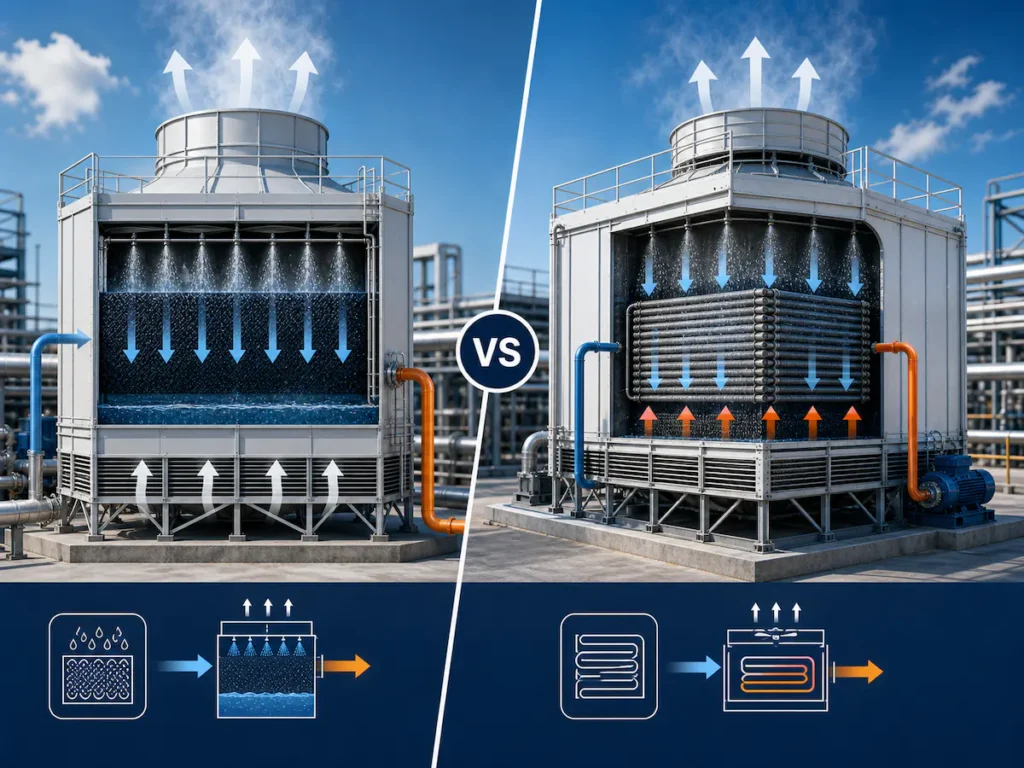
Open Circuit vs Closed Circuit Cooling Tower: Which One Should You Choose?
Open circuit and closed circuit cooling towers are both used to reject heat from HVAC, industrial, refrigeration, and process cooling systems. They may look similar from the outside, but they work in different ways and are suitable for different operating conditions.
The main difference is simple:
In an open circuit cooling tower, the circulating water directly contacts the air. In a closed circuit cooling tower, the process fluid flows inside a heat exchange coil and remains isolated from the outside air.
This difference affects water quality, system cleanliness, maintenance, installation cost, energy use, water treatment, and long-term operating reliability.
For project engineers, HVAC contractors, industrial plant managers, and equipment buyers, choosing between an open cooling tower and a closed circuit cooling tower should not be based only on price. The right choice depends on the heat load, water quality, process requirements, local climate, maintenance strategy, installation space, and whether the fluid must remain clean.
Quick Comparison Table
| Factor | Open Circuit Cooling Tower | Closed Circuit Cooling Tower |
| Heat transfer method | Direct contact between water and air | Process fluid transfers heat through a coil |
| Process fluid exposure | Exposed to outside air | Isolated inside a closed loop |
| Main heat exchange component | Fill | Heat exchange coil, sometimes with fill |
| Water quality control | More demanding for circulating water | Process fluid stays cleaner |
| Initial cost | Usually lower | Usually higher |
| System cleanliness | More exposed to dust, oxygen, and airborne contaminants | Better protection from contamination |
| Maintenance focus | Fill, nozzles, basin, water treatment, condenser loop | Coil, spray system, basin water, external spray loop |
| Suitable for | HVAC condenser water, general industrial cooling | Process cooling, clean water loops, glycol systems, sensitive equipment |
| Water treatment | Required for the main circulating loop | Required mainly for spray water circuit |
| Freezing protection | More complex for exposed water systems | Easier to use glycol in the closed loop |
| Footprint | Often compact for the same heat rejection | May be larger due to coil heat transfer resistance |
| Best choice when | Cost efficiency and direct evaporative cooling are priorities | Fluid cleanliness, system protection, and long-term reliability are priorities |
What Is an Open Circuit Cooling Tower?
An open circuit cooling tower is a cooling tower where the circulating water directly contacts the air.
Hot water enters the tower and is distributed over the fill. Air passes through the fill, and part of the water evaporates. This evaporation removes heat from the remaining water. The cooled water falls into the cold water basin and returns to the system.
Because the water is directly exposed to the atmosphere, open cooling towers provide efficient evaporative cooling with a relatively simple structure.
Open circuit cooling towers are commonly used in:
- HVAC condenser water systems
- Commercial buildings
- Hotels and hospitals
- Shopping centers
- Industrial process cooling
- Power and utility systems
- General heat rejection applications
How an Open Circuit Cooling Tower Works
The working process of an open cooling tower can be summarized in six steps:
- Hot water enters the cooling tower from the process or chiller system.
- Water is distributed over the fill by nozzles or a gravity distribution basin.
- Air enters the tower through louvers or air inlet sections.
- Water and air directly contact each other over the fill surface.
- A small amount of water evaporates and removes heat from the remaining water.
- Cooled water collects in the basin and returns to the system.
The fill plays a key role in this process. It increases the contact area and contact time between water and air, allowing more efficient heat transfer.
Open circuit cooling towers are often selected when the circulating water can be exposed to air and when a simple, economical, and efficient cooling solution is required.
Advantages of Open Circuit Cooling Towers
Lower Initial Cost
Open circuit cooling towers usually have a simpler structure than closed circuit cooling towers. Since they do not require an internal process coil, the initial equipment cost is often lower.
Efficient Direct Evaporative Cooling
Because the water directly contacts the air, open towers can provide efficient heat rejection. This makes them widely used in HVAC condenser water systems and general industrial cooling.
Simple System Design
Open circuit towers are straightforward to understand, install, operate, and maintain. For many projects, this simplicity is an advantage.
Wide Capacity Range
Open cooling towers are available in many configurations, including crossflow, counterflow, square type, rectangular type, and bottle type designs. This makes them suitable for many commercial and industrial projects.
Suitable for Standard HVAC Systems
For water-cooled chillers and condenser water systems, open cooling towers are one of the most common and economical heat rejection solutions.
Limitations of Open Circuit Cooling Towers
Process Water Is Exposed to Air
The biggest limitation of an open circuit cooling tower is that the circulating water is exposed to the atmosphere. Dust, oxygen, airborne particles, biological contaminants, and other impurities can enter the water loop.
More Water Treatment Attention
Because the circulating water contacts air directly, water treatment is important. Without proper treatment, the system may experience scaling, corrosion, biological growth, sediment accumulation, and fouling.
Risk of Fouling Downstream Equipment
If the same water circulates through chillers, heat exchangers, or process equipment, poor water quality may affect the performance and service life of downstream components.
Not Ideal for Clean Process Fluid
If the process requires clean water, glycol solution, special fluid, or strict contamination control, an open cooling tower may not be the best option unless an additional heat exchanger is installed.
What Is a Closed Circuit Cooling Tower?
A closed circuit cooling tower is a cooling tower where the process fluid flows inside a heat exchange coil and does not directly contact the outside air.
In this design, there are usually two separate circuits:
- Internal closed loop: The process fluid flows inside the coil.
- External spray water loop: Spray water circulates over the outside surface of the coil and contacts air.
Heat transfers from the process fluid to the coil wall, then from the coil wall to the spray water and air. The process fluid remains isolated and clean inside the closed loop.
Closed circuit cooling towers are also known as closed-loop cooling towers, evaporative fluid coolers, or closed circuit fluid coolers.
How a Closed Circuit Cooling Tower Works
The working process of a closed circuit cooling tower includes three heat transfer stages:
- Hot process fluid enters the heat exchange coil.
- Spray water flows over the outside surface of the coil.
- Air passes through the tower and contacts the spray water.
- Heat transfers from the process fluid to the coil wall.
- Heat transfers from the coil wall to the spray water.
- A portion of spray water evaporates and rejects heat to the air.
- The cooled process fluid leaves the coil and returns to the system.
The most important feature is that the process fluid does not contact the atmosphere. This helps protect fluid quality and reduce contamination inside the connected equipment and piping.
Advantages of Closed Circuit Cooling Towers
Process Fluid Stays Clean
Closed circuit cooling towers keep the process fluid inside a closed loop. This helps prevent dust, oxygen, airborne particles, and biological contaminants from entering the process system.
This is especially important for clean water systems, glycol systems, precision cooling, and industrial process equipment.
Better Protection for Connected Equipment
Because the process fluid remains cleaner, closed loop systems can help reduce fouling and scaling inside heat exchangers, molds, compressors, coils, and other connected equipment.
Suitable for Glycol and Special Fluids
Closed circuit cooling towers are suitable for systems using glycol solutions or special process fluids. The fluid can remain inside the closed loop without being exposed to air or tower basin water.
Lower Contamination Risk
For data centers, injection molding, chemical plants, food and beverage plants, pharmaceutical facilities, and sensitive industrial processes, contamination control can be more important than initial equipment cost.
More Flexible System Design
A closed circuit cooling tower can sometimes replace a combination of an open cooling tower and a separate heat exchanger. This may simplify the system layout in certain projects.
Better Long-Term System Reliability
Although the initial cost may be higher, cleaner process fluid can reduce maintenance problems in the overall system. For many industrial projects, long-term reliability is more valuable than the lowest purchase price.
Limitations of Closed Circuit Cooling Towers
Higher Initial Cost
Closed circuit cooling towers usually cost more than open circuit cooling towers because they include a heat exchange coil and a more complex internal structure.
Coil Maintenance Is Important
The coil must be protected from scaling, corrosion, and fouling on the external spray side. Good water quality management is still necessary for the spray water loop.
May Require Larger Heat Exchange Area
Because heat must pass through the coil wall, the design may require a larger heat exchange surface compared with direct-contact open cooling towers under the same duty.
More Detailed Selection Is Required
Closed circuit cooling tower selection should consider process fluid type, fluid concentration, flow rate, heat load, coil material, freezing protection, spray water quality, and maintenance access.
Open Circuit vs Closed Circuit: Working Principle Difference
The biggest working principle difference is whether the process water directly contacts the air.
In an open circuit cooling tower, the same water that carries heat from the system is exposed directly to air inside the tower. Heat transfer is direct and efficient, but the water loop is open to outside contamination.
In a closed circuit cooling tower, the process fluid is separated by a heat exchange coil. The spray water and air cool the outside of the coil, while the process fluid remains inside the coil. Heat transfer is indirect, but the process loop stays cleaner.
Open Circuit vs Closed Circuit: Water Quality Difference
Water quality is one of the most important factors when choosing between open and closed cooling towers.
Open Circuit Cooling Tower
In an open system, the circulating water is exposed to air. It may collect dust, oxygen, leaves, biological matter, and airborne contaminants. Water treatment is essential to control:
- Scaling
- Corrosion
- Biological growth
- Sediment
- Fouling
- Nozzle clogging
- Fill blockage
Closed Circuit Cooling Tower
In a closed circuit system, the process fluid remains inside the coil and is not exposed to outside air. This helps protect the process loop from contamination.
However, the external spray water still needs treatment because it contacts air and evaporates. The difference is that this spray water is usually separate from the process fluid.
Practical Selection Point
Choose an open cooling tower when the circulating water can be exposed to air and regular water treatment is acceptable.
Choose a closed circuit cooling tower when the process fluid must remain clean or when contamination inside the process loop would create expensive maintenance problems.
Open Circuit vs Closed Circuit: Maintenance Difference
Both open and closed cooling towers need maintenance, but the maintenance focus is different.
Open Circuit Cooling Tower Maintenance
Open tower maintenance usually focuses on:
- Fill cleaning
- Spray nozzle inspection
- Basin cleaning
- Water treatment
- Drift eliminator cleaning
- Fan and motor inspection
- Scale and biological control
- Chiller condenser or heat exchanger protection
Because the process water is exposed to air, maintenance of the circulating water loop is especially important.
Closed Circuit Cooling Tower Maintenance
Closed tower maintenance usually focuses on:
- Coil surface inspection
- Spray nozzle cleaning
- Spray pump inspection
- Basin cleaning
- Fan and motor inspection
- Drift eliminator cleaning
- External spray water treatment
- Closed loop fluid quality monitoring
The process loop is better protected, but the external spray circuit still requires regular maintenance.
Open Circuit vs Closed Circuit: Cost Difference
Open circuit cooling towers usually have a lower initial purchase cost. This is one reason they are widely used in standard HVAC condenser water systems and general industrial cooling.
Closed circuit cooling towers usually have a higher initial cost because of the heat exchange coil and more complex structure. However, they can reduce contamination-related problems in the process loop and connected equipment.
When comparing cost, buyers should not only compare equipment price. They should compare total project cost and lifetime cost, including:
- Initial equipment cost
- Piping and heat exchanger requirements
- Pumping energy
- Water treatment cost
- Cleaning frequency
- Downtime risk
- Process fluid replacement
- Heat exchanger or equipment fouling
- Long-term maintenance labor
- Expected service life
For simple HVAC condenser water systems, an open cooling tower may be the most economical choice. For clean process cooling or sensitive industrial systems, a closed circuit cooling tower may be more cost-effective over the long term.
Open Circuit vs Closed Circuit: Energy and Water Use
Both open and closed circuit cooling towers can provide efficient evaporative heat rejection.
Open cooling towers often have very efficient direct heat transfer because water and air contact each other directly. In many standard applications, this can make the open tower compact and energy efficient.
Closed circuit cooling towers transfer heat through a coil, so there is additional thermal resistance. However, they protect the process loop and may help maintain system efficiency over time by reducing fouling in connected equipment.
Water use depends on heat load, climate, approach temperature, cycles of concentration, blowdown control, and water treatment strategy. Both types use water through evaporation, drift, and blowdown, but the system impact is different:
- Open towers expose the main circulating water to the atmosphere.
- Closed towers usually expose only the external spray water circuit to the atmosphere.
- Closed loop process fluid can often be protected from evaporation loss and contamination.
For projects where water availability is limited, a dry cooler or adiabatic cooler may also be considered.
Open Circuit vs Closed Circuit: Application Difference
The best cooling tower type depends on the application.
Open Circuit Cooling Tower Applications
Open circuit cooling towers are commonly used for:
- HVAC chiller condenser water systems
- Commercial buildings
- Hotels
- Hospitals
- Shopping malls
- General industrial cooling
- Power plant auxiliary cooling
- Utility cooling systems
- Applications where direct water-air contact is acceptable
Open towers are often preferred when the system requires economical heat rejection and the circulating water can be treated and maintained properly.
Closed Circuit Cooling Tower Applications
Closed circuit cooling towers are commonly used for:
- Industrial process cooling
- Data center cooling
- Injection molding
- Plastic processing
- Chemical plants
- Pharmaceutical plants
- Food and beverage production
- Compressor cooling
- Glycol cooling systems
- Clean water loops
- Applications where process fluid quality is important
Closed circuit towers are preferred when contamination control, system cleanliness, and process reliability are more important than the lowest initial cost.
Which Cooling Tower Should You Choose?
There is no universal best choice. The right cooling tower depends on your project conditions.
Choose an Open Circuit Cooling Tower When:
- The circulating water can contact outside air
- The system is a standard HVAC condenser water loop
- Lower initial cost is important
- Simple structure is preferred
- Water treatment and regular maintenance are acceptable
- The process is not sensitive to water contamination
- High-efficiency direct evaporative cooling is required
Choose a Closed Circuit Cooling Tower When:
- The process fluid must stay clean
- The system uses glycol or special fluid
- Contamination could damage equipment or affect production
- The application requires closed-loop cooling
- Water quality control inside the process loop is important
- The project involves sensitive equipment or process cooling
- Long-term system reliability is more important than lowest initial cost
Selection Checklist for Buyers
Before choosing between an open circuit and closed circuit cooling tower, prepare the following project information:
| Selection Factor | Why It Matters |
| Heat load or cooling capacity | Determines tower size and thermal duty |
| Water or fluid flow rate | Affects heat transfer and pump selection |
| Inlet water temperature | Defines entering heat condition |
| Outlet water temperature | Defines required cooling result |
| Wet-bulb temperature | Determines evaporative cooling potential |
| Fluid type | Important for closed loop and glycol systems |
| Water quality | Affects scaling, corrosion, fouling, and material selection |
| Process cleanliness requirement | Helps decide open or closed loop |
| Installation space | Affects tower layout and footprint |
| Noise limit | Important for urban, commercial, and data center sites |
| Material requirement | Important for coastal, chemical, or corrosive environments |
| Maintenance access | Affects long-term service convenience |
THERMOCORE Recommendation
THERMOCORE supplies both open circuit cooling towers and closed circuit cooling towers for HVAC and industrial applications.
For projects where economical direct evaporative cooling is required and water exposure is acceptable, an open cooling tower can be a practical solution.
For projects where process fluid cleanliness, closed-loop protection, glycol compatibility, or equipment reliability is important, a closed circuit cooling tower is often the better choice.
THERMOCORE can help project teams compare both options based on actual working conditions instead of selecting only by catalog model. Our engineering support can review:
- Heat load
- Flow rate
- Inlet and outlet temperatures
- Wet-bulb temperature
- Fluid type
- Water quality
- Installation space
- Noise requirement
- Material and anti-corrosion requirements
- Maintenance access
- Shipping and installation conditions
FAQ: Open Circuit vs Closed Circuit Cooling Tower
What is the main difference between open and closed circuit cooling towers?
The main difference is whether the process water directly contacts the air. In an open circuit cooling tower, water is directly exposed to air. In a closed circuit cooling tower, the process fluid flows inside a coil and remains isolated from the outside air.
Is a closed circuit cooling tower better than an open cooling tower?
Not always. A closed circuit cooling tower is better when process fluid cleanliness, closed-loop protection, or contamination control is important. An open cooling tower may be better when lower initial cost and direct evaporative cooling are priorities.
Which cooling tower is better for HVAC systems?
For standard water-cooled chiller condenser water systems, open cooling towers are commonly used. For water-source heat pump systems, clean loops, or projects requiring better water quality control, closed circuit cooling towers may be preferred.
Which cooling tower is better for industrial process cooling?
Closed circuit cooling towers are often preferred for industrial process cooling when clean water, glycol solution, or process fluid isolation is required. Open cooling towers may still be suitable for general industrial heat rejection where water exposure is acceptable.
Does a closed circuit cooling tower need water treatment?
Yes. The external spray water loop still needs water treatment to control scaling, corrosion, biological growth, and fouling. However, the process fluid inside the coil is better protected from outside contamination.
Is an open cooling tower cheaper than a closed circuit cooling tower?
Usually, yes. Open circuit cooling towers typically have a lower initial cost. However, closed circuit cooling towers may reduce long-term maintenance and contamination-related costs in some systems.
Can an open cooling tower be converted into a closed loop system?
In some systems, an additional heat exchanger can be added to separate the process loop from the open tower water loop. However, this increases system complexity, footprint, pumping requirements, and maintenance points. A closed circuit cooling tower may be a more integrated option for some projects.
What information should I provide for selection?
Please provide heat load, water or fluid flow rate, inlet and outlet temperatures, local wet-bulb temperature, fluid type, water quality, application industry, installation location, footprint limits, noise requirements, and material preferences.
Need Help Choosing Between Open and Closed Cooling Towers?
Choosing between an open circuit and closed circuit cooling tower should be based on the complete cooling system, not only the equipment price.
THERMOCORE can help you compare both options and recommend a practical cooling solution according to your working conditions, water quality, project layout, climate, and long-term maintenance requirements.
To receive a technical proposal, please share:
- Heat load or cooling capacity
- Water or fluid flow rate
- Inlet and outlet temperatures
- Local wet-bulb temperature
- Fluid type and concentration
- Water quality condition
- Application industry
- Installation location
- Noise and footprint limits
- Preferred material or anti-corrosion requirement
Request a Technical Proposal from THERMOCORE