Uptime and Redundancy
N+1, N+2 or 2N expectations affect cell count, pumps, controls, isolation and how equipment can be serviced.
Data centers require cooling systems that can support continuous IT operation, high heat density, redundancy,
energy efficiency and predictable maintenance. Whether the facility uses chilled water, condenser water, dry coolers,
adiabatic cooling or liquid cooling loops, the heat must eventually be rejected safely and reliably to the outdoor environment.
This page explains how data center cooling systems work, how to choose between open cooling towers, closed circuit cooling towers,
dry coolers, adiabatic coolers and hybrid systems, and what engineering data is needed for data centers, colocation facilities,
edge sites, AI/HPC clusters and liquid-cooled IT environments.
Data center cooling is not only a thermal design problem. It is a reliability, energy, water and scalability problem.
The cooling system must support continuous IT load, future rack density growth, maintenance without downtime and stable heat rejection
under peak ambient conditions.
A complete data center cooling solution may include water-cooled chillers, cooling towers, closed circuit cooling towers,
dry coolers, adiabatic coolers, heat exchangers, pumps, CDUs, CRAH units, rear-door heat exchangers, liquid cooling loops,
controls and water treatment. The right solution depends on IT load, redundancy target, climate, water availability,
allowable fluid temperature and lifecycle efficiency goals.
Data centers punish cooling designs that optimize only one metric. The system must survive peak ambient conditions, future rack density and maintenance events without risking IT load.
N+1, N+2 or 2N expectations affect cell count, pumps, controls, isolation and how equipment can be serviced.
Low energy use may increase water use, while low water use may increase fan or chiller energy depending on climate.
Higher rack density and warmer liquid loops change supply temperatures, free cooling hours and heat rejection architecture.
A cooling yard that cannot isolate equipment safely can create unacceptable outage risk during cleaning or repair.
For data centers, the cooling problem is uptime, energy, water and scalability. Heat rejection equipment must support IT load, chiller plants, liquid cooling CDUs, free cooling strategies and maintenance without risking the white space.
Thermocore products are selected by architecture: dry coolers for closed-loop free cooling and low water use, adiabatic coolers for peak assist, closed circuit cooling towers for protected evaporative loops, and open towers for efficient condenser water systems.
Data center heat starts at IT equipment and moves through air or liquid cooling systems before reaching outdoor heat rejection. The right Thermocore product is chosen by fluid temperature, redundancy target, climate and water strategy.

Data center heat rejection equipment should be selected according to IT load, climate, water strategy, redundancy,
free cooling potential and whether the facility uses air cooling or liquid cooling.
Closed-loop dry heat rejection for glycol or water loops, often used for free cooling and low-water strategies.
Dry cooler with evaporative air pre-cooling for peak conditions, balancing water use and summer performance.
Closed-loop evaporative cooling for clean fluid protection and lower approach temperatures than dry cooling in many climates.
Efficient condenser water heat rejection for water-cooled chiller plants where water treatment is well managed.
Data center product selection should start with the cooling architecture and site targets, then choose the heat rejection equipment.
| Industry Condition | Better-Fit Product | Why It Fits | Selection Caution |
|---|---|---|---|
| Water-cooled chiller plant with strong water program | Open Cooling Tower | Efficient condenser water heat rejection and strong chiller plant performance. | Requires water treatment, drift control, plume review and maintainable redundancy. |
| Facility glycol loop or high-temperature liquid cooling loop | Dry Cooler | Supports closed-loop free cooling and very low water use when temperatures allow. | Dry bulb temperature limits outlet temperature and may increase coil footprint. |
| Hot climate with WUE limit but peak performance need | Adiabatic Cooler | Uses evaporative assist only when needed to balance PUE and WUE. | Pads, nozzles, water quality and mode-switching controls must be maintained. |
| Clean closed loop with lower approach requirement | Closed Circuit Cooling Tower | Provides evaporative performance while keeping facility fluid inside the coil. | Spray water treatment, coil access and redundancy must be included. |
Data center cooling selection should balance uptime, energy efficiency, water use and maintainability.
The “best” system depends heavily on climate and the data center’s cooling temperature strategy.
| Item | Dry Cooler | Adiabatic Cooler | Closed Circuit Cooling Tower | Open Cooling Tower |
|---|---|---|---|---|
| Cooling Principle | Finned coil rejects heat to ambient air | Air pre-cooling plus dry coil heat rejection | Closed coil cooled by spray water and airflow | Direct evaporative cooling of condenser water |
| Water Use | Very low in dry operation | Moderate; water used mainly during hot periods | Evaporative spray water required | Evaporation and blowdown required |
| Fluid Cleanliness | Closed fluid loop | Closed fluid loop with adiabatic water section | Process fluid protected inside coil | Condenser water exposed to outdoor air |
| Energy / PUE Potential | Strong when fluid temperatures allow free cooling | Good balance in hot climates with limited water use | Good evaporative performance with closed-loop protection | Strong chiller plant efficiency where water use is acceptable |
| Best Fit | Water-sensitive sites, high-temperature liquid loops, free cooling | Sites balancing PUE and WUE under peak summer conditions | Clean loop heat rejection and lower approach requirements | Water-cooled chiller plants with strong water treatment program |
| Main Caution | Limited by dry bulb temperature and coil approach | Water quality, pad/nozzle maintenance and control logic | Spray water treatment and coil maintenance | Water treatment, drift, plume and condenser water cleanliness |
These are the practical failure points to check before choosing between an open cooling tower, closed circuit cooling tower, dry cooler or evaporative condenser.
A system that meets capacity but cannot be cleaned or repaired online creates operational risk.
Optimizing only PUE or only WUE can create a poor lifecycle result for the actual climate and load profile.
Future liquid cooling loads may exceed the original heat rejection temperature and capacity assumptions.
Dry or adiabatic systems sized from incomplete weather data can lose margin during heat waves.
Liquid cooling changes the heat collection method inside the data center, but it does not remove the need for external heat rejection.
The facility still needs a reliable way to reject heat from CDUs, plate heat exchangers, liquid loops or warm water cooling systems.

Liquid cooling can sometimes use higher supply/return temperatures, improving dry cooling and free cooling opportunities.
Heat rejection equipment should be coordinated with CDU approach temperature, flow rate, pressure drop and redundancy.
AI and HPC loads may grow quickly, so heat rejection should allow modular expansion and service isolation.
A strong data center solution page should connect heat rejection equipment with the actual cooling infrastructure used inside the facility.
Cooling towers reject heat from condenser water loops serving chilled water plants.
Computer room air handlers use chilled water to remove heat from white space airflow.
Coolant distribution units transfer heat from IT-side liquid loops to facility water loops.
Used for waterside economizer operation, loop separation and free cooling strategies.
Rack-level heat exchangers can transfer server exhaust heat to a water loop.
Cold plates transfer heat from CPUs, GPUs or accelerators into a coolant loop.
Dielectric fluid heat rejection may require heat exchangers and facility water loops.
Facility pumps, buffer tanks and control valves coordinate flow and redundancy.
Data center cooling design must consider more than one peak design point. It should evaluate annual climate, IT load growth,
redundancy, maintainability, water strategy and energy control.
Data center cooling selection should include IT load, fluid temperatures, redundancy and climate data.
If future expansion is expected, phase planning should be included from the beginning.
| Required Data | Why It Matters |
|---|---|
| Current IT Load | Defines initial heat rejection capacity in kW or MW. |
| Future IT Load / Phase Plan | Determines modular expansion, space reservation and equipment staging. |
| Cooling Architecture | Air cooling, chilled water, liquid cooling or hybrid architecture changes equipment selection. |
| Fluid Type and Flow Rate | Water, glycol or facility fluid affects coil design, pressure drop and pump sizing. |
| Supply and Return Fluid Temperature | Defines heat rejection approach and free cooling potential. |
| Design Dry Bulb Temperature | Required for dry cooler, adiabatic cooler and hybrid cooling design. |
| Design Wet Bulb Temperature | Required for evaporative cooling towers and closed circuit cooling tower design. |
| Redundancy Requirement | Defines standby capacity, equipment count, isolation and control strategy. |
| Water Availability and Water Quality | Affects adiabatic, wet, closed circuit and open cooling system selection. |
| Free Cooling Target | Determines whether dry coolers, heat exchangers or waterside economizers should be included. |
| Footprint, Noise and Maintenance Access | Affects cooling yard layout, serviceability and acoustic design. |
Data center cooling should be evaluated by total lifecycle performance. A design that reduces chiller power may use more water,
while a water-saving dry system may require higher fan energy or larger equipment. Control logic must balance both PUE and WUE.

When outdoor conditions allow, heat exchangers or dry coolers can reduce or bypass mechanical refrigeration.
VFD fans, pump staging and differential pressure control help reduce part-load energy use.
Dry, adiabatic, evaporative and chiller-assisted modes should be sequenced to maintain temperature while optimizing energy and water.
Water strategy is a key decision for data center cooling. Evaporative systems can reduce energy use but consume water.
Dry systems save water but may require larger heat exchange area or higher fan power.
Wet and adiabatic systems should be evaluated by annual water use, not only peak design conditions.
Scale, corrosion, biological growth and suspended solids can affect towers, coils, pads and heat exchangers.
Water treatment, pump systems and makeup water supply should be considered part of cooling system reliability.
Maintenance must be planned around uptime. The system should allow inspection, cleaning, testing and component replacement without exposing
the IT load to unacceptable thermal risk.
Cooling towers, dry coolers, pumps and heat exchangers should be designed with isolation valves and safe service access.
Coils, fill, pads and heat exchangers should remain clean to maintain temperature and energy performance.
Mode switching, fan staging, pump sequencing, alarms and failover logic should be tested regularly.
Data center cooling systems can be customized according to IT load, redundancy, climate, water strategy, cooling architecture,
fluid temperature, liquid cooling plan, phased expansion and maintenance policy.
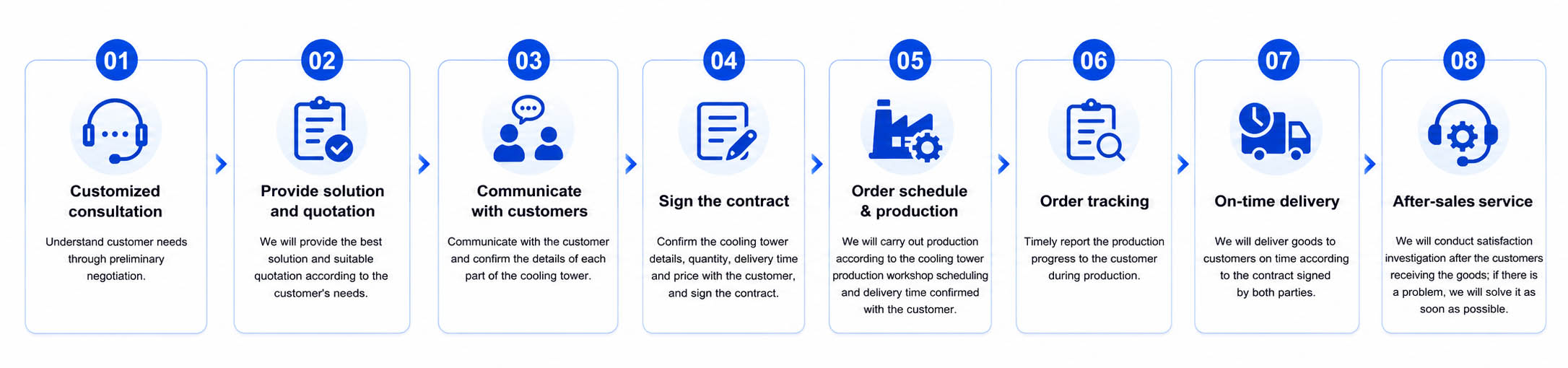
Designed around current IT load, future phases, N+1/2N redundancy, modular cells and service isolation.
Configured for chilled water, condenser water, glycol loops, liquid cooling, dry cooling or evaporative heat rejection.
Adjusted for PUE, WUE, adiabatic operation, free cooling hours, control sequence and local water availability.
Send your IT load, future expansion plan, redundancy requirement, cooling architecture, fluid type,
supply and return temperature, dry bulb and wet bulb design conditions, water availability and footprint.
Our engineering team will review whether a dry cooler, adiabatic cooler, closed circuit cooling tower,
open cooling tower or hybrid system is more suitable.
These FAQs are written for data center owners, consultants, contractors and facility engineers who need to understand
data center heat rejection, cooling towers, dry coolers, adiabatic systems, liquid cooling support, free cooling,
redundancy, PUE/WUE and selection data before requesting a quotation.
A data center cooling solution is a heat rejection system designed to remove heat from IT equipment, server rooms, chilled water plants, liquid cooling loops, computer room air handlers, rear-door heat exchangers or heat exchanger skids. It may include cooling towers, closed circuit cooling towers, dry coolers, adiabatic coolers, chillers, pumps, heat exchangers, controls and redundancy planning. The purpose is to maintain stable IT environmental conditions while balancing uptime, energy use, water use and serviceability.
In a water-cooled data center cooling system, heat from servers is transferred to air-side cooling equipment or liquid cooling loops, then to chilled water or condenser water systems. A chiller or heat exchanger may transfer the heat to a condenser water loop. The cooling tower rejects this heat to outdoor air through evaporation, closed circuit spray cooling or other heat rejection methods, and the cooled water returns to the plant.
There is no single best cooling tower type for all data centers. Open cooling towers can provide efficient heat rejection for water-cooled chiller plants. Closed circuit cooling towers are useful when clean fluid loops, glycol protection or reduced contamination risk are required. Dry coolers are suitable for low-water or free cooling strategies where ambient conditions allow. Adiabatic and hybrid systems are often used to balance water savings and peak cooling performance.
Open cooling towers can be efficient and economical, but the condenser water is exposed to air and requires water treatment. Closed circuit cooling towers keep the process fluid or glycol loop inside a coil, reducing contamination risk and supporting cleaner loop operation. For data centers, the choice should consider uptime requirements, water quality, maintenance capability, chiller design, free cooling strategy and redundancy requirements.
Free cooling means using favorable outdoor conditions to reduce or bypass mechanical refrigeration. In data center heat rejection, this may involve dry coolers, closed circuit towers, plate heat exchangers, waterside economizers or adiabatic systems. The goal is to reject heat to outdoor air with lower compressor energy when ambient conditions are suitable.
Air cooling removes heat from server rooms through air handlers, CRAC or CRAH units, while liquid cooling transfers heat through water, glycol or dielectric liquid closer to the IT hardware. Liquid cooling can support high-density racks and AI/HPC workloads, but it still needs a heat rejection path outside the data center, such as dry coolers, cooling towers, chillers, heat exchangers or hybrid systems.
Dry coolers are suitable when water saving, closed-loop operation, low plume and free cooling potential are important, and when the required fluid temperature can be maintained above ambient dry bulb temperature by a practical approach. They are commonly used for chilled water economizers, liquid cooling loops, glycol systems and water-restricted data center sites.
Adiabatic cooling is suitable when dry cooling alone cannot meet peak summer load or fluid temperature requirements, but the project wants to use less water than a full wet cooling tower. Adiabatic systems can operate dry during many hours and activate evaporative air pre-cooling during hot conditions, making them useful for data centers that balance PUE and WUE.
Maintenance should include tower basin cleaning, water treatment, coil or fill inspection, fan and motor maintenance, VFD checks, pump inspection, heat exchanger cleaning, strainer cleaning, sensor calibration, valve testing, control logic verification and redundancy testing. Data centers should also plan maintenance without interrupting IT cooling, which requires isolation valves, standby capacity and safe access.
To request a quotation, send the IT load, current and future capacity, redundancy requirement, cooling architecture, fluid type, flow rate, supply and return temperature, design dry bulb and wet bulb temperature, project location, water quality, water availability, footprint, noise requirement, free cooling target, control requirements and material preference.
Send us your current IT load, future capacity plan, redundancy requirement, cooling architecture,
fluid type, flow rate, supply and return fluid temperature, design dry bulb temperature, design wet bulb temperature,
project location, water quality, water availability, free cooling target, footprint, noise requirement,
control requirements and material preference. We will help you evaluate the right data center cooling solution.