Mixed Equipment Loads
Heat exchangers, hydraulic units, furnaces, compressors and tooling may require different flow and temperature levels.
Industrial process cooling systems remove heat from production equipment, process water loops, hydraulic systems,
compressors, molds, heat exchangers, reactors, furnaces and other industrial loads. A reliable cooling solution helps maintain
process temperature, protect equipment, reduce downtime and support stable production quality.
This page explains how industrial process cooling systems work, how to choose between open cooling towers,
closed circuit cooling towers, dry coolers, adiabatic coolers and evaporative condensers, and what design data is needed
for engineering selection in manufacturing and industrial utility cooling projects.
Industrial process cooling is not only about lowering water temperature. It is part of the production system.
If cooling water temperature is unstable, equipment may overheat, product quality may change, production cycle time may increase
and shutdown risk may rise. Therefore, the cooling system must be selected around the actual process, not only a nominal cooling capacity.
A complete industrial cooling solution may include cooling towers, closed circuit cooling towers, dry coolers, adiabatic coolers,
evaporative condensers, heat exchangers, pumps, filters, water treatment, controls and piping. The best system depends on heat load,
process fluid, temperature target, water quality, corrosion environment, operating hours and site constraints.
Industrial process cooling often fails when very different loads are forced into one generic loop. Each production load should be checked for temperature, cleanliness and uptime needs.
Heat exchangers, hydraulic units, furnaces, compressors and tooling may require different flow and temperature levels.
Cooling instability can stop a line even if the cooling tower is technically running.
Suspended solids, oil, scale or high return temperature can reduce heat transfer and damage equipment.
Future production lines and changing duty cycles can make an initially adequate system undersized.
Industrial process cooling is about keeping production equipment within its required temperature and cleanliness range. Different loads in the same factory may need different cooling methods, so the solution cannot be selected only by total heat load.
Thermocore products are applied by load type: open cooling towers for general utility water, closed circuit towers for clean machine loops, dry coolers for water-saving closed circuits, and evaporative condensers or chiller support for low-temperature process duties.
Industrial heat can come from many sources, and each source has a different tolerance for dirt, temperature and downtime. Thermocore equipment is selected after grouping loads by temperature level and fluid cleanliness.
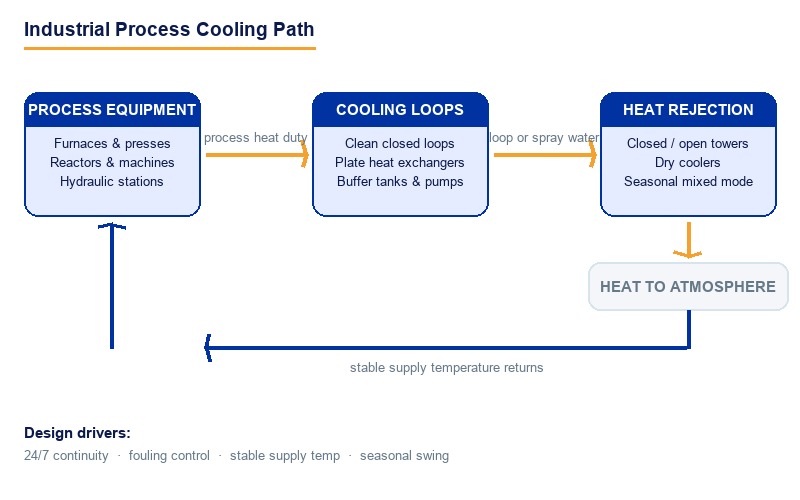
Industrial cooling should be selected according to process sensitivity, water quality, water use, temperature target, operating hours and maintenance capability.
Economical evaporative cooling for general industrial utility water where direct air-water contact is acceptable.
Closed-loop cooling for clean process fluids, glycol systems and applications where contamination must be reduced.
Air-cooled closed-loop heat rejection for water-saving applications, glycol loops and dry operation requirements.
Refrigerant condensing solution for industrial refrigeration and process chilling systems.
Industrial plants should map each load to the cooling product that protects that load best.
| Industry Condition | Better-Fit Product | Why It Fits | Selection Caution |
|---|---|---|---|
| General utility process water with manageable quality | Open Cooling Tower | Economical high-capacity cooling for common factory water loops. | Needs filtration, water treatment and fouling control. |
| Clean machine loop, glycol loop or heat exchanger protection | Closed Circuit Cooling Tower | Keeps process fluid closed while rejecting heat outdoors. | Coil pressure drop, scaling and material compatibility must be reviewed. |
| Water-saving requirement or closed high-temperature loop | Dry Cooler | Simple closed-loop heat rejection with low water consumption. | Outlet temperature is limited by dry bulb temperature. |
| Low-temperature process or refrigeration-supported load | Evaporative Condenser or Chiller Support | Supports process chilling or refrigerant condensing where tower water alone is not enough. | Energy use, refrigerant design and controls need engineering review. |
The right industrial cooling solution depends on whether the process fluid can be exposed to air, how clean the loop must remain,
how much water can be used and what outlet temperature is required.
| Item | Open Cooling Tower | Closed Circuit Cooling Tower | Dry Cooler | Evaporative Condenser |
|---|---|---|---|---|
| Cooling Principle | Direct evaporative cooling of circulating water | Closed fluid coil cooled by spray water and air | Finned coil rejects heat to ambient air | Refrigerant vapor condenses inside a wetted coil |
| Fluid Exposure | Water directly exposed to air | Process fluid protected inside coil | Process fluid protected inside coil | Refrigerant protected inside pressure-rated coil |
| Water Use | Evaporation and blowdown required | Spray water loop required | Very low water use in dry operation | Evaporative water use required |
| Best Fit | General utility cooling water and cost-sensitive projects | Clean process loops, glycol, sensitive equipment | Water-saving, glycol, dry closed-loop systems | Industrial refrigeration and process chilling |
| Main Caution | Water treatment, fouling, drift and basin maintenance | Coil scaling, spray system and water treatment | Limited by dry bulb and larger coil area | Refrigerant design, pressure rating and maintenance access |
These are the practical failure points to check before choosing between an open cooling tower, closed circuit cooling tower, dry cooler or evaporative condenser.
A loop designed for average conditions may fail a critical machine that needs cleaner or colder water.
Debris and scale can foul heat exchangers, nozzles and narrow cooling channels.
Cooling tower water may be insufficient for low-temperature process needs without chiller support.
Adding machines later can overload pumps, piping and heat rejection equipment.
A strong industrial solution page should connect the cooling system to the actual equipment customers need to protect.
This helps both buyers and search engines understand the application context.
Plate, shell-and-tube or process heat exchangers that transfer heat from production fluids.
Air compressors, gas compressors, jacket water systems, intercoolers and oil cooling loops.
Hydraulic oil and machine cooling loops that require stable temperature and viscosity.
Injection molds, extrusion dies and forming equipment where temperature affects cycle time.
Chemical or process vessels requiring controlled heat removal.
High-temperature equipment requiring cooling water for coils, jackets or auxiliary systems.
Process condensers or refrigeration condensers requiring heat rejection.
Central plant cooling water systems serving multiple machines and production lines.
Industrial process cooling design must match the process, fluid, environment and operation schedule.
A correct solution should protect production reliability, not only meet a theoretical heat load.
Industrial process cooling selection should begin with process data. If the exact heat load is unknown, equipment power,
flow rate and temperature difference can often be used for preliminary review.
| Required Data | Why It Matters |
|---|---|
| Process Heat Load / Cooling Capacity | Defines the total heat rejection duty. |
| Process Fluid Type | Determines material compatibility, coil design and pump requirements. |
| Fluid Flow Rate | Determines heat transfer, pipe sizing, pump flow and pressure drop. |
| Inlet Fluid Temperature | Defines hot fluid condition entering the cooling equipment. |
| Outlet Fluid Temperature | Defines required cooling target and approach. |
| Temperature Control Tolerance | Determines control strategy and equipment sizing margin. |
| Design Wet Bulb Temperature | Critical for open towers, closed circuit towers and evaporative condensers. |
| Design Dry Bulb Temperature | Critical for dry coolers, adiabatic systems and hybrid systems. |
| Water Quality and Fouling Risk | Affects open/closed loop selection, filtration, fill, coil and nozzle design. |
| Corrosion or Chemical Exposure | Affects FRP, galvanized steel, stainless steel, coil coating and hardware selection. |
| Operating Schedule and Redundancy | Determines whether standby capacity, modular cells or service isolation are needed. |
Industrial cooling efficiency should be evaluated across the whole system: cooling tower, fans, pumps, heat exchangers, controls,
water treatment and process temperature requirements.

VFD or EC fan control can reduce power consumption during part-load or cooler ambient conditions.
Correct flow control prevents unnecessary pump energy while maintaining process temperature stability.
Setpoints should match process needs; overcooling can waste energy and increase condensation or process instability risk.
Water quality is one of the most important differences between industrial cooling and standard comfort cooling.
Poor water conditions can quickly reduce cooling capacity, damage components and increase maintenance cost.
Minerals, suspended solids, oil or process contamination can block fill, foul heat exchangers and reduce heat transfer.
Chemical exposure, low pH, chlorides or industrial fumes may require special materials or closed circuit design.
Closed circuit cooling can protect sensitive equipment by separating process fluid from outdoor air and spray water.
Industrial process cooling maintenance should be planned around production uptime. Equipment should be accessible, serviceable
and designed to minimize unplanned shutdowns.
Inspect fill, nozzles, coils, heat exchangers, basins and drift eliminators for fouling, scaling and blockage.
Fans, motors, pumps, VFDs, sensors and control valves should be inspected to keep stable cooling performance.
Industrial water systems may need filtration, chemical treatment, blowdown control and corrosion monitoring.
Industrial process cooling systems can be customized according to process temperature, fluid type, heat load, water quality,
material requirements, redundancy, site layout and control strategy.
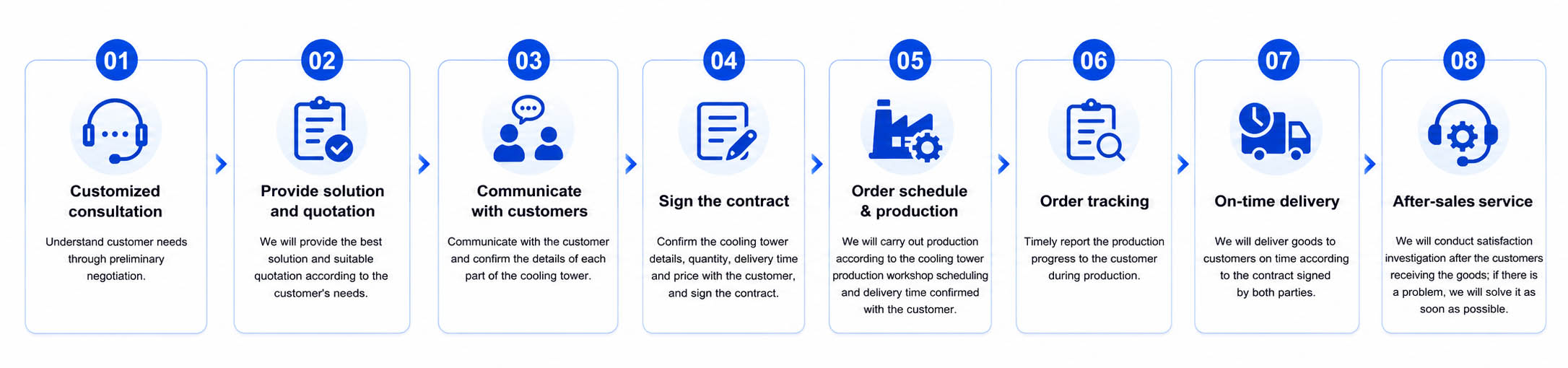
Designed around heat load, process fluid, flow rate, temperature target and required control tolerance.
Configured as open cooling, closed circuit cooling, dry cooling, adiabatic cooling or evaporative condensing.
Adjusted for water quality, corrosion environment, 24/7 operation, redundancy, access and modular expansion.
Send your process heat load, fluid type, flow rate, inlet and outlet temperature, water quality,
operating hours, corrosion environment, footprint and required temperature stability.
Our engineering team will review whether an open cooling tower, closed circuit cooling tower, dry cooler,
adiabatic cooler or evaporative condenser is more suitable.
These FAQs are written for plant engineers, project contractors, equipment manufacturers and industrial buyers who need to understand
process cooling selection, open vs closed loop cooling, dry vs wet cooling, water quality, corrosion control, energy strategy and maintenance
before requesting a quotation.
An industrial process cooling solution is a cooling system designed to remove heat from manufacturing equipment, process fluids, heat exchangers, compressors, furnaces, hydraulic systems, molds, reactors, condensers or other production equipment. Unlike comfort HVAC cooling, industrial process cooling is usually selected around process stability, equipment protection, continuous operation, water quality, corrosion control and production reliability.
In many industrial systems, heat is transferred from production equipment or process fluid into a cooling water loop, glycol loop, heat exchanger or closed circuit. The warm water or fluid then flows to a cooling tower, closed circuit cooling tower, dry cooler or evaporative condenser. The heat is rejected to outdoor air through evaporation, air cooling or a combined method, and the cooled fluid returns to the process.
HVAC cooling is mainly designed for building comfort and chiller plant operation. Industrial process cooling is designed to control process temperature, protect equipment and maintain production quality. Industrial projects often have more demanding requirements for high heat load, dirty water, corrosive fluids, continuous operation, redundancy, special materials, high ambient temperature and process-specific control.
There is no single best type for all industrial process cooling applications. Open cooling towers are economical for general utility cooling water. Closed circuit cooling towers are useful when the process fluid must remain clean or glycol is used. Dry coolers are suitable where water saving or closed-loop dry operation is required. Evaporative condensers are used for industrial refrigeration or refrigerant condensing. The correct choice depends on heat load, fluid type, temperature target, water quality and site conditions.
Open cooling towers are often used when circulating water can directly contact air and water treatment is manageable. Closed circuit cooling towers are preferred when the process fluid should be protected from dust, air, biological growth or contamination, or when glycol, deionized water, treated water or special process fluid must remain in a closed loop. The decision should consider process sensitivity, water quality, maintenance capability and lifecycle cost.
A dry cooler is suitable when water use must be minimized, the process fluid should remain completely closed, visible plume should be avoided, or the required outlet temperature can be achieved above ambient dry bulb temperature. Dry coolers are common for compressor cooling, hydraulic oil cooling, glycol loops, power electronics, machinery cooling and water-restricted sites.
An evaporative condenser is used when the system needs to condense refrigerant vapor, commonly in industrial refrigeration systems for cold storage, food processing, chemical refrigeration and process chilling. It is not the same as a standard water cooling tower, because the refrigerant flows inside a coil and is condensed by spray water and airflow.
Important data includes heat load, process fluid type, fluid flow rate, inlet and outlet fluid temperature, required process temperature stability, design wet bulb or dry bulb temperature, project location, altitude, water quality, open or closed loop requirement, pressure drop limit, corrosion environment, operating hours, redundancy requirement, footprint, noise limit, power supply and material preference.
Water quality affects scaling, corrosion, biological growth, fouling, nozzle blockage, fill selection, coil material and maintenance frequency. Dirty or corrosive water may require closed circuit cooling, stainless steel components, special fill, filtration, side-stream treatment or chemical control. Water quality should be reviewed before selecting tower type and materials.
To request a quotation, send the process heat load, fluid type, flow rate, inlet and outlet temperature, required temperature stability, design wet bulb or dry bulb temperature, project location, water quality, open or closed loop preference, pressure drop limit, operating hours, footprint, corrosion environment, noise requirement, power supply and material preference.
Send us your process heat load, equipment type, fluid type, fluid flow rate, inlet and outlet fluid temperature,
design wet bulb or dry bulb temperature, project location, water quality, operating schedule, corrosion environment,
pressure drop limit, footprint, noise requirement, power supply and material preference.
We will help you evaluate the right industrial process cooling solution.