Corrosive Water and Air
pH swings, chloride, acid or alkali vapor can attack coils, fasteners, basins, casings and fill supports if material selection is too generic.
Chemical plants require cooling systems that can handle process heat, corrosive environments, water quality variation,
continuous operation and strict reliability requirements. Cooling towers, closed circuit cooling towers, dry coolers and evaporative condensers
must be selected around the actual process duty, chemical exposure and material compatibility.
This page explains how chemical plant cooling systems work, how to choose between open cooling towers, closed circuit cooling towers,
dry coolers and evaporative condensers, and what engineering data is needed for reactors, condensers, heat exchangers,
distillation systems, absorption processes and industrial utility cooling water loops.
In chemical production, cooling is directly connected to process stability and equipment protection.
A cooling tower system may serve reactors, condensers, heat exchangers, distillation units, absorption systems,
compressors, vacuum systems and utility cooling water networks. If cooling performance is unstable, process temperature,
product quality, equipment life and plant safety can be affected.
Chemical plant cooling tower selection must consider more than thermal capacity. Water chemistry, process leakage risk,
chemical vapor, corrosion environment, operating temperature, material compatibility, redundancy, water treatment and maintenance access
should be reviewed together.
Chemical cooling projects fail when the design treats the plant like a generic water loop. The real issues are chemical exposure, process contamination risk and continuous operation.
pH swings, chloride, acid or alkali vapor can attack coils, fasteners, basins, casings and fill supports if material selection is too generic.
Leaked process fluid, dirty tower water or fouled heat exchangers can affect product quality, safety and downstream equipment reliability.
Many chemical units cannot stop cooling for easy maintenance, so modular cells, isolation valves and standby capacity matter.
Scaling, biological growth, suspended solids and blowdown control often decide the real lifecycle cost more than the initial tower price.
For chemical plants, the cooling requirement is not just removing heat. The system must protect reactors, condensers, distillation columns, compressors and utility loops while dealing with corrosive water, chemical vapor, contamination risk and continuous operation.
Thermocore products are selected by process risk: open cooling towers for large utility cooling water, closed circuit cooling towers for protected process loops, dry coolers for low-water closed circuits, and evaporative condensers for chemical refrigeration or solvent recovery duties.
The heat path starts at chemical equipment and ends at outdoor heat rejection. The product choice depends on whether the process loop can touch open tower water, whether corrosion is severe, and whether water use or contamination risk is the main constraint.
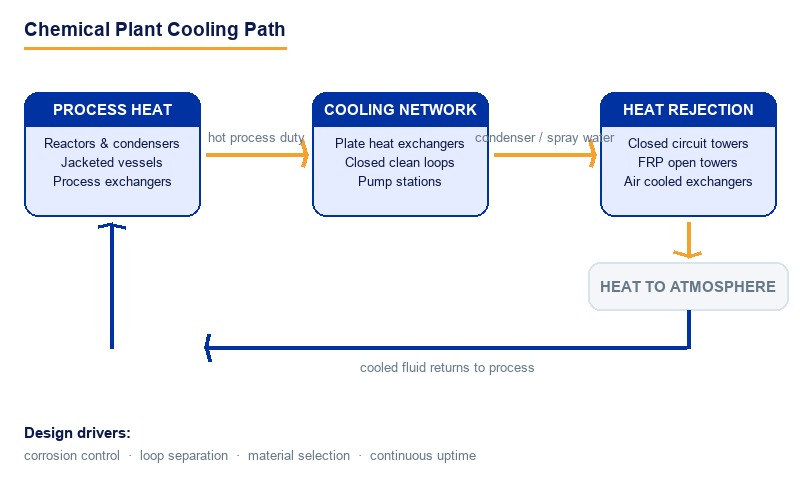
Chemical plant cooling should be selected according to process risk, corrosion environment, water quality, temperature requirements
and whether the process fluid can be exposed to air or cooling water.
Cost-effective evaporative cooling for large utility cooling water loops where direct air-water contact is acceptable.
Closed-loop evaporative cooling that protects process fluid from air, dust and spray water contamination.
Closed-loop dry heat rejection for water-saving applications, glycol loops and processes that require no open water contact.
Refrigerant condensing solution for chemical refrigeration, solvent recovery, low-temperature process cooling and process chillers.
Use the cooling product as a response to the process condition, not as a generic catalog choice.
| Industry Condition | Better-Fit Product | Why It Fits | Selection Caution |
|---|---|---|---|
| Large utility cooling water loop with manageable treatment | Open Cooling Tower | Provides high-capacity evaporative cooling at a competitive cost for general plant utility water. | Water is exposed to air, fumes, drift and fouling; treatment and material review are mandatory. |
| Sensitive process fluid, glycol loop or contamination concern | Closed Circuit Cooling Tower | Keeps the process fluid inside the coil and reduces contact with outdoor air and spray water. | Coil material, spray water scaling and access for coil cleaning must be reviewed. |
| Water-limited site or aggressive outdoor chemical atmosphere | Dry Cooler | Runs as a closed dry loop with very low water use and no spray water in dry operation. | Outlet temperature is limited by dry bulb temperature, so summer performance may require larger coils. |
| Solvent recovery, process refrigeration or low-temperature duty | Evaporative Condenser | Condenses refrigerant directly and can support chemical refrigeration or process chilling loads. | Requires refrigerant design, pressure rating, coil material and service access review. |
The right chemical plant cooling solution depends on process isolation, water chemistry, corrosion risk, outlet temperature and operating reliability.
| Item | Open Cooling Tower | Closed Circuit Cooling Tower | Dry Cooler | Evaporative Condenser |
|---|---|---|---|---|
| Cooling Principle | Direct evaporative cooling of circulating water | Closed fluid coil cooled by spray water and air | Finned coil rejects heat to ambient air | Refrigerant vapor condenses inside wetted coil |
| Fluid Exposure | Cooling water exposed to air and outdoor contaminants | Process fluid protected inside coil | Process fluid protected inside finned coil | Refrigerant protected inside pressure-rated coil |
| Water Use | Evaporation and blowdown required | Spray water loop required | Very low water use in dry operation | Evaporative water use required |
| Best Fit | General chemical plant utility cooling water systems | Sensitive process loops, glycol, treated water and contamination control | Water-saving sites, closed-loop cooling and dry operation | Process refrigeration, solvent recovery and refrigerant condensing |
| Main Caution | Water treatment, drift, plume, fouling and corrosion | Coil material, spray water quality and scaling control | Limited by dry bulb temperature and larger footprint | Refrigerant design, pressure rating and maintenance access |
These are the practical failure points to check before choosing between an open cooling tower, closed circuit cooling tower, dry cooler or evaporative condenser.
Wrong casing, coil, fastener or basin material can lead to corrosion, leakage and early replacement.
Sensitive fluids or contaminated loops may foul heat exchangers and create process risk if direct open cooling is chosen too quickly.
A single cell or pump without isolation can turn routine cleaning into a production interruption.
Scaling, chloride, TDS or suspended solids can reduce heat transfer and shorten equipment life.
A strong chemical plant solution page should connect the cooling tower system to the actual process equipment and heat sources
that chemical buyers need to protect.
Cooling jackets, external heat exchangers or circulation loops for reaction temperature control.
Process vapor condensation, solvent recovery and overhead condenser cooling.
Plate, shell-and-tube or air/water heat exchangers used in process cooling.
Cooling for condensers, reflux systems and related heat rejection loads.
Heat removal from absorption processes, scrubbers or gas treatment systems.
Intercoolers, aftercoolers, seal water and auxiliary cooling systems.
Low-temperature chemical process cooling and refrigeration support.
Central cooling water systems serving multiple process units and equipment groups.
Chemical plant cooling tower design should combine thermal engineering, material engineering, water chemistry,
process safety and maintenance planning.
Chemical plant cooling selection requires both thermal data and chemistry data. A water quality report or basic chemistry values
can be very helpful for material and system selection.
| Required Data | Why It Matters |
|---|---|
| Process Heat Load / Cooling Capacity | Defines total heat rejection duty and tower capacity. |
| Cooling Water Flow Rate | Determines water loading, pipe sizing, pump flow and tower distribution. |
| Inlet Water Temperature | Defines hot water condition entering the cooling equipment. |
| Outlet Water Temperature | Defines required cooling target and approach. |
| Design Wet Bulb Temperature | Required for open cooling towers, closed circuit towers and evaporative condensers. |
| Design Dry Bulb Temperature | Required for dry coolers, adiabatic coolers and hybrid systems. |
| Process Fluid Type | Determines whether closed loop protection or special coil material is required. |
| Water Quality Report | pH, hardness, chloride, TDS and suspended solids affect fouling, corrosion and material selection. |
| Chemical Vapor or Corrosive Exposure | Affects FRP resin, stainless steel grade, coil coating, fasteners and casing material. |
| Operating Hours and Redundancy | Determines whether standby cells, isolation valves and maintainable layout are required. |
| Environmental and Safety Requirements | Affects drift, plume, blowdown, fire performance, access and site layout requirements. |
Corrosion control is a central issue in chemical plant cooling tower design. The cooling tower may be exposed to chemical vapor,
drift, acidic or alkaline water, chlorides, high humidity and elevated temperature.
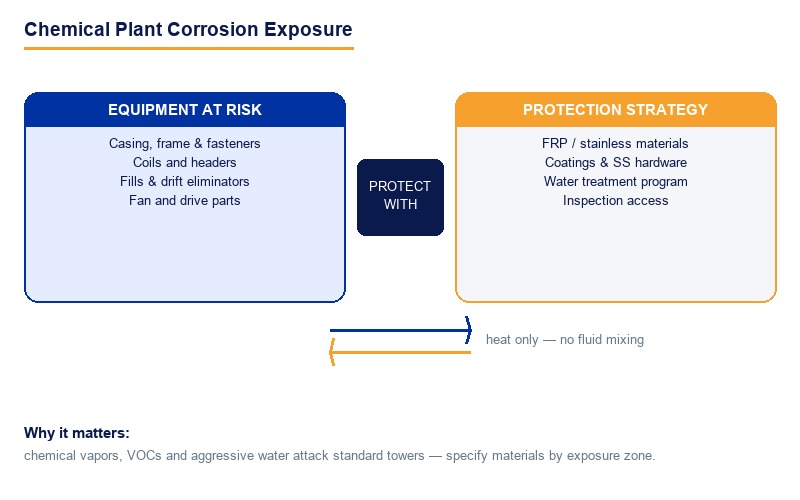
Low pH, high chloride, dissolved oxygen, conductivity and chemical contamination can affect coils, basins and piping.
Acid mist, alkaline vapor, solvent vapor or process fumes can affect casing, fan stacks, fasteners and motors.
FRP, stainless steel, coated steel, PVC/PP fill, special resin and coated coils should be selected according to actual exposure.
Chemical plant cooling water systems require careful treatment because poor water quality can quickly cause scaling,
corrosion, biological growth, nozzle blockage, fill fouling and coil performance loss.
Hardness, suspended solids, oil or process contamination can block fill, foul heat exchangers and reduce heat transfer.
pH, chlorides, oxygen and chemical exposure should be managed through treatment and material selection.
Blowdown controls concentration but may require treatment or compliance with local discharge requirements.
In chemical plants, cooling failure may affect process safety, product quality and plant uptime.
Cooling systems should be designed with reliability and safe maintenance in mind.
Critical processes may require multiple cells, standby pumps or spare heat exchanger capacity.
Valves, bypasses and safe platforms help maintenance teams service equipment without stopping the whole plant.
Temperature, flow, conductivity, vibration and water level monitoring can help detect issues before process disruption.
Maintenance should focus on water treatment, corrosion inspection, heat transfer cleanliness, mechanical reliability
and safe access under plant operating procedures.
Maintain water chemistry, clean basins, remove suspended solids and control biological growth to protect performance.
Fill, nozzles, coils and heat exchangers should be inspected for fouling, scaling, blockage or chemical attack.
Fans, motors, fasteners, supports, casing, basins and platforms should be checked for corrosion and vibration damage.
Chemical plant cooling systems can be customized according to process temperature, heat load, water chemistry,
chemical exposure, corrosion level, material requirements, redundancy, safety access and control strategy.
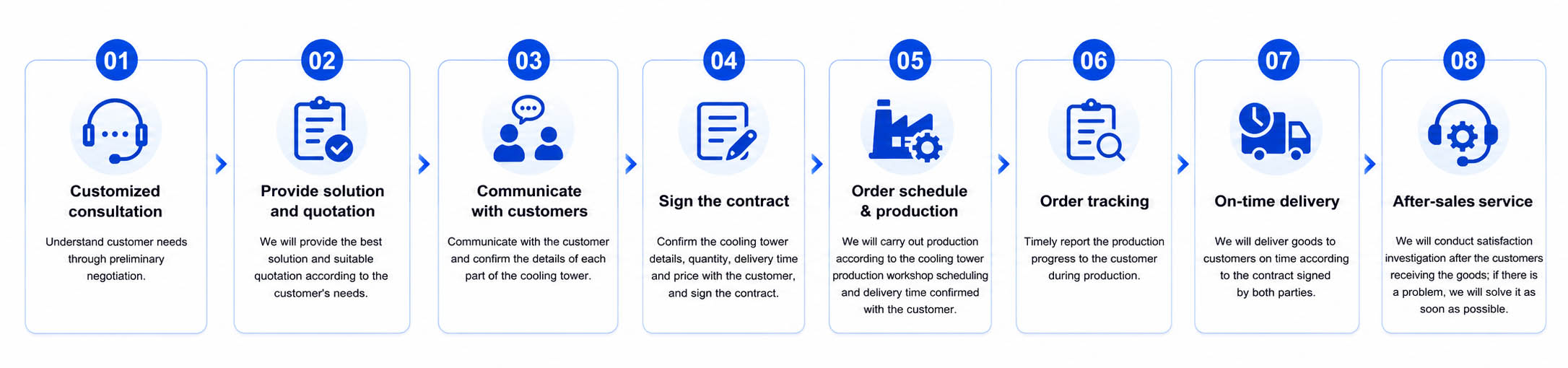
Designed around heat load, cooling water flow, temperature range, process stability and operating schedule.
Adjusted by FRP resin, stainless steel grade, coil material, casing material, chemical exposure and water chemistry.
Configured for redundancy, modular cells, isolation valves, safe maintenance access, monitoring and plant integration.
Send your heat load, water flow rate, inlet and outlet temperature, water quality report, pH, chloride level,
chemical exposure, corrosion environment, operating hours, footprint and material preference.
Our engineering team will review whether an open cooling tower, closed circuit cooling tower, dry cooler or evaporative condenser is more suitable.
These FAQs are written for chemical plant engineers, EPC contractors, utility system designers and industrial buyers who need to understand
chemical plant cooling tower selection, corrosion control, open vs closed circuit cooling, material selection, water quality,
maintenance and customization before requesting a quotation.
A chemical plant cooling tower solution is a heat rejection system designed to remove heat from reactors, condensers, heat exchangers, absorption systems, distillation units, process water loops and utility cooling water systems in chemical production facilities. It must consider thermal duty, process safety, corrosion, water quality, chemical exposure, continuous operation, maintenance access and environmental requirements.
In a chemical plant, heat from reactors, condensers, heat exchangers or process equipment is transferred into a cooling water loop, closed fluid loop or refrigerant system. The warm water or fluid is then sent to an open cooling tower, closed circuit cooling tower, dry cooler, adiabatic cooler or evaporative condenser. Heat is rejected to ambient air through evaporation, dry air cooling or wetted coil heat transfer, and the cooled water or fluid returns to the process.
There is no single best cooling tower type for all chemical plants. Open cooling towers are often used for general cooling water systems. Closed circuit cooling towers are useful when process fluid cleanliness, contamination control or glycol protection is important. Dry coolers can reduce water use and isolate process fluids. Evaporative condensers may be selected for process refrigeration. The correct choice depends on fluid type, water quality, corrosion environment, temperature target and safety requirements.
Open cooling towers can be economical for large utility cooling water systems, but the circulating water is exposed to air and requires strong water treatment. Closed circuit cooling towers keep process fluid inside a coil and reduce contamination risk, making them useful for sensitive process fluids, glycol loops, corrosive environments or plants where water cleanliness and system isolation are important. The decision should be made based on process risk, water chemistry and lifecycle cost.
Chemical plants may expose cooling towers to acidic or alkaline water, chloride, chemical vapor, process fumes, high humidity, high temperature and airborne contaminants. These conditions can accelerate corrosion of metal components and degrade unsuitable materials. Material selection for casing, basin, coils, fasteners, fill supports and hardware should be reviewed based on actual water chemistry and site environment.
Common material options include FRP casing, stainless steel 304 or 316, galvanized steel, aluminum-zinc coated panels, PVC or PP fill, stainless steel hardware, coated coils, carbon steel coils, stainless steel coils and special resin systems for FRP components. The best material depends on water chemistry, operating temperature, chemical vapor, chloride level, acid/alkali exposure and required service life.
Stainless steel may be selected when corrosion resistance, hygiene, mechanical strength, temperature resistance or long service life is required. Stainless steel 304 may be suitable for many general environments, while 316 is often considered when chloride exposure or stronger corrosion resistance is needed. However, grade selection should always be reviewed against actual water chemistry and chemical exposure.
FRP is often selected for chemical plant cooling tower casing, basins, panels, fan stacks and louvers because it offers corrosion resistance and lightweight construction in many humid and chemically exposed environments. Resin type, laminate thickness, UV protection, fire performance and chemical compatibility should be specified according to the plant environment.
Water quality affects scaling, corrosion, biological growth, fouling, blowdown, fill selection, nozzle performance, coil material and maintenance frequency. High hardness, high chloride, low pH, suspended solids, oil contamination or process leakage risk can require closed circuit cooling, filtration, special materials, stronger water treatment or heat exchanger separation.
To request a quotation, send the heat load, cooling water flow rate, inlet and outlet water temperature, design wet bulb or dry bulb temperature, project location, process fluid type, water quality report, pH, chloride level, suspended solids, chemical exposure, open or closed loop preference, operating hours, redundancy requirement, footprint, material preference and any environmental or safety requirements.
Send us your heat load, cooling water flow rate, inlet and outlet water temperature, design wet bulb or dry bulb temperature,
project location, process fluid type, water quality report, pH, chloride level, suspended solids, chemical exposure,
operating hours, redundancy requirement, footprint, noise requirement, material preference and environmental or safety requirements.
We will help you evaluate the right chemical plant cooling tower solution.