ThermoCore

Evaporative Condenser Manufacturer

Evaporative Condensers

Thermocore manufactures evaporative condensers for industrial refrigeration, cold storage, food processing, chemical plants, HVAC systems and process cooling applications. Our evaporative condenser solutions are engineered to condense refrigerant vapor inside heat exchange coils by combining spray water, airflow and evaporative heat transfer.

Compared with purely air-cooled condensers, evaporative condensers can often support lower condensing temperatures and improved refrigeration system efficiency under suitable wet bulb conditions. We provide crossflow, counterflow, composite flow and forced draft evaporative condenser configurations for different project layouts and operating requirements.

Products We Supply

Evaporative Condensers We Supply

Evaporative condensers can be configured according to airflow direction, coil arrangement, refrigerant type, heat rejection capacity, wet bulb temperature, installation space, maintenance access and project environment. Thermocore supplies crossflow, counterflow, composite flow and forced draft evaporative condensers for industrial refrigeration and HVAC heat rejection systems.

Crossflow Evaporative Condenser

Crossflow Evaporative Condenser

Crossflow evaporative condensers use horizontal airflow across the wetted coil section. Spray water flows downward over the coil while air moves laterally through the condenser. This design can provide convenient inspection, practical maintenance access and stable evaporative heat rejection.

  • Good maintenance access
  • Stable air-water contact
  • Suitable for refrigeration and HVAC heat rejection
View Crossflow Options →
Counterflow Evaporative Condenser

Counterflow Evaporative Condenser

Counterflow evaporative condensers use upward airflow against downward spray water over the condenser coil. This arrangement supports efficient heat transfer in a compact footprint and is widely used for industrial refrigeration applications requiring strong condensing performance.

  • Compact footprint
  • Efficient vertical airflow design
  • Suitable for ammonia refrigeration and cold storage
View Counterflow Options →
Composite Flow Evaporative Condenser

Composite Flow Evaporative Condenser

Composite flow evaporative condensers combine multiple heat transfer paths or airflow arrangements to support stable condensing performance under demanding operating conditions. They are suitable for larger refrigeration systems, variable loads and projects requiring balanced efficiency and reliability.

  • Suitable for demanding refrigeration systems
  • Balanced performance and reliability
  • Project-based configuration available
View Composite Flow Options →
Forced Draft Evaporative Condenser

Forced Draft Evaporative Condenser

Forced draft evaporative condensers use fans to push air into the unit. This structure can be suitable for special installation layouts, lower height requirements, service access preferences or projects requiring customized airflow arrangement.

  • Flexible airflow arrangement
  • Suitable for special site layouts
  • Custom industrial refrigeration applications
View Forced Draft Options →
Applications

Applications of Evaporative Condensers

Evaporative condensers are widely used where refrigerant vapor or process vapor must be condensed efficiently. They are common in industrial refrigeration, ammonia systems, cold storage, food processing, ice plants, chemical plants, process cooling and large HVAC refrigeration systems.

Definition

What Is an Evaporative Condenser?

An evaporative condenser is a refrigeration heat rejection device that condenses refrigerant vapor inside a coil by using evaporative cooling on the outside of the coil. Spray water flows over the coil surface, while air passes through the condenser. A portion of the spray water evaporates and removes heat from the refrigerant, allowing the refrigerant vapor to condense into liquid.

Unlike a cooling tower, which cools circulating water, an evaporative condenser directly condenses refrigerant or process vapor. This makes it a compact and efficient solution for refrigeration systems because it combines condenser heat transfer and evaporative heat rejection in one piece of equipment.

Evaporative condenser Industrial refrigeration condenser Ammonia condenser Evaporative refrigerant condenser
Working Principle

How Does an Evaporative Condenser Work?

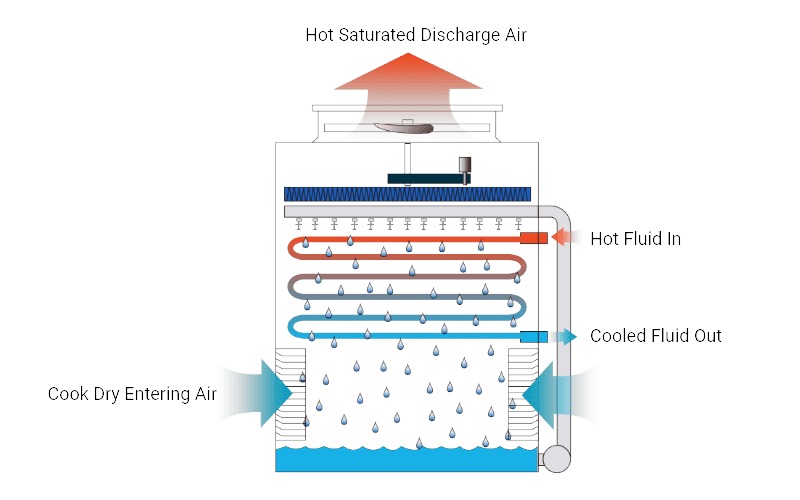
An evaporative condenser works by transferring heat from refrigerant vapor inside the coil to spray water and air outside the coil. The refrigerant condenses inside the coil, while spray water evaporates on the coil surface and removes heat. The fan system moves air through the condenser to support evaporation and heat rejection.

Evaporative Condensers working principle diagram
1
Refrigerant vapor enters the coilHot refrigerant vapor from the compressor flows into the condenser coil.
2
Spray water wets the coil surfaceThe spray system distributes water evenly over the outside of the coil.
3
Airflow supports evaporationFans move air through the wetted coil area and help evaporate part of the spray water.
4
Heat is rejectedEvaporation removes heat from the coil and lowers the refrigerant condensing temperature.
5
Liquid refrigerant leaves the condenserThe condensed liquid refrigerant returns to the refrigeration system.
Comparison

Evaporative Condenser vs Cooling Tower

Evaporative condensers and cooling towers are both heat rejection equipment, but they serve different system functions. Choosing the right equipment depends on whether the project needs to cool water, condense refrigerant, reduce water consumption or improve refrigeration efficiency.

Evaporative Condenser
Cooling Tower
Item Evaporative Condenser Cooling Tower
Main Function Condenses refrigerant vapor inside a coil Cools circulating water
Heat Transfer Method Coil heat transfer plus spray water evaporation Direct water-air evaporative cooling
Primary Fluid Refrigerant or process vapor inside coil Water exposed to air
Water Use Requires spray water and make-up water Requires circulating water and make-up water
Typical Advantage Lower condensing temperature and compact refrigeration heat rejection Efficient water cooling for chiller and process systems
Typical Application Industrial refrigeration, ammonia systems, cold storage HVAC condenser water and industrial water cooling
Technical Selection

Technical Selection Guide for Evaporative Condensers

Selecting an evaporative condenser requires accurate refrigeration and ambient data. A professional selection should consider total heat rejection, refrigerant type, condensing temperature, wet bulb temperature, coil pressure rating, water quality, installation layout, noise requirement and maintenance access.

Selection Parameter Meaning Why It Matters
Heat Rejection Capacity Total heat removed from the refrigeration system Determines condenser size and condensing performance
Refrigerant Type Ammonia or other refrigerant used in the system Affects coil design, pressure rating and connection requirements
Condensing Temperature Temperature at which refrigerant vapor condenses Influences compressor efficiency and condenser selection
Wet Bulb Temperature Local design wet bulb condition Key ambient limit for evaporative condenser performance
Compressor Load Operating load from the refrigeration system Ensures the condenser matches real system heat rejection
Coil Pressure Rating Design pressure required for refrigerant operation Important for safety and refrigerant system compatibility
Water Quality Condition of spray water and make-up water Affects scaling, corrosion, spray nozzles and coil maintenance
Installation Space Available footprint, height and service clearance Influences crossflow, counterflow, composite or forced draft design
Noise Requirement Acceptable sound level at the site Affects fan selection, fan speed and low-noise configuration
Material Requirement Corrosion resistance and durability expectations Influences coil, casing, basin and structural material selection

Not Sure Which Evaporative Condenser Is Right for Your Refrigeration System?

Choosing between crossflow, counterflow, composite flow and forced draft evaporative condensers requires real refrigeration data. Send us your refrigerant type, heat rejection capacity, condensing temperature, design wet bulb temperature and project layout. Our engineering team will recommend a suitable condenser configuration.

Refrigerant type Heat rejection Condensing temperature Wet bulb Project layout
Ask for Model Selection
Material Options

Evaporative Condenser Material Options

Material selection affects pressure safety, corrosion resistance, service life and maintenance requirements. For evaporative condensers, the coil material, casing material, basin structure, spray water components and fasteners should be selected according to refrigerant type, water quality, outdoor environment and corrosion level.

Condenser Coil Materials

Condenser Coil Materials

The condenser coil must match refrigerant pressure, corrosion conditions and system safety requirements.

Common consideration: tube material, pressure rating, weld quality, refrigerant compatibility and inspection access.
Galvanized / Aluzinc / Stainless Steel

Galvanized / Aluzinc / Stainless Steel

Metal materials can be selected for casing, frame, basin and water-contact components based on corrosion resistance and project budget.

Common options: galvanized steel, Aluzinc steel, #304 stainless steel and #316 stainless steel.
FRP and PVC Components

FRP and PVC Components

FRP and PVC components can be used for casing parts, drift eliminators, louvers and spray water system components.

Common value: corrosion resistance, lightweight structure and practical water-side durability.
Key Components

Key Components of an Evaporative Condenser

Evaporative condenser performance depends on the condenser coil, spray water system, fan arrangement, drift eliminator, basin, pump, airflow path and maintenance access. Each component must support safe refrigerant condensation and stable heat rejection.

Condenser Coil

Condenser Coil

Contains refrigerant vapor and provides the heat transfer surface for condensation.

Spray Water System

Spray Water System

Distributes water over the coil surface to support evaporative heat transfer.

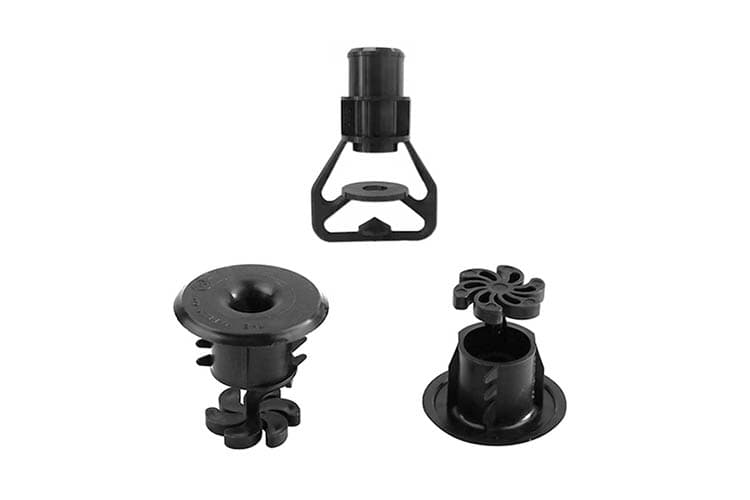
Spray Nozzles

Spray Nozzles

Provide uniform water coverage and help prevent dry coil areas.

Axial Fan

Axial Fan

Moves air through the condenser and support evaporation and heat rejection.

Spray Pump

Spray Pump

Circulates spray water from the basin to the distribution system.

Drift Eliminator

Drift Eliminator

Reduces water droplets carried out of the condenser by discharge air.

Spray Water Basin

Spray Water Basin

Collects spray water for recirculation and requires cleaning access.

Operation & Maintenance

Water Treatment and Maintenance for Evaporative Condensers

Evaporative condensers protect refrigerant inside the coil, but the spray water loop is exposed to air and requires proper treatment. Coil cleanliness, spray coverage, basin condition, fan operation and water quality directly affect condensing temperature and refrigeration efficiency.

Spray Water Treatment

Water treatment helps control scaling, corrosion, biological growth and suspended solids in the spray water loop.

  • Control dissolved solids
  • Reduce scale on coil surface
  • Manage biological growth

Coil and Nozzle Inspection

Uniform spray coverage and clean coil surfaces are essential for stable refrigerant condensing performance.

  • Inspect coil surface
  • Check spray nozzle coverage
  • Clean blocked nozzles when needed

Fan, Pump and Basin Maintenance

Fans, motors, spray pumps and basins should be checked regularly to maintain airflow and water circulation.

  • Check fan and motor operation
  • Inspect spray pump performance
  • Clean basin sediment and debris
Advantages

Advantages of Evaporative Condensers

Evaporative condensers are selected when refrigeration systems require efficient condensing, compact heat rejection and better performance than purely air-cooled condensation under suitable wet bulb conditions.

Efficient Condensing

Evaporative heat transfer can support lower condensing temperatures than air-cooled systems in many climates.

Compact Refrigeration Heat Rejection

Combines condenser coil and evaporative heat rejection in one integrated unit.

Energy Saving Potential

Lower condensing temperature can reduce compressor energy consumption in refrigeration systems.

Suitable for Ammonia Systems

Widely used in industrial ammonia refrigeration and cold storage applications.

Multiple Airflow Designs

Crossflow, counterflow, composite and forced draft layouts support different project needs.

Industrial Duty Operation

Suitable for food processing, cold storage, chemical plants and process cooling systems.

Flexible Material Selection

Coil, casing, basin and water-contact materials can be selected for corrosion requirements.

Project-Based Customization

Capacity, fan system, coil design and control strategy can be matched to refrigeration conditions.

Why Choose Thermocore

Why Choose Thermocore Evaporative Condensers

Thermocore supports refrigeration engineers, contractors, distributors and industrial end users with project-based evaporative condenser selection, durable materials, custom design options and export project support.

Why Choose Thermocore

Refrigeration-Based Selection

Selection based on refrigerant type, heat rejection, condensing temperature and wet bulb conditions.

Multiple Condenser Types

Crossflow, counterflow, composite flow and forced draft evaporative condenser options.

Coil Design Support

Coil pressure rating, material and connection design can be reviewed according to project needs.

Export Project Support

Technical communication, drawing confirmation, packaging and shipping coordination.

Industrial Application Experience

Suitable for cold storage, ammonia refrigeration, food processing and process cooling.

Water System Design Awareness

Spray water treatment, drift control and basin maintenance are considered in system communication.

Material Options

Different coil, casing, basin and structural materials can be selected for corrosion conditions.

Custom Engineering

Support for special layouts, low noise, voltage requirements and project-specific documentation.

Custom Engineering

Custom Engineering Options for Evaporative Condensers

Different refrigeration systems require different condenser configurations. We support customization for heat rejection capacity, coil design, refrigerant connections, airflow structure, fan system, spray water system, corrosion resistance, voltage, control strategy and export shipping requirements.

Custom Evaporative Condenser Engineering Drawing

Thermal & Structure Customization

For projects with special heat rejection capacity, footprint, height, airflow direction or installation requirements.

Heat rejection capacity Crossflow structure Counterflow structure Composite flow design Forced draft layout

Coil & Material Customization

For ammonia systems, special refrigerants, corrosion conditions and industrial refrigeration requirements.

Coil material options Pressure rating Refrigerant connections Stainless steel options Anti-corrosion design

Project & Export Customization

For international projects requiring low noise, special voltage, modular shipping or OEM cooperation.

Low-noise fans Special motor voltage Spray pump options Container loading OEM / private label
FAQ

Evaporative Condenser FAQ

These FAQs are written in a technical HVAC and industrial refrigeration style. The answers explain refrigerant condensation, evaporative heat rejection, selection data, water treatment, maintenance and engineering considerations for evaporative condensers.

What is an evaporative condenser?

An evaporative condenser is a heat rejection device that condenses refrigerant vapor inside a coil by using a combination of spray water and airflow. Hot refrigerant vapor enters the condenser coil, spray water wets the outside of the coil, and air passes across the coil surface. A small portion of the spray water evaporates and removes heat, allowing the refrigerant inside the coil to condense into liquid. Evaporative condensers are widely used in industrial refrigeration, cold storage, food processing, chemical plants and HVAC systems where efficient refrigerant condensing is required.

How does an evaporative condenser work?

An evaporative condenser works by combining refrigerant condensation, spray water evaporation and airflow. Refrigerant vapor from the compressor enters the coil and releases heat through the coil wall. Spray water flows over the outside surface of the coil, while fans move air through the condenser. Part of the spray water evaporates and carries away heat, so the refrigerant vapor inside the coil condenses into liquid. The liquid refrigerant then returns to the refrigeration system through the receiver or liquid line.

What is the difference between an evaporative condenser and a cooling tower?

A cooling tower cools circulating water, while an evaporative condenser directly condenses refrigerant or process vapor inside a coil. In a cooling tower, water is the main fluid being cooled and then returns to a chiller, heat exchanger or process system. In an evaporative condenser, refrigerant vapor flows inside the coil and changes phase into liquid. This makes evaporative condensers especially suitable for refrigeration systems because they combine the condenser and evaporative heat rejection function into one piece of equipment.

What is the difference between an evaporative condenser and an air-cooled condenser?

An air-cooled condenser rejects heat only through airflow over dry coils, while an evaporative condenser uses spray water evaporation plus airflow. Because evaporative heat transfer is more effective under many conditions, an evaporative condenser can often operate at a lower condensing temperature than an air-cooled condenser. This may improve refrigeration system efficiency, especially in hot climates. However, evaporative condensers require water treatment and maintenance, while air-cooled condensers generally have lower water-related maintenance.

When should I choose an evaporative condenser?

An evaporative condenser is a strong choice when the refrigeration system requires efficient condensing, lower condensing temperature and compact heat rejection. It is commonly selected for ammonia refrigeration, cold storage, food processing, industrial refrigeration, ice plants, chemical cooling and large HVAC refrigeration systems. It is especially useful when system energy efficiency and refrigeration performance are important, and when the project can support water treatment and routine maintenance.

When should I avoid an evaporative condenser?

An evaporative condenser may not be ideal when water is scarce, when water treatment cannot be managed, when maintenance access is limited, or when the system owner wants to avoid spray water loops. In those cases, an air-cooled condenser or dry cooler may be considered. However, the trade-off is that air-cooled systems may operate at higher condensing temperatures in hot weather, which can reduce refrigeration efficiency.

What information is needed to select an evaporative condenser?

Accurate selection requires refrigeration heat rejection capacity, refrigerant type, condensing temperature, wet bulb temperature, compressor load, refrigerant flow conditions, site altitude, power supply, noise requirement, water quality, installation space and material requirements. For industrial refrigeration, it is also important to confirm ammonia or refrigerant system pressure, connection sizes, safety standards and operating profile.

Why is wet bulb temperature important for evaporative condenser selection?

Wet bulb temperature is critical because evaporative condensers reject heat mainly through evaporation of spray water. The achievable condensing temperature is strongly influenced by local wet bulb temperature. A project in a high wet bulb climate will require different condenser sizing than a project in a dry or moderate climate. Professional selection should always use the design wet bulb temperature at the project site rather than relying only on dry bulb air temperature.

Do evaporative condensers need water treatment?

Yes. Although the refrigerant stays inside the coil, the spray water loop is open to air and requires water treatment. Without proper treatment, scaling, corrosion, biological growth and suspended solids can affect the coil surface, spray nozzles, basin and pump. Water treatment helps maintain heat transfer, reduce maintenance problems and extend equipment life.

What should I send to get an evaporative condenser quotation?

To receive an accurate quotation, provide refrigerant type, heat rejection capacity, refrigeration capacity if available, condensing temperature, design wet bulb temperature, project location, power supply, installation space, noise requirements and material preferences. For replacement projects, existing condenser photos, nameplate data, connection sizes and layout drawings are helpful. Complete operating data allows the supplier to select the right model and avoid undersizing or oversizing.
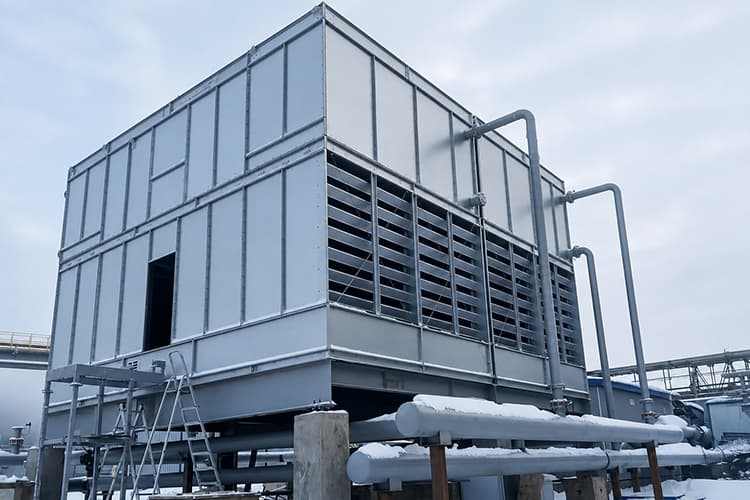
Start Your Project

Need an Evaporative Condenser for Your Refrigeration Project?

Send us your refrigerant type, heat rejection capacity, condensing temperature, design wet bulb temperature, project location, power supply and layout requirements. Our engineering team will help you select a suitable crossflow, counterflow, composite flow or forced draft evaporative condenser configuration.

Scroll to Top