Cycle Time Pressure
Cooling is often the longest part of the molding cycle, so unstable cooling directly affects output per machine.
Injection molding plants need stable cooling to control mold temperature, protect hydraulic systems, reduce cycle time,
improve part quality and support continuous plastic production. The cooling solution may include cooling towers,
closed circuit cooling towers, dry coolers, chillers, heat exchangers, filtration, pumps and water treatment systems.
This page explains how injection molding cooling systems work, how to choose between cooling towers, closed circuit towers,
dry coolers and chiller-assisted systems, and what engineering data is needed for mold cooling, hydraulic oil cooling,
process water loops, plastic processing lines and factory cooling system upgrades.
In injection molding, cooling is often the longest part of the cycle and one of the biggest factors affecting part quality.
A stable cooling system helps the plastic part solidify consistently, reduces cycle time, protects mold temperature control,
prevents hydraulic oil overheating and supports continuous machine operation.
A complete injection molding cooling solution may include a central cooling tower, process chiller, closed circuit cooling tower,
dry cooler, heat exchanger, pump station, filter, water treatment system and mold temperature controller.
The correct design depends on plastic material, machine tonnage, mold structure, required water temperature, production rhythm,
water quality and local ambient conditions.
Molding plants do not buy cooling just to remove heat. They buy shorter cycles, fewer rejects and cleaner mold water.
Cooling is often the longest part of the molding cycle, so unstable cooling directly affects output per machine.
Uneven mold temperature can cause dimensional variation, sink marks, warpage and repeatability issues.
Scale, rust and debris restrict small mold passages and create local hot spots.
Machine oil cooling must be included for hydraulic presses and high-duty production.
Injection molding cooling must shorten cycle time, protect mold channels, stabilize part dimensions and control hydraulic oil temperature. The cooling system is part of production quality, not just a utility system.
Thermocore products are selected by water temperature and cleanliness: open cooling towers for general mold and oil cooling, closed circuit towers for cleaner mold loops, dry coolers for water-saving closed circuits, and chiller-assisted systems when molds need lower or tighter temperature control.
The heat path starts inside the mold. Thermocore equipment removes heat from mold water, machine oil and auxiliary loops so the plant can maintain cycle time and part quality.

Injection molding cooling should be selected according to required water temperature, mold precision, plastic material,
water quality, machine count, climate and expansion plan.
Cost-effective evaporative cooling for general process water, hydraulic oil cooling and utility cooling where open water exposure is acceptable.
Closed-loop cooling that protects process water from outdoor contamination and helps reduce fouling in molds and heat exchangers.
Closed-loop air cooling for water-saving operation, glycol loops, free cooling and auxiliary machine cooling.
Used when molds need lower or more precise water temperature than a cooling tower or dry cooler can provide.
Injection molding product selection should be based on mold temperature, cleanliness and precision requirements.
| Industry Condition | Better-Fit Product | Why It Fits | Selection Caution |
|---|---|---|---|
| General mold water and hydraulic oil cooling | Open Cooling Tower | Economical heat rejection for standard molding plants where treated open water is acceptable. | Open water can scale or foul mold circuits if filtration and treatment are weak. |
| Clean mold circuits or reduced fouling requirement | Closed Circuit Cooling Tower | Keeps process water closed and helps protect molds, manifolds and heat exchangers. | Coil performance and spray water treatment still need maintenance. |
| Engineering plastics or low mold water temperature | Chiller-Assisted System | Provides lower and more precise water temperature than tower-only cooling. | Higher energy use requires proper controls and load staging. |
| Water-saving plant or suitable free-cooling climate | Dry Cooler | Closed-loop cooling with low water use and optional glycol protection. | May not meet low mold temperature targets during hot weather. |
The best cooling system depends on required mold water temperature and whether the plant prioritizes low cost,
water cleanliness, water saving or precise temperature control.
| Item | Open Cooling Tower | Closed Circuit Cooling Tower | Dry Cooler | Chiller-Assisted System |
|---|---|---|---|---|
| Cooling Principle | Direct evaporative cooling of circulating water | Closed fluid coil cooled by spray water and air | Finned coil rejects heat to ambient air | Mechanical refrigeration cools process water or glycol |
| Temperature Capability | Limited by wet bulb temperature and approach | Evaporative performance with closed-loop protection | Limited by dry bulb temperature and coil approach | Can provide lower and more precise water temperature |
| Water Cleanliness | Water exposed to air, dust and biological growth | Process fluid protected inside coil | Closed-loop fluid protected inside coil | Usually closed chilled water loop, requires water treatment |
| Best Fit | General mold cooling and cost-sensitive plants | Plants needing cleaner water and reduced mold fouling | Water-saving sites, glycol loops and suitable ambient climates | Precision molding, engineering plastics and low-temperature requirements |
| Main Caution | Scale, corrosion, fouling and water treatment | Coil scaling, spray water treatment and material selection | Higher outlet temperature in hot climates | Higher energy use and refrigeration maintenance |
These are the practical failure points to check before choosing between an open cooling tower, closed circuit cooling tower, dry cooler or evaporative condenser.
Undersized or unstable cooling can increase cooling time and reduce machine output.
Uneven mold temperature can cause shrinkage, warpage and inconsistent part dimensions.
Scale and rust reduce flow through small channels and create hot spots.
Hydraulic oil overheating can damage seals, pumps and machine stability.
Mold cooling is not only a utility water problem. It is a production quality problem. The cooling system should provide stable flow,
clean water and suitable temperature for the mold design and plastic material.

Enough flow through each mold circuit is required to remove heat evenly and prevent local hot spots.
Stable supply temperature supports repeatable shrinkage, consistent dimensions and predictable cycle time.
Scale, rust or debris can restrict small mold channels, reduce flow and create uneven temperature distribution.
A professional injection molding cooling page should connect cooling equipment with the actual factory systems that need heat rejection.
Mold cooling channels remove heat from molded parts and control solidification.
Machines may require cooling for hydraulic oil, barrels, drive systems and auxiliary heat loads.
Oil cooling protects hydraulic pumps, seals, valves and machine stability.
Control mold temperature for repeatability and material-specific processing requirements.
Provide lower-temperature water for precision molding, engineering plastics and hot climates.
Distribute cooling water to multiple mold circuits, machines and production lines.
Cooling support for compressed air systems, dryers and auxiliary plant equipment.
Separate loops, protect clean water circuits and remove debris from process cooling water.
Injection molding cooling selection should consider both production process requirements and utility system conditions.
The goal is stable mold temperature and reliable heat rejection, not only nominal cooling capacity.
Injection molding cooling selection can begin with machine data and required water temperature.
If exact heat load is not available, machine tonnage, machine quantity, plastic throughput and cycle time can support preliminary selection.
| Required Data | Why It Matters |
|---|---|
| Number of Injection Molding Machines | Defines total production cooling load and system scale. |
| Machine Tonnage and Power | Helps estimate heat load and hydraulic oil cooling demand. |
| Plastic Material | Affects mold temperature, cooling rate and water temperature requirement. |
| Part Weight and Cycle Time | Useful for estimating heat removal and cooling time. |
| Required Mold Cooling Water Temperature | Determines whether tower cooling, dry cooling or chiller-assisted cooling is needed. |
| Water Flow Rate and Temperature Difference | Allows direct heat load calculation when available. |
| Hydraulic Oil Cooling Requirement | Important for machine reliability and oil temperature control. |
| Design Wet Bulb Temperature | Required for open and closed evaporative cooling tower selection. |
| Design Dry Bulb Temperature | Required for dry cooler and air-cooled system selection. |
| Water Quality and Open/Closed Loop Preference | Affects fouling control, filtration, treatment and system configuration. |
| Factory Layout and Expansion Plan | Determines equipment location, pump station, piping and future capacity reservation. |
Cooling performance is one of the biggest factors affecting molded part quality and cycle time.
The cooling system should be designed with the mold, plastic material and product quality requirements in mind.
Stable water temperature and adequate flow can shorten cooling time when the mold and material allow it.
Consistent mold temperature helps reduce shrinkage variation and improves repeatability.
Proper cooling can help reduce warpage, sink marks, stress, surface defects and uneven solidification.
Injection mold cooling channels can be narrow and difficult to clean. Poor water quality can reduce cooling performance,
increase cycle time and cause uneven mold temperature.
Hard water can create scale inside mold channels and heat exchangers, reducing heat transfer and flow.
Rust, particles, biofilm and debris can block small mold passages and water manifolds.
Open water systems need treatment to reduce corrosion and biological growth that can affect molds and machines.
Maintenance should focus on stable water flow, clean mold channels, heat transfer performance and reliable machine operation.
A neglected cooling system can increase cycle time and product defect risk.
Inspect basins, fill, nozzles, coils, fans, motors and water distribution to maintain cooling capacity.
Filters, strainers, manifolds and mold channels should be kept clean to prevent uneven cooling and reduced flow.
Temperature sensors, pumps, chiller controls and tower controls should be checked to maintain stable process cooling.
Injection molding cooling systems can be customized according to machine count, mold temperature, cooling load,
water quality, factory layout, water-saving target, chiller integration and future production expansion.
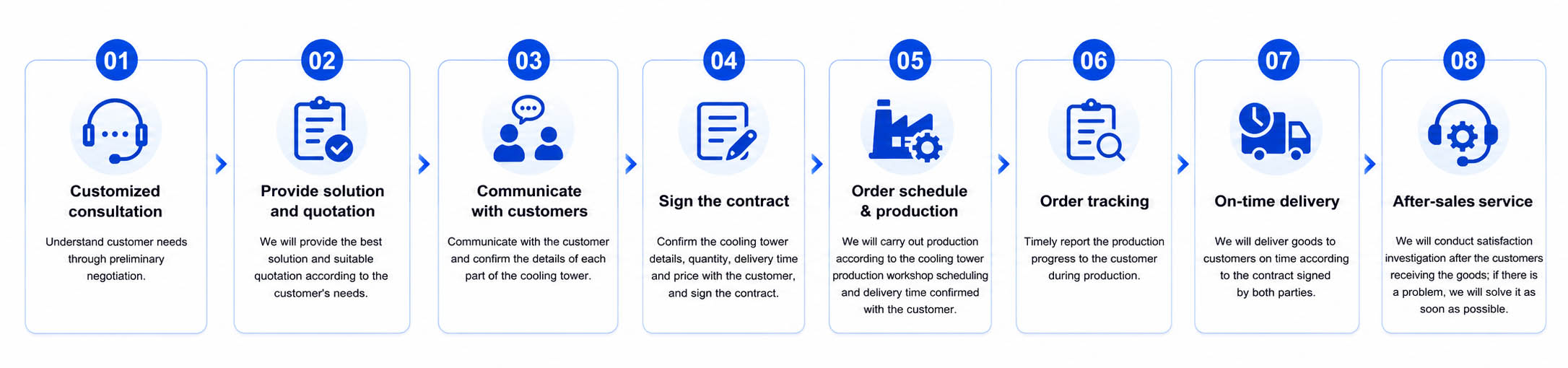
Designed around machine quantity, tonnage, part weight, cycle time, plastic material and required mold temperature.
Configured as open cooling tower, closed circuit cooling tower, dry cooler, chiller-assisted system or combined central plant.
Adjusted for filtration, water treatment, heat exchanger separation, pump station, low-noise design and future expansion.
Send your machine quantity, machine tonnage, plastic material, part weight, cycle time,
required mold cooling water temperature, water quality, project location and factory expansion plan.
Our engineering team will review whether an open cooling tower, closed circuit cooling tower, dry cooler,
chiller-assisted system or combined cooling plant is more suitable.
These FAQs are written for injection molding factories, plastic processing engineers, mold manufacturers,
equipment integrators and industrial buyers who need to understand mold cooling, cooling tower vs chiller selection,
closed-loop cooling, water quality, cycle time, maintenance and quotation data.
An injection molding cooling solution is a process cooling system designed to remove heat from injection molds, hydraulic oil, plasticizing units, machine auxiliaries, chillers and plant utility loops. The purpose is to maintain stable mold temperature, protect injection molding machines, improve cycle time, reduce product defects and support continuous plastic production.
After molten plastic is injected into the mold cavity, heat must be removed through mold cooling channels so the part can solidify and be ejected. Cooling water, chilled water or temperature-controlled fluid circulates through the mold and carries heat away. The heat is then rejected through a chiller, cooling tower, closed circuit cooling tower, dry cooler or a combined process cooling system.
Mold cooling directly affects cycle time, part shrinkage, warpage, dimensional stability, surface finish and production efficiency. If mold temperature is unstable or cooling water flow is poor, molded parts may have inconsistent dimensions, longer cooling time, internal stress, deformation or quality defects. A stable cooling system helps improve repeatability and production output.
Common equipment includes open cooling towers, closed circuit cooling towers, dry coolers, industrial chillers, mold temperature controllers, plate heat exchangers, process water pumps, filters, water treatment systems and hydraulic oil coolers. The correct combination depends on mold temperature requirement, plastic material, machine capacity, water quality, ambient climate and required temperature precision.
A cooling tower is suitable when the required cooling water temperature can be achieved above the outdoor wet bulb temperature. A chiller is required when the mold or process needs water temperature below what a tower can provide, or when precise low-temperature control is needed. Many injection molding plants use both: a cooling tower for general heat rejection and a chiller for low-temperature mold or process cooling.
A closed circuit cooling tower is useful when the plant wants to keep process water clean, reduce contamination in mold channels, protect heat exchangers and minimize fouling risk. The process fluid stays inside a coil, while spray water and air remove heat from the outside of the coil. It is suitable for treated water loops, glycol loops, precision molds and plants with poor outdoor air or water quality.
Important data includes number and tonnage of injection molding machines, plastic material, part weight, cycle time, mold cooling water temperature, water flow rate, heat load, hydraulic oil cooling requirement, chiller capacity if any, design wet bulb or dry bulb temperature, project location, water quality, open or closed loop preference, footprint, noise requirement and expansion plan.
Water quality affects scaling, corrosion, biological growth and blockage in mold cooling channels, heat exchangers, nozzles and cooling equipment. Poor water quality can reduce flow, create uneven mold temperature and increase cycle time. Closed loops, filtration, water treatment and proper material selection help protect molds and maintain stable cooling.
Open loop cooling exposes circulating water to air or tower water, which can be economical but may introduce oxygen, dust, minerals and biological contamination. Closed loop cooling keeps process water or glycol separated from the outdoor environment, reducing fouling and corrosion risk in molds and equipment. Closed loops usually require a heat exchanger, closed circuit tower, dry cooler or chiller.
To request a quotation, send the number and tonnage of injection molding machines, plastic material, production capacity, part weight, cycle time, required mold cooling water temperature, water flow rate if available, hydraulic oil cooling load, chiller capacity if existing, design wet bulb or dry bulb temperature, project location, water quality, open or closed loop preference, footprint, noise limit, power supply and expansion plan.
Send us your number and tonnage of injection molding machines, plastic material, production capacity,
part weight, cycle time, required mold cooling water temperature, water flow rate if available,
hydraulic oil cooling load, existing chiller capacity if any, design wet bulb or dry bulb temperature,
project location, water quality, open or closed loop preference, footprint, noise limit, power supply and expansion plan.
We will help you evaluate the right injection molding cooling solution.