Hygienic Separation
Tower water should not contact product-side or clean process loops; heat exchangers and closed loops often matter.
Food and beverage plants need cooling systems that can support stable product temperature, refrigeration efficiency,
hygienic separation, water quality management and continuous production. Cooling towers, closed circuit cooling towers,
dry coolers, adiabatic coolers and evaporative condensers can be selected according to process load, glycol loop,
refrigeration duty and site operating conditions.
This page explains how food and beverage cooling systems work, how to choose between open cooling, closed circuit cooling,
dry cooling and evaporative condensing, and what engineering data is needed for dairy, beverage, brewery, meat processing,
cold storage, frozen food, packaging and process cooling applications.
In food and beverage production, cooling is directly connected to product quality, process repeatability and plant uptime.
Cooling systems may serve process water loops, chilled water systems, glycol loops, refrigeration condensers, pasteurizers,
fermentation tanks, cold rooms, packaging lines and compressor systems.
The cooling tower or dry cooler is usually part of a separated heat rejection system, not a food-contact system.
Correct engineering should separate cooling tower water from product-side hygienic processes through heat exchangers,
jackets, closed loops or refrigeration circuits.
Food plants need cooling, but they also need hygienic separation. The wrong open loop can create contamination risk or unstable process temperature.
Tower water should not contact product-side or clean process loops; heat exchangers and closed loops often matter.
Cold rooms, blast freezing, fermentation, pasteurization and process chillers may need different temperature levels.
Moisture, cleaning chemicals and salty or acidic products can accelerate corrosion around equipment.
Temperature swings can affect fermentation, cooling tunnels, crystallization, beverage quality or freezing performance.
Food and beverage cooling must remove process and refrigeration heat without compromising hygiene, product quality or clean utility separation. The right system keeps tower water away from food-side circuits while supporting stable temperature for production and storage.
Thermocore products are selected by separation and temperature level: open towers for separated utility loops, closed circuit towers for clean glycol or process water, evaporative condensers for refrigeration, and dry coolers for low-water closed loops.
Food plant cooling starts at product processes, refrigeration equipment or utility systems. Thermocore equipment rejects heat while maintaining the separation needed between dirty tower water and clean production circuits.

Food and beverage cooling should be selected according to process temperature, refrigeration duty, hygiene separation,
water use, glycol concentration and maintenance capability.
Closed-loop evaporative cooling for glycol, treated water or utility loops that should remain protected from outdoor contaminants.
Efficient refrigerant condensing for cold storage, process refrigeration, dairy, meat, beverage and frozen food systems.
Dry closed-loop cooling for glycol systems, compressor cooling, water-saving sites and free cooling opportunities.
Cost-effective evaporative cooling for condenser water or utility cooling loops where open water exposure is acceptable.
Food plant heat rejection should be chosen around hygiene separation and temperature level.
| Industry Condition | Better-Fit Product | Why It Fits | Selection Caution |
|---|---|---|---|
| Non-product utility condenser water or chiller plant | Open Cooling Tower | Economical heat rejection for utility loops where tower water is properly separated. | Do not connect tower water directly to food-side process circuits. |
| Glycol, clean process water or protected secondary loop | Closed Circuit Cooling Tower | Keeps clean fluid inside the coil and reduces contamination risk. | Coil material, cleaning access and spray water treatment should be specified. |
| Cold storage or industrial refrigeration condenser duty | Evaporative Condenser | Efficient refrigerant condensing for low-temperature food refrigeration systems. | Refrigerant safety, water treatment and condenser cleaning must be planned. |
| Water-limited site or closed low-maintenance loop | Dry Cooler | Low water use and closed-loop operation for suitable temperature ranges. | May not reach low fluid temperatures during hot weather without chiller support. |
The best cooling system for food and beverage production depends on whether the load is process water, glycol cooling,
refrigeration condensing or general utility cooling.
| Item | Closed Circuit Cooling Tower | Evaporative Condenser | Dry Cooler | Open Cooling Tower |
|---|---|---|---|---|
| Cooling Principle | Closed fluid coil cooled by spray water and air | Refrigerant vapor condenses inside wetted coil | Finned coil rejects heat to ambient air | Direct evaporative cooling of circulating water |
| Typical Loop | Water, glycol or treated utility fluid | Ammonia, CO2 or other refrigeration system | Glycol, water or closed utility loop | Condenser water or plant utility water |
| Hygiene Separation | Good closed-loop separation from outdoor air | Refrigerant side is closed; water side requires treatment | Strong closed-loop separation | Requires process separation through heat exchanger or chiller |
| Water Use | Evaporative spray water required | Evaporative water use required | Very low water use in dry operation | Evaporation and blowdown required |
| Best Fit | Glycol loops, process utility cooling and protected water loops | Industrial refrigeration and cold storage systems | Water-saving sites, glycol loops and free cooling | General condenser water and utility cooling loops |
| Main Caution | Spray water treatment and coil maintenance | Refrigeration design, water quality and coil access | Limited by dry bulb temperature and larger footprint | Water treatment, drift, plume and contamination control |
These are the practical failure points to check before choosing between an open cooling tower, closed circuit cooling tower, dry cooler or evaporative condenser.
Direct or poorly separated loops can create food safety and audit concerns.
Fermentation, freezing, pasteurization or beverage cooling can drift when heat rejection is inconsistent.
Washdown chemicals and humid rooms can damage unsuitable materials and fasteners.
High condensing temperature increases compressor energy and can limit cold room capacity.
Cooling towers are outdoor heat rejection equipment. Their water systems should be treated as utility systems, not hygienic product-contact systems.
For food and beverage applications, the design should keep product-side fluids separated from tower-side water.

Plate heat exchangers, jacketed tanks and closed glycol loops help separate product-side cooling from tower-side water.
Even when separated, tower water needs treatment to reduce scale, biological growth, corrosion and fouling.
Tower location, drift control, discharge direction and service access should be considered during plant layout.
A strong solution page should connect the cooling system to the actual equipment and production processes the buyer needs to serve.
Cooling support for product temperature reduction after heat treatment.
Separation between product-side fluids, glycol, chilled water or tower-side utility water.
Glycol jacket cooling for beer, wine, dairy and fermentation processes.
Evaporative condensers or auxiliary cooling for ammonia, CO2 or other refrigeration systems.
Refrigeration heat rejection for chilled storage, blast freezing and frozen food facilities.
Chilled water or glycol systems for production lines and product cooling.
Cooling for packaging machines, compressed air systems and production utilities.
Cooling for air compressors, vacuum pumps, hydraulic systems and plant service equipment.
Food and beverage cooling design should consider process temperature, refrigeration duty, hygiene separation,
glycol use, water quality, energy control and production schedule.
Food and beverage cooling selection should include process information, refrigeration information and site conditions.
If the exact heat load is not known, equipment capacity and fluid temperature data can help with preliminary selection.
| Required Data | Why It Matters |
|---|---|
| Process Type | Dairy, beverage, brewery, meat, frozen food or cold storage changes cooling requirements. |
| Heat Load or Refrigeration Capacity | Defines total heat rejection duty. |
| Fluid Type | Water, glycol, chilled water or refrigerant affects equipment selection. |
| Fluid Flow Rate | Determines coil sizing, pump flow and pressure drop. |
| Inlet Fluid Temperature | Defines hot-side condition entering the cooling equipment. |
| Outlet Fluid Temperature | Defines required cooling target and approach. |
| Glycol Concentration | Required for low-temperature or freeze-protected loops. |
| Design Wet Bulb Temperature | Required for open towers, closed circuit towers and evaporative condensers. |
| Design Dry Bulb Temperature | Required for dry coolers, adiabatic coolers and hybrid cooling. |
| Water Quality and Hygiene Separation Requirement | Affects water treatment, closed-loop design and heat exchanger separation. |
| Operating Hours, Redundancy and Footprint | Determines maintainability, standby capacity and layout constraints. |
Many food and beverage plants rely on refrigeration and glycol systems. The external heat rejection equipment should match refrigerant type,
condensing temperature, glycol concentration, cooling load and annual operating profile.

Often used for ammonia or industrial refrigeration condensing where efficient heat rejection is needed.
Suitable for closed-loop glycol heat rejection, free cooling and water-saving plant operation.
Provides evaporative performance while keeping treated water or glycol protected inside a coil.
Cooling tower water treatment is essential in food and beverage plants. Even when tower water is separated from product-side processes,
poor water quality can reduce heat transfer, increase energy use and create maintenance problems.
Hardness, suspended solids and poor blowdown control can reduce cooling tower or condenser performance.
Warm water systems require treatment and cleaning to reduce biological growth and maintain reliable operation.
Water chemistry, cleaning chemicals, outdoor exposure and plant environment affect casing, basin, coils and hardware.
Maintenance should protect cooling performance, production reliability and utility system cleanliness.
The cooling tower or condenser should be accessible without disrupting production areas unnecessarily.
Inspect basins, fill, nozzles, coils, fans and drift eliminators to maintain heat transfer and reliable operation.
Glycol concentration, refrigerant condensing performance, heat exchanger cleanliness and pump operation should be reviewed regularly.
Production loads and ambient conditions change, so cooling setpoints and mode control should be checked across seasons.
Food and beverage cooling systems can be customized according to process type, refrigeration load, glycol concentration,
hygiene separation, water quality, energy target, production schedule and maintenance requirements.
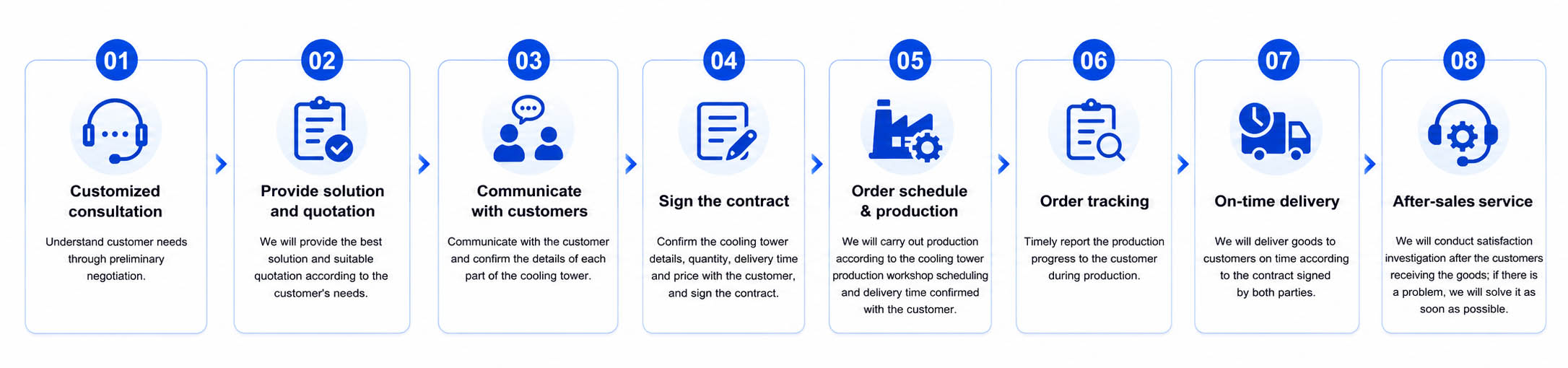
Designed around process heat load, refrigeration duty, product temperature, glycol concentration and cooling schedule.
Configured as closed circuit cooling, evaporative condensing, dry cooling, adiabatic cooling or open utility cooling.
Adjusted for heat exchanger separation, water treatment, free cooling, low-noise design, access and factory layout.
Send your process type, heat load or refrigeration capacity, fluid type, flow rate, inlet and outlet temperature,
glycol concentration, water quality, hygienic separation requirement, footprint and operating schedule.
Our engineering team will review whether a closed circuit cooling tower, evaporative condenser, dry cooler,
adiabatic cooler or open cooling tower is more suitable.
These FAQs are written for food factory engineers, refrigeration contractors, beverage producers, dairy plants, cold storage operators
and industrial buyers who need to understand food and beverage cooling selection, glycol cooling, refrigeration heat rejection,
hygiene separation, water quality, maintenance and quotation data.
A food and beverage cooling solution is a heat rejection system designed to remove heat from process water, glycol loops, refrigeration systems, pasteurization lines, fermentation tanks, packaging lines, cold rooms and utility cooling systems in food and beverage production facilities. The cooling tower or dry cooler normally does not directly contact the product; it rejects heat from a separated cooling water, glycol or refrigeration loop.
In a food and beverage plant, heat from process equipment or refrigeration systems is transferred into a cooling water loop, glycol loop, condenser water loop or refrigerant system. The warm fluid is then sent to an open cooling tower, closed circuit cooling tower, dry cooler, adiabatic cooler or evaporative condenser. The equipment rejects heat to outdoor air, and the cooled fluid returns to the process or refrigeration plant.
Common heat rejection equipment includes open cooling towers, closed circuit cooling towers, evaporative condensers, dry coolers, adiabatic coolers and industrial air coolers. The plant may also use process chillers, plate heat exchangers, glycol skids, ammonia refrigeration systems, CO2 refrigeration systems and chilled water loops depending on the production process.
An open cooling tower can be suitable for condenser water or utility cooling where water exposure to air is acceptable and water treatment is well managed. A closed circuit cooling tower is often preferred when the plant needs a cleaner loop, glycol protection, reduced contamination risk or separation between process-side fluid and outdoor air. The final decision should consider hygiene requirements, water quality, refrigeration design, maintenance capability and lifecycle cost.
An evaporative condenser is commonly used for industrial refrigeration systems in food processing, cold storage, dairy, meat processing, beverage production and freezing applications. Refrigerant vapor flows inside a coil and is condensed by spray water and airflow. It is different from a standard cooling tower because it directly condenses refrigerant rather than only cooling water.
A dry cooler is suitable when the plant wants to reduce water use, keep the cooling fluid in a closed loop, avoid visible plume, support glycol cooling or use free cooling during cooler ambient conditions. Dry coolers are often used for glycol loops, compressor cooling, process water pre-cooling, packaging equipment cooling and water-restricted sites.
Cooling tower water should normally be separated from product contact surfaces through heat exchangers, jacketed equipment, closed loops or refrigeration systems. Food safety considerations include avoiding cross-contamination, selecting cleanable heat exchangers, maintaining water treatment, preventing uncontrolled spray exposure near hygienic areas, and keeping process-side loops separated from tower water where required.
Important data includes process heat load, refrigeration load, product or process temperature requirement, fluid type, fluid flow rate, inlet and outlet fluid temperature, design wet bulb or dry bulb temperature, project location, water quality, hygiene separation requirement, glycol concentration, operating hours, footprint, noise limit, redundancy requirement and material preference.
Water quality affects scale, corrosion, biological growth, fouling, nozzle blockage, fill life, condenser performance and maintenance frequency. Food and beverage plants should pay attention to makeup water quality, blowdown control, biological control, suspended solids, water treatment chemicals and separation between cooling tower water and hygienic process loops.
To request a quotation, send the process type, heat load or refrigeration capacity, fluid type, flow rate, inlet and outlet temperature, required process temperature, glycol concentration if applicable, design wet bulb or dry bulb temperature, project location, water quality, hygiene separation requirement, footprint, operating hours, redundancy requirement, noise limit, power supply and material preference.
Send us your process type, heat load or refrigeration capacity, fluid type, fluid flow rate,
inlet and outlet fluid temperature, required process temperature, glycol concentration if applicable,
design wet bulb or dry bulb temperature, project location, water quality, hygiene separation requirement,
operating hours, footprint, noise requirement, redundancy requirement, power supply and material preference.
We will help you evaluate the right food and beverage cooling solution.