GMP Utility Separation
Tower water should be separated from clean utilities, purified water support systems and product-side processes.
Pharmaceutical facilities require cooling systems that support stable cleanroom temperature and humidity, process reliability,
GMP-oriented utility separation, continuous operation and documented maintenance. Cooling towers, closed circuit cooling towers,
dry coolers, adiabatic coolers, chillers and heat exchangers must be selected according to cleanroom load, process duty,
water quality, redundancy and validation requirements.
This page explains how pharmaceutical cooling systems work, how to choose between open cooling towers, closed circuit cooling,
dry cooling and chiller-based systems, and what engineering data is needed for cleanrooms, laboratories, reactors, fermenters,
lyophilizers, purified water utilities, cold storage, packaging rooms and central utility plants.
In pharmaceutical manufacturing, cooling supports more than comfort HVAC. It affects cleanroom temperature and humidity,
process equipment stability, cold storage, laboratory operation, purified water utilities, product handling, packaging,
and the reliability of central utility systems.
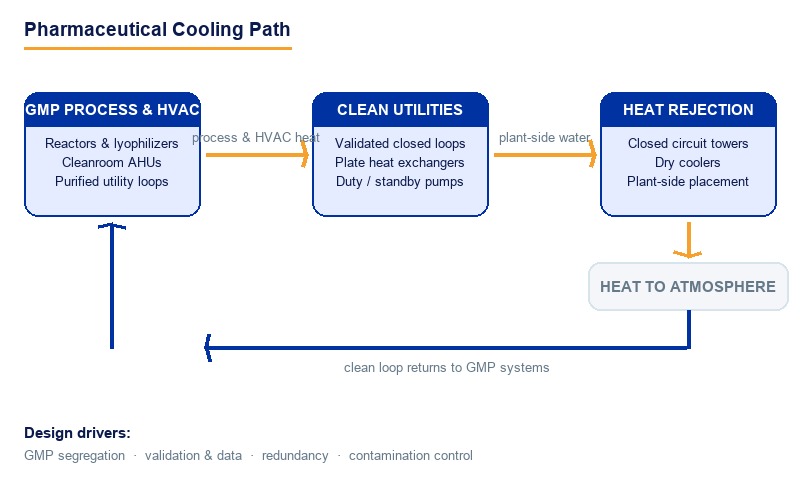
A pharmaceutical cooling solution should clearly separate utility-side heat rejection from GMP-critical or product-side systems.
Cooling tower water is typically part of the utility side and should not contact product-side fluids. Heat exchangers, closed loops,
glycol circuits, validated sensors and documented maintenance practices help reduce process risk and improve facility reliability.
Pharmaceutical plants need cooling systems that are both thermally stable and defensible from a quality and validation perspective.
Tower water should be separated from clean utilities, purified water support systems and product-side processes.
Temperature excursions can affect crystallization, reactors, fermenters, freeze dryers or process chillers.
Materials, controls, alarms and maintenance access may need to fit site quality procedures.
Validated or batch-critical systems often require backup capacity and clear isolation strategy.
Pharmaceutical cooling must support stable process temperature, clean utility separation, GMP expectations and batch reliability. The cooling solution should be understandable to engineering, maintenance and quality teams.
Thermocore products are selected by cleanliness and criticality: open towers for separated utility loads, closed circuit towers for clean glycol or protected loops, dry or adiabatic coolers for low-water campus needs, and chiller-supported systems for precise process or cleanroom conditions.
Pharmaceutical cooling starts with the need to control process or utility temperature without compromising clean loop separation. Thermocore equipment rejects heat while keeping the correct boundary between tower water and protected utilities.
Pharmaceutical cooling should be selected according to cleanroom load, process duty, GMP boundary, water strategy,
energy target, operating schedule and maintenance capability.
Efficient heat rejection for water-cooled chillers and condenser water systems where water treatment and utility separation are well managed.
Closed-loop evaporative cooling for protected fluid circuits, glycol loops, process utilities and cleaner water operation.
Water-saving closed-loop cooling for glycol systems, laboratory cooling, free cooling and low-maintenance utility loops.
Dry cooling with evaporative assistance to balance water savings with peak summer performance and plume control.
Pharmaceutical selection should prioritize separation, stability and maintainability before lowest first cost.
| Industry Condition | Better-Fit Product | Why It Fits | Selection Caution |
|---|---|---|---|
| Non-GMP utility condenser water or chiller plant | Open Cooling Tower | Efficient heat rejection for utility systems kept separate from clean process loops. | Requires water treatment, biological control and clear loop separation. |
| Clean glycol, process support or protected utility loop | Closed Circuit Cooling Tower | Keeps the clean fluid closed and reduces contamination exposure. | Coil material, access, monitoring and documentation should be aligned with site standards. |
| Precise low-temperature process or cleanroom support | Chiller plus Tower or Dry Cooler | Provides controlled temperature for critical process or HVAC loads. | Energy use, backup capacity and controls must be reviewed. |
| Water or plume restricted pharmaceutical campus | Dry Cooler or Adiabatic Cooler | Can reduce open water exposure and visible plume. | Peak ambient conditions and water-side maintenance still need checking. |
The best pharmaceutical cooling solution depends on utility boundary, water availability, energy target, process risk,
maintenance strategy and required temperature level.
| Item | Open Cooling Tower | Closed Circuit Cooling Tower | Dry Cooler | Adiabatic / Hybrid Cooling |
|---|---|---|---|---|
| Cooling Principle | Direct evaporative cooling of condenser or utility water | Closed fluid coil cooled by spray water and air | Finned coil rejects heat to ambient air | Dry cooling with evaporative air pre-cooling or wet assist |
| Utility Separation | Requires heat exchanger or chiller boundary for GMP-critical systems | Process fluid protected inside coil | Process fluid protected inside finned coil | Depends on design; often closed-loop on process side |
| Water Use | Evaporation and blowdown required | Spray water loop required | Very low water use in dry operation | Lower than full wet operation when dry mode is available |
| Best Fit | Water-cooled chiller plants and large condenser water systems | Protected glycol, process utility and cleaner closed-loop cooling | Water-saving sites, labs, free cooling and low-maintenance loops | Projects balancing water saving, peak cooling and plume concerns |
| Main Caution | Water treatment, drift, plume, condenser water quality and GMP separation | Coil scaling, spray water treatment and inspection access | Higher fluid temperature in hot climates and larger footprint | Mode control, adiabatic water quality and maintenance planning |
These are the practical failure points to check before choosing between an open cooling tower, closed circuit cooling tower, dry cooler or evaporative condenser.
Poor loop separation can create avoidable quality and audit questions.
Unstable cooling can affect process repeatability and batch outcome.
Unclear materials, controls or maintenance access can slow project approval.
A single heat rejection path can put validated utilities at risk during service or failure.
In pharmaceutical facilities, the cooling tower is typically utility-side equipment. The design should clearly separate open tower water
from product-side, clean utility or GMP-critical systems using heat exchangers, closed loops or refrigeration boundaries.

Cooling tower water should remain outside product-contact or clean utility loops unless separated through appropriate equipment.
Closed loops, glycol circuits and heat exchangers help protect process equipment from tower water contamination risk.
Temperature, flow, alarms, water treatment and maintenance activities should be documented according to facility procedures.
A professional pharmaceutical cooling page should connect the cooling system to the actual cleanroom, utility and process systems it supports.
Chillers producing chilled water for cleanrooms and processes while rejecting heat to condenser water and cooling towers.
Air handling systems requiring stable chilled water for temperature and humidity control.
Dedicated chillers serving reactors, fermenters, lyophilizers, laboratories and process equipment.
Closed freeze-protected loops for low-temperature process cooling and outdoor dry cooler systems.
Utility separation between condenser water, chilled water, process water, glycol and clean utility loops.
Cooling support for cold storage, stability testing and controlled storage areas.
Cooling and heat exchanger support for purified water, WFI and clean utility systems where applicable.
Chilled water pumps, condenser water pumps, sensors, alarms, BMS and documented control sequences.
Pharmaceutical cooling selection should consider controlled-environment requirements, process duty, utility separation,
redundancy, water quality, control documentation and future expansion.
Pharmaceutical cooling selection should include load data, temperature requirements, GMP separation requirements and site conditions.
If exact heat load is not available, equipment served and utility temperatures can support preliminary review.
| Required Data | Why It Matters |
|---|---|
| Facility Type | Cleanroom, laboratory, production, warehouse or utility plant affects cooling strategy. |
| Equipment or Area Served | Defines whether the load is HVAC, process, refrigeration, laboratory or clean utility support. |
| Cooling Load / Heat Rejection | Defines equipment capacity and redundancy planning. |
| Temperature and Humidity Requirement | Important for cleanroom HVAC and controlled environments. |
| Chilled Water or Process Fluid Temperatures | Determines chiller, heat exchanger, tower or dry cooler selection. |
| Flow Rate and Temperature Difference | Allows direct heat load calculation and pump sizing. |
| Glycol Concentration | Required for freeze-protected or low-temperature closed loops. |
| Design Wet Bulb Temperature | Required for evaporative cooling tower and closed circuit tower selection. |
| Design Dry Bulb Temperature | Required for dry cooler, air-cooled and adiabatic system selection. |
| Water Quality and GMP Separation Requirement | Affects water treatment, open/closed loop strategy and heat exchanger boundaries. |
| Redundancy, Monitoring and Documentation Requirement | Determines standby capacity, control alarms, sensors and maintainability. |
Pharmaceutical cooling must support stable utilities and documented operation. Redundancy and control logic should be defined according to
production criticality, cleanroom requirements, storage conditions and maintenance strategy.

Chilled water, glycol and condenser water control should support cleanroom and process temperature stability.
Critical loads may need standby chillers, cooling tower cells, pumps, control paths or heat exchangers.
Temperature, flow, pressure, water quality, pump status and fan status should be integrated with facility monitoring where required.
Pharmaceutical cooling towers and condenser water loops require consistent water treatment and documented maintenance.
Poor water quality can reduce heat transfer, raise chiller energy, increase maintenance and create operational risk.
Hardness, conductivity, pH and chloride levels affect condenser tubes, cooling tower fill, coils, basins and piping.
Warm utility water systems require biological control, basin cleaning and regular water treatment verification.
Process utility and glycol loops should be protected with compatible inhibitors, filtration and periodic concentration checks.
Pharmaceutical cooling maintenance should protect system reliability and support documented facility operation.
Maintenance access, cleaning procedures and records should be considered during design.
Inspect basins, fill, nozzles, drift eliminators, fans, motors, condenser tubes and water treatment systems.
Closed loops should be checked for glycol concentration, inhibitors, filtration, air removal and heat exchanger cleanliness.
Sensors, alarms, valves, VFDs and BMS sequences should be verified and documented according to facility procedures.
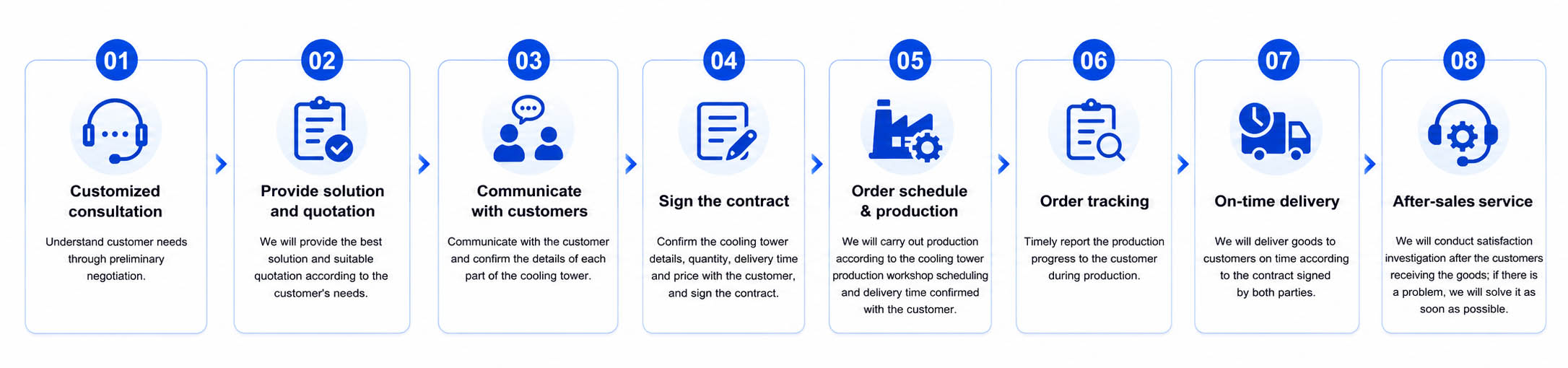
Pharmaceutical cooling systems can be customized according to cleanroom requirements, process duty, chilled water temperature,
GMP separation, redundancy, low-noise operation, water quality, monitoring and future expansion.
Designed around cleanroom class, HVAC load, process equipment, temperature/humidity target and operation schedule.
Configured as open cooling tower, closed circuit cooling, dry cooling, adiabatic cooling, chiller-assisted or glycol loop systems.
Adjusted for N+1 redundancy, heat exchanger separation, water treatment, low noise, BMS integration and documented maintenance.
Send your cleanroom load, process cooling duty, chilled water temperature, condenser water conditions,
glycol concentration, water quality, GMP separation requirement, redundancy target and site conditions.
Our engineering team will review whether an open cooling tower, closed circuit cooling tower, dry cooler,
adiabatic cooler, chiller-assisted system or heat exchanger-separated loop is more suitable.
These FAQs are written for pharmaceutical plant engineers, HVAC consultants, cleanroom contractors, process equipment suppliers,
laboratory facility teams and industrial buyers who need to understand cleanroom HVAC cooling, process cooling,
GMP separation, cooling tower selection, dry coolers, glycol loops, water quality, redundancy, maintenance and quotation data.
A pharmaceutical cooling solution is a utility cooling and heat rejection system designed to support pharmaceutical manufacturing, cleanroom HVAC, process chillers, purified water systems, laboratory cooling, cold storage, fermentation, reactors, lyophilizers, packaging rooms and central utility plants. It may include cooling towers, closed circuit cooling towers, dry coolers, adiabatic coolers, chillers, heat exchangers, glycol loops, pumps, controls, filtration and water treatment.
Heat from cleanroom air handling units, chillers, process equipment, reactors, fermenters, WFI or purified water utilities, cold rooms and laboratories is transferred into chilled water, condenser water, glycol, process water or closed utility loops. The heat is then rejected outdoors through cooling towers, closed circuit cooling towers, dry coolers, adiabatic coolers or refrigeration condensers. Product-side or GMP-critical systems are normally separated from tower-side water through heat exchangers or closed loops.
Common equipment includes water-cooled chillers, air-cooled chillers, open cooling towers, closed circuit cooling towers, dry coolers, adiabatic coolers, evaporative condensers, plate heat exchangers, glycol skids, condenser water pumps, chilled water pumps, process cooling skids, cleanroom AHUs and validated monitoring/control systems.
Open cooling towers can be efficient for condenser water heat rejection, but the circulating water is exposed to air and requires strong treatment and maintenance. Closed circuit cooling towers or dry coolers are often preferred for protected utility loops, glycol loops, laboratory cooling, process equipment cooling or applications where cleaner fluid isolation is important. The final choice should consider GMP boundaries, process risk, water quality, energy, maintenance and site conditions.
Cooling towers usually reject heat from water-cooled chillers that serve chilled water systems for cleanrooms, laboratories, production rooms, warehouses and utility areas. The cooling tower is part of the utility side, not the sterile product-contact side. Proper tower sizing, water treatment, drift control, plume management, redundancy and condenser water temperature control help maintain HVAC stability and chiller efficiency.
GMP-related cooling design focuses on system separation, control, monitoring, maintainability, documentation and risk reduction. Cooling tower water should not contact product-side or clean process fluids. Heat exchangers, closed loops, validated sensors, alarm logic, hygienic utility separation, cleanroom temperature/humidity stability and documented maintenance procedures are important for GMP-oriented facilities.
Glycol cooling is used when freeze protection, low-temperature process cooling, cold room support, outdoor dry cooler operation, free cooling, fermentation control, reactor jacket cooling or chilled utility loops require a protected fluid. Glycol concentration should be selected carefully because it affects freeze protection, heat transfer, pump energy, viscosity and equipment sizing.
Important data includes facility type, cooling load, cleanroom class or temperature/humidity requirement, process equipment served, chilled water supply and return temperature, condenser water temperature, process fluid type, glycol concentration, flow rate, design wet bulb and dry bulb temperature, water quality, redundancy requirement, GMP boundary, operating schedule, noise limit, footprint, monitoring requirement and expansion plan.
Water quality affects scaling, corrosion, biological growth, condenser tube fouling, cooling tower fill life, spray nozzle performance, drift control and maintenance frequency. Pharmaceutical plants should manage conductivity, hardness, pH, chlorides, suspended solids, biological treatment, filtration, blowdown and documentation of water treatment procedures.
To request a quotation, send the facility type, cooling load, equipment served, chilled water or process fluid flow rate, inlet and outlet temperature, required temperature/humidity conditions, glycol concentration if applicable, design wet bulb and dry bulb temperature, project location, water quality, GMP separation requirement, operating hours, redundancy target, footprint, noise limit, monitoring requirement, power supply and expansion plan.
Send us your facility type, cooling load, equipment served, chilled water or process fluid flow rate,
inlet and outlet temperature, required temperature/humidity conditions, glycol concentration if applicable,
design wet bulb and dry bulb temperature, project location, water quality, GMP separation requirement,
operating hours, redundancy target, footprint, noise limit, monitoring requirement, power supply and expansion plan.
We will help you evaluate the right pharmaceutical cooling solution.