Hydrocarbon Contamination Risk
Process leakage into cooling water can create safety, environmental and exchanger fouling concerns.
Petrochemical plants and refineries need cooling systems that can support high heat rejection loads, continuous production,
process reliability, corrosion control, water management and safe maintenance. Cooling towers, closed circuit cooling towers,
dry coolers, air coolers, heat exchangers, filtration and water treatment must be engineered around the actual process unit,
site conditions and operating risk.
This page explains how refinery and petrochemical cooling systems work, how to compare open cooling towers, closed circuit towers,
dry coolers, air-cooled heat exchangers and hybrid systems, and what engineering data is needed for process exchangers,
condensers, compressors, reactors, utility cooling water loops and refinery cooling system upgrades.
Cooling systems in petrochemical and refinery facilities are closely connected to process stability, equipment reliability,
throughput and safety. They may serve process condensers, shell-and-tube exchangers, compressor coolers, lube oil coolers,
reactor jackets, distillation overhead condensers, hydrogen units, sulfur recovery units, utility systems and tank farm auxiliaries.
A professional refinery cooling solution should not only size a tower by water flow. It must evaluate process duty, cooling range,
approach temperature, water source, water chemistry, fouling tendency, hydrocarbon contamination risk, corrosion environment,
redundancy, hazardous-area boundaries, access for maintenance and long-term operating strategy.
Refineries and petrochemical plants run harsh cooling water systems. The design must respect safety, fouling and continuous operation from the start.
Process leakage into cooling water can create safety, environmental and exchanger fouling concerns.
High chlorides, sulfides, suspended solids and deposits can damage towers, exchangers and piping.
Many units cannot easily shut down for tower cleaning or exchanger maintenance.
Layout, access, electrical classification and fire safety may influence equipment selection and controls.
Petrochemical and refinery cooling must handle large process heat loads while controlling hydrocarbon contamination risk, fouling, corrosion and continuous unit operation. The solution is closely tied to process safety and production availability.
Thermocore products are selected by loop risk: open cooling towers for central circulating cooling water, closed circuit towers or heat exchanger isolation for sensitive loops, dry coolers for water-limited or closed high-temperature services, and evaporative condensers for process refrigeration duties.
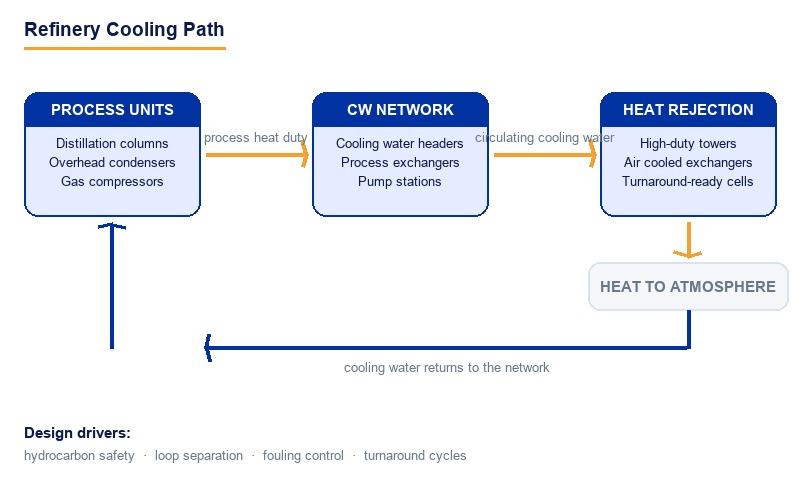
Refinery heat rejection starts at process exchangers and condensers. Thermocore equipment is selected according to contamination risk, water quality, unit criticality and whether the fluid should be isolated from open cooling water.
Refinery cooling solutions should be selected according to heat load, required outlet temperature, water availability,
process risk, water chemistry, site layout and continuous operation requirements.
Large-scale evaporative heat rejection for refinery circulating cooling water systems and process heat exchanger networks.
Closed-loop evaporative cooling for clean utility loops, compressor auxiliaries, glycol circuits and sensitive equipment.
Water-saving heat rejection for closed-loop utility cooling, lube oil cooling, glycol loops and water-restricted sites.
Dry cooling with evaporative assistance for sites balancing water savings, plume reduction and peak summer performance.
Petrochemical product selection should protect process continuity and reduce contamination risk.
| Industry Condition | Better-Fit Product | Why It Fits | Selection Caution |
|---|---|---|---|
| Large refinery circulating cooling water network | Open Cooling Tower | High-capacity evaporative cooling for central utility water systems. | Requires robust treatment, drift control, blowdown management and contamination monitoring. |
| Hydrocarbon process loop or contamination-sensitive service | Closed Circuit Cooling Tower or Heat Exchanger Isolation | Keeps process-side fluid separated and reduces direct exposure to tower water. | Coil material, exchanger duty and fouling strategy must be checked. |
| Water-limited site or high-temperature air cooling duty | Dry Cooler or Air Cooler | Reduces water use and can isolate process fluids in a closed loop. | May need large footprint and careful summer outlet temperature review. |
| Process refrigeration or vapor condensing service | Evaporative Condenser | Supports efficient refrigerant condensing for selected process refrigeration duties. | Pressure rating, refrigerant, materials and service access are critical. |
The right refinery cooling system depends on process duty, outlet temperature target, water strategy, fouling risk,
equipment location and long-term operating cost.
| Item | Open Cooling Tower | Closed Circuit Cooling Tower | Dry Cooler | Air-Cooled Heat Exchanger |
|---|---|---|---|---|
| Cooling Principle | Direct evaporative cooling of circulating water | Closed fluid coil cooled by spray water and air | Finned coil rejects heat from a closed fluid loop | Process stream or utility fluid rejects heat directly to air through finned tubes |
| Temperature Basis | Wet bulb temperature | Wet bulb temperature with closed-loop protection | Dry bulb temperature | Dry bulb temperature |
| Water Use | Evaporation and blowdown required | Spray water loop required | Very low water use | No cooling tower water required |
| Best Fit | Large circulating water systems and process heat exchanger networks | Clean loops, glycol, compressor auxiliaries and sensitive equipment | Closed utility loops, lube oil, glycol and water-saving applications | Direct process cooling, condensers and water-restricted refinery units |
| Main Caution | Water treatment, hydrocarbon contamination risk, drift and fouling | Coil scaling, spray water treatment and material selection | Higher outlet temperatures in hot climates | Larger footprint, fan noise and high dry bulb limitations |
These are the practical failure points to check before choosing between an open cooling tower, closed circuit cooling tower, dry cooler or evaporative condenser.
Hydrocarbon leakage or poor loop separation can create operational and environmental risk.
Dirty or corrosive cooling water can reduce heat transfer and force unit rate reductions.
No standby cells or isolation can make routine maintenance a production issue.
Sour, saline or chemically contaminated water can quickly damage unsuitable metals and coatings.
Refinery and petrochemical cooling systems should clearly define which fluids are exposed, which fluids are isolated,
and where process leakage or contamination could affect the cooling water network.

Open water systems can serve many process exchangers but require water treatment, leakage monitoring and contamination response planning.
Closed loops can protect clean fluid circuits, glycol systems, compressor auxiliaries and sensitive equipment from open water exposure.
Bypass lines, isolation valves, access platforms, fan lockout procedures and maintainable layouts reduce operating and maintenance risk.
A strong solution page should connect the cooling system to the actual equipment and heat sources that refinery engineers need to protect.
Shell-and-tube and plate exchangers transferring heat from process streams to cooling water or closed loops.
Overhead condensers, process condensers and utility condensers that rely on stable heat rejection.
Intercoolers, aftercoolers, lube oil coolers, seal coolers and auxiliary compressor cooling systems.
Reactor temperature control and auxiliary heat removal where cooling water or closed loops are required.
Cooling for overhead systems, condensers, pumparound exchangers and reflux systems.
Cooling for gas processing, hydrogen compression, purification and process support equipment.
Closed-loop or water-cooled systems protecting rotating equipment reliability.
Cooling for pump seals, utility exchangers, water treatment equipment and auxiliary systems.
Refinery cooling selection should consider thermal performance, process risk, water chemistry, corrosion environment,
continuous operation and maintainability. The design should serve the process, not only match nominal flow.
Refinery cooling selection should include process duty, water chemistry, site constraints and safety requirements.
If exact heat load is not available, water flow and temperature difference can support preliminary sizing.
| Required Data | Why It Matters |
|---|---|
| Process Unit | Crude, FCC, hydroprocessing, petrochemical, compressor or utility units have different duty profiles. |
| Equipment Served | Defines whether cooling is for condenser, exchanger, compressor, reactor or auxiliary loop. |
| Heat Load / Cooling Capacity | Defines total heat rejection duty. |
| Water or Fluid Flow Rate | Determines pump flow, pipe size, tower loading and pressure drop. |
| Inlet Water or Fluid Temperature | Defines hot-side condition entering the cooling equipment. |
| Outlet Water or Fluid Temperature | Defines required cooling target and approach. |
| Design Wet Bulb Temperature | Required for evaporative cooling tower selection. |
| Design Dry Bulb Temperature | Required for dry cooler, air cooler and adiabatic cooler selection. |
| Water Source and Water Quality | Affects material selection, scaling, corrosion, blowdown and treatment strategy. |
| Hydrocarbon Contamination Risk | Important for refinery circulating water monitoring and treatment planning. |
| Operating Hours, Redundancy and Site Constraints | Determines maintainability, standby capacity, tower cell count and plant layout. |
Refinery circulating water systems are exposed to severe water quality challenges. Effective water treatment and monitoring
protect cooling tower performance, heat exchanger cleanliness and long-term plant reliability.
Hardness, suspended solids and high cycles of concentration can reduce heat exchanger and cooling tower performance.
pH, chloride, oxygen, temperature and chemical treatment affect tower structure, piping, exchangers and coils.
Hydrocarbon leakage into cooling water can create fouling, treatment challenges and operational risk.
Petrochemical and refinery cooling systems are often mission-critical. Reliability planning should address equipment redundancy,
maintainability, monitoring and safe operating modes.
Multiple cells allow part-load operation, maintenance isolation and partial cooling availability during service.
Critical cooling loops may require standby pumps, bypasses, emergency operation and stable flow control.
Monitoring helps detect performance decline, water quality problems and mechanical failures before shutdown risk increases.
Maintenance should protect heat transfer performance, mechanical reliability, water quality and safe access.
Refinery cooling systems require planned maintenance practices because operating conditions are severe and downtime is costly.
Inspect basins, fill, nozzles, drift eliminators, fan systems, structure and water distribution to maintain thermal performance.
Monitor chemistry, biological control, suspended solids, oil contamination and blowdown strategy.
Pumps, fans, gearboxes, motors, exchangers, condensers and control valves should be inspected regularly.
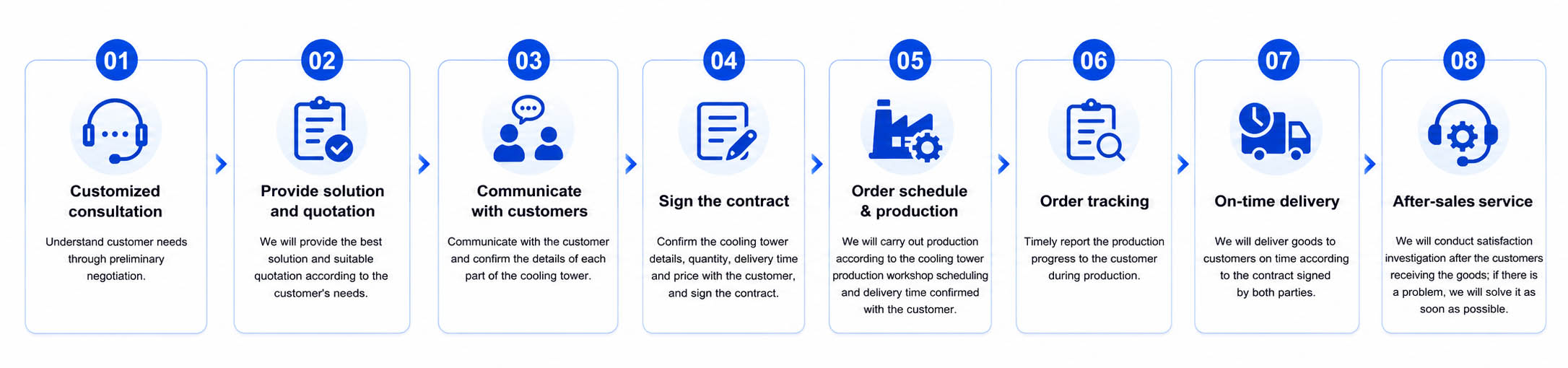
Petrochemical and refinery cooling systems can be customized according to process unit, heat load, water chemistry,
cooling method, safety boundary, redundancy, site layout, material requirements and long-term maintenance strategy.
Designed around condensers, process exchangers, compressor auxiliaries, reactors, distillation units and utility systems.
Configured as open cooling tower, closed circuit cooling, dry cooler, air cooler, adiabatic cooler or hybrid heat rejection.
Adjusted for corrosion, water treatment, contamination risk, redundancy, low-noise design, drift control and service access.
Send your process unit, equipment served, heat load, water or fluid flow rate, inlet and outlet temperature,
water quality, contamination risk, wet bulb and dry bulb design data, operating schedule, redundancy target and site constraints.
Our engineering team will review whether an open cooling tower, closed circuit tower, dry cooler, air cooler,
hybrid system or heat exchanger-separated loop is more suitable.
These FAQs are written for refinery engineers, petrochemical plant operators, EPC contractors, process equipment suppliers
and industrial buyers who need to understand circulating cooling water systems, cooling towers, closed circuit cooling,
dry cooling, air coolers, water quality, corrosion control, safety, redundancy, maintenance and quotation data.
A petrochemical and refinery cooling solution is an industrial heat rejection system designed to remove heat from process units, condensers, heat exchangers, compressors, reactors, distillation columns, hydrogen units, utility systems and auxiliary equipment. It may include open cooling towers, closed circuit cooling towers, dry coolers, air coolers, adiabatic coolers, heat exchangers, circulating water pumps, filtration, chemical water treatment, controls and redundancy planning.
Heat from process streams, condensers, compressors, reactors, exchangers or utility systems is transferred into circulating cooling water, closed-loop water, glycol, lube oil or heat transfer fluid systems. The warm fluid is sent to cooling towers, closed circuit towers, dry coolers, air-cooled heat exchangers or hybrid systems. Heat is rejected to ambient air and the cooled fluid returns to the process equipment.
In a refinery, a cooling tower rejects heat from the circulating cooling water system. This water may serve process condensers, heat exchangers, compressor coolers, lube oil coolers and utility cooling loads. Cooling tower performance affects process temperatures, condenser pressure, compressor reliability, water consumption, energy use and plant uptime.
There is no single best cooling tower type for all refinery applications. Open cooling towers are common for large circulating cooling water systems. Closed circuit cooling towers are useful for clean or sensitive loops. Dry coolers and air coolers are suitable for water-saving or closed-loop applications. Hybrid or adiabatic systems may be considered where water savings, plume control or peak summer capacity are important.
A closed circuit cooling tower is suitable when the process fluid or utility water must remain clean and protected from outdoor contamination. It can serve compressor auxiliary cooling, lube oil cooling, glycol loops, closed process cooling, clean water loops, heat exchanger isolation systems and sensitive equipment where fouling or contamination risk should be reduced.
Dry coolers and air coolers are suitable when water availability is limited, plume must be reduced, closed-loop operation is preferred, or the required outlet temperature can be achieved above the design dry bulb temperature. Air-cooled heat exchangers are widely used for direct process cooling, while dry coolers can support closed water, glycol or oil cooling loops.
A cooling tower cools water by evaporative heat rejection, and the cooled water then removes heat from process heat exchangers or condensers. An air-cooled heat exchanger transfers heat directly from a process stream or utility fluid to ambient air through finned tubes and fans. Cooling towers can usually provide lower temperatures based on wet bulb temperature, while air coolers save water but are limited by dry bulb temperature.
Water quality affects scale, corrosion, biological growth, fouling, oil contamination, suspended solids, drift, blowdown, fill life, nozzle performance and heat exchanger cleanliness. Refinery circulating water systems require careful management of conductivity, hardness, chlorides, pH, microbiological control, hydrocarbons, suspended solids, side-stream filtration and chemical treatment.
Important data includes process unit served, heat load, circulating water flow rate, inlet and outlet temperature, design wet bulb and dry bulb temperature, water source, water quality, hydrocarbon contamination risk, closed or open loop preference, redundancy requirement, operating hours, hazardous area considerations, footprint, noise limit, drift or plume requirement, material preference and maintenance strategy.
To request a quotation, send the process unit, equipment served, heat load, water or fluid flow rate, inlet and outlet temperature, design wet bulb and dry bulb temperature, project location, water source, water quality, hydrocarbon contamination risk, open or closed loop preference, operating hours, redundancy target, footprint, noise limit, drift or plume requirement, power supply and material preference.
Send us your process unit, equipment served, heat load, water or fluid flow rate, inlet and outlet temperature,
design wet bulb and dry bulb temperature, project location, water source, water quality, hydrocarbon contamination risk,
open or closed loop preference, operating hours, redundancy target, footprint, noise limit, drift or plume requirement,
power supply and material preference. We will help you evaluate the right petrochemical and refinery cooling solution.