Chiller Energy Sensitivity
Higher condenser water temperature can raise chiller power and operating cost across the cooling season.
HVAC cooling towers provide heat rejection for water-cooled chillers, condenser water loops and large building cooling systems.
A well-designed cooling tower solution helps maintain stable condenser water temperature, improve chiller plant efficiency,
reduce operating risk and support reliable comfort cooling for commercial and public buildings.
This page explains how HVAC cooling tower systems work, how to choose between open cooling towers, closed circuit cooling towers,
dry coolers and adiabatic solutions, and what design data is needed for engineering selection in offices, hotels, hospitals,
malls, campuses, airports and district cooling projects.
In a water-cooled HVAC system, the cooling tower is not an isolated product. It is part of a complete chiller plant that includes chillers,
condenser water pumps, cooling tower fans, piping, controls, valves, strainers, water treatment and building automation.
The cooling tower must be selected and controlled together with the chiller system.
For commercial HVAC projects, the main engineering goal is usually not only “cooling capacity”. A good solution must balance condenser water temperature,
chiller efficiency, fan energy, pump energy, water consumption, noise, plume, drift, hygiene, maintenance access, structural load and project budget.
Commercial HVAC cooling towers look simple until chiller energy, tenant comfort, water treatment and rooftop restrictions all meet in one project.
Higher condenser water temperature can raise chiller power and operating cost across the cooling season.
Undersized heat rejection shows up as poor indoor comfort during the hottest days.
Scaling, biological control, drift and basin cleaning require a realistic maintenance program.
Urban buildings often need low-noise fans, drift control, airflow clearance and safe access.
HVAC cooling towers support building comfort by helping water-cooled chillers reject heat efficiently. The practical goal is stable condenser water temperature, lower chiller energy, reliable peak-day operation and maintainable water treatment.
Thermocore products are selected by building plant constraints: open cooling towers for standard chiller condenser water, closed circuit towers for protected hydronic or glycol loops, dry coolers for low-water projects, and low-noise configurations for rooftops or urban sites.
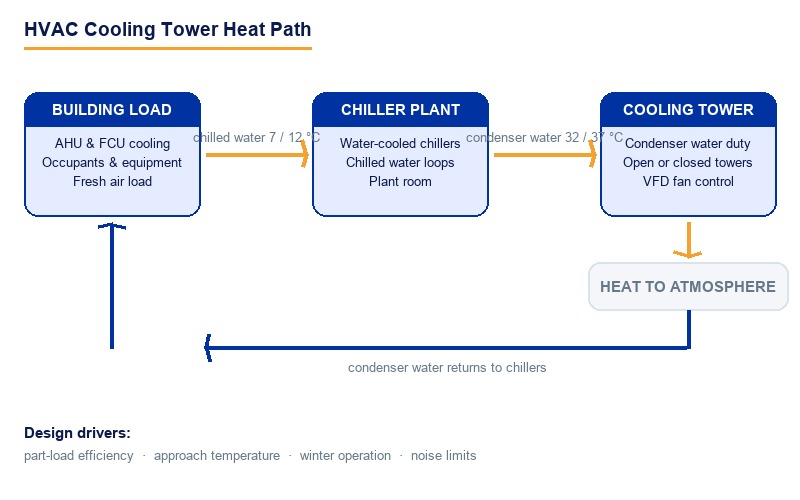
In HVAC systems, heat from occupied spaces is collected by chilled water or refrigerant systems and rejected outdoors. Thermocore equipment keeps condenser water or hydronic loops within the temperature range the building plant needs.
HVAC projects may use different cooling tower technologies depending on climate, water quality, building type, owner preference,
maintenance capability and energy strategy.
Direct evaporative cooling for condenser water loops. Often selected for efficient and economical water-cooled chiller plants.
Condenser water or glycol loop stays inside a coil while spray water and air remove heat from the coil surface.
Closed-loop heat rejection through finned coils. Useful where water saving, plume reduction or free cooling is important.
Combines dry operation with evaporative assistance for peak conditions, water saving or plume reduction.
HVAC product selection should follow the chiller plant, building constraints and owner maintenance capability.
| Industry Condition | Better-Fit Product | Why It Fits | Selection Caution |
|---|---|---|---|
| Water-cooled chiller condenser water loop | Open Cooling Tower | Strong efficiency for commercial chiller plants and common HVAC applications. | Needs water treatment, drift control and seasonal cleaning. |
| Closed hydronic or glycol loop | Closed Circuit Cooling Tower | Protects the building fluid while using evaporative cooling outdoors. | Coil access, spray water quality and freeze protection must be reviewed. |
| Water restriction or simple closed loop | Dry Cooler | Reduces water use and avoids open tower water treatment in suitable climates. | Can raise condenser or loop temperature during hot weather. |
| Noise-sensitive roof or property line | Low-Noise Cooling Tower Configuration | Fan selection, sound attenuation and layout can reduce acoustic impact. | Low-noise design may increase footprint, fan power or capital cost. |
HVAC cooling tower selection should be based on the whole building cooling plant, not only the tower price.
The right solution depends on water quality, chiller requirements, climate, maintenance strategy and lifecycle cost.
| Item | Open Cooling Tower | Closed Circuit Cooling Tower | Dry Cooler | Adiabatic / Hybrid Cooling |
|---|---|---|---|---|
| Cooling Principle | Direct evaporative cooling of condenser water | Closed fluid coil cooled by spray water and air | Air-cooled finned coil without evaporation in normal operation | Dry cooling with evaporative assistance or wet-dry operation |
| Water Use | Higher due to evaporation and blowdown | Evaporative spray water required, but process loop remains closed | Lowest water use in dry operation | Lower than full wet operation when dry mode is available |
| Fluid Cleanliness | Condenser water exposed to air | Process/condenser fluid protected inside coil | Closed-loop fluid protected inside coil | Depends on wet-dry system arrangement |
| Best Fit | Standard commercial HVAC chiller plants | Projects needing clean loop, glycol or reduced contamination risk | Water-saving or dry climate HVAC/free cooling applications | Projects balancing water saving and peak summer performance |
| Main Caution | Water treatment, drift, plume and basin maintenance | Coil, spray system and water treatment maintenance | Limited by dry bulb temperature and larger footprint | More complex controls and water quality review |
These are the practical failure points to check before choosing between an open cooling tower, closed circuit cooling tower, dry cooler or evaporative condenser.
Poor tower approach or fouled fill raises condenser water temperature and operating cost.
A tower sized without real wet bulb and airflow clearance can lose capacity on hot days.
Water treatment and cleaning gaps can create scaling, biological growth and performance loss.
Noise, plume recirculation or service access can cause trouble after installation.
HVAC cooling tower design should be coordinated with the chiller plant. The tower, condenser water pump, control system and water treatment plan
should be evaluated together.
To select the correct cooling tower for an HVAC chiller plant, engineering data from the chiller schedule and site conditions should be reviewed.
If the complete schedule is not available, preliminary selection can be made from capacity, water flow and design conditions.
| Required Data | Why It Matters |
|---|---|
| Chiller Cooling Capacity or Heat Rejection Capacity | Defines total tower duty and required number of cells. |
| Condenser Water Flow Rate | Determines water loading, pipe size, pump flow and tower distribution. |
| Entering Condenser Water Temperature | Defines hot water condition entering the cooling tower. |
| Leaving Condenser Water Temperature | Defines the target water temperature returning to the chiller. |
| Design Wet Bulb Temperature | Critical for open and closed evaporative cooling tower sizing. |
| Design Dry Bulb Temperature | Important for dry coolers, adiabatic coolers and hybrid systems. |
| Project Location and Altitude | Affects ambient design conditions, air density, corrosion environment and logistics. |
| Open or Closed Circuit Preference | Determines whether condenser water is exposed to air or protected inside a coil. |
| Available Footprint and Height | Determines tower layout, cell quantity, lifting plan and service access. |
| Noise Requirement | Affects fan speed, fan type, VFD control, attenuation and tower location. |
| Water Quality and Material Requirement | Affects fill, nozzles, basin, casing, coil, corrosion protection and water treatment plan. |
Cooling tower efficiency should be evaluated at chiller plant level. A lower condenser water temperature can improve chiller efficiency,
but it may also increase tower fan power or pump energy if not controlled properly.

VFD fans allow tower airflow to match actual load instead of operating at fixed full speed.
Multi-cell towers can stage fans and cells to improve part-load efficiency and provide redundancy.
Reset control can adjust tower leaving water temperature based on chiller efficiency, fan power and ambient conditions.
HVAC cooling towers operate in warm, wet outdoor conditions. Water treatment and maintenance are essential for performance,
equipment life and safe operation.
Water chemistry should be managed to reduce scaling, corrosion and heat transfer loss in tower and condenser surfaces.
Warm water systems require biological control and regular cleaning to reduce fouling and hygiene risks.
Drift eliminators, airflow design and tower location help reduce water carryover and visible plume concerns.
HVAC cooling tower maintenance should be planned for safe access, reliable building operation and stable condenser water performance.
A neglected tower can increase chiller energy consumption and reduce cooling capacity.
Inspect basin, fill, nozzles, louvers, drift eliminators, fan and motor condition on a regular schedule.
Fans, motors, belts, gearboxes, VFDs and sensors should be checked for stable operation and energy control.
HVAC load changes across seasons, so tower operation should be adjusted for summer peak, part load and shutdown periods.
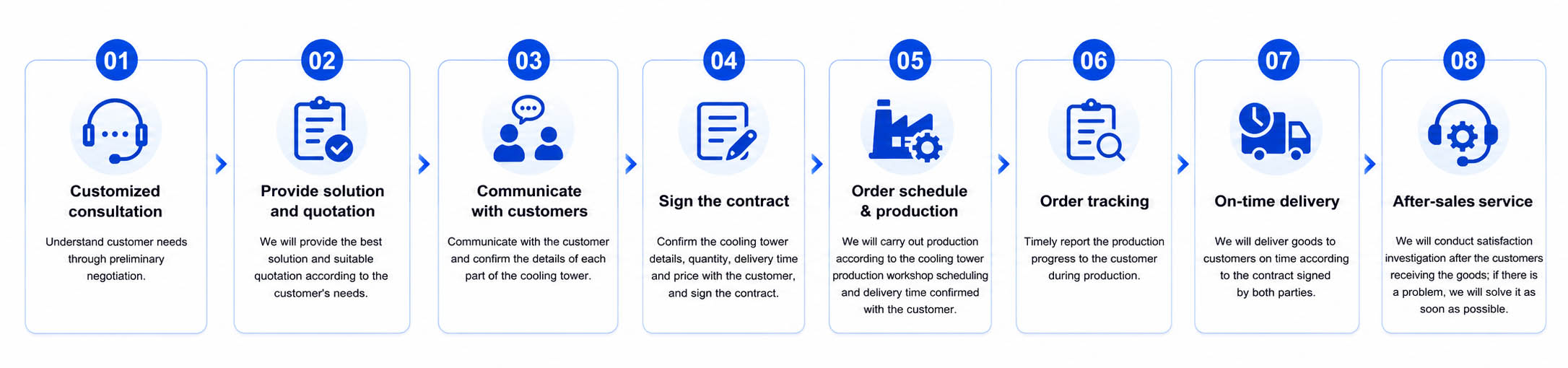
HVAC cooling tower solutions can be customized according to building type, chiller plant design, climate, water quality, acoustic limits,
site layout and long-term maintenance strategy.
Designed around chiller heat rejection, condenser water flow, temperature range, wet bulb condition and approach target.
Adjusted for rooftop layout, mechanical yard, air clearance, structural load, low-noise fans and sound-sensitive surroundings.
Configured with multi-cell staging, VFD control, temperature reset, N+1 planning and integration with building automation.
Send your chiller capacity, condenser water flow rate, entering and leaving condenser water temperature,
design wet bulb temperature, project location, footprint, noise requirement and water quality.
Our engineering team will review whether an open cooling tower, closed circuit cooling tower, dry cooler or adiabatic solution is more suitable.
These FAQs are written for consultants, contractors, facility owners and HVAC buyers who need to understand cooling tower selection,
chiller plant heat rejection, condenser water systems, open vs closed cooling, wet bulb design, energy control and maintenance before requesting a quotation.
An HVAC cooling tower solution is a heat rejection system designed to remove heat from a building’s chilled water plant, typically by cooling condenser water from water-cooled chillers. It may include open cooling towers, closed circuit cooling towers, dry coolers, adiabatic coolers, pumps, controls, water treatment, piping and maintenance access. The goal is to maintain stable condenser water temperature while balancing efficiency, water use, noise, footprint and reliability.
In a typical water-cooled HVAC system, the chiller absorbs heat from the building’s chilled water loop and rejects that heat into a condenser water loop. The warm condenser water is pumped to the cooling tower. Inside the tower, air and water exchange heat, usually through evaporation in an open tower or through a wetted coil in a closed circuit tower. The cooled condenser water returns to the chiller so the refrigeration cycle can continue.
Chilled water is the cold water supplied to air handling units, fan coil units or process loads inside the building. Condenser water is a separate loop that carries heat from the chiller condenser to the cooling tower. The cooling tower normally serves the condenser water side, not the chilled water side, unless a special system arrangement is used.
There is no single best cooling tower type for every HVAC project. Open cooling towers are common for conventional water-cooled chiller plants because they are efficient and economical. Closed circuit cooling towers are useful when condenser water cleanliness, glycol protection or reduced contamination risk is important. Dry coolers or adiabatic coolers may be selected when water saving, plume reduction or closed-loop operation is a priority.
An open cooling tower is often selected when lower initial cost and efficient evaporative cooling are priorities, and when water treatment can be managed. A closed circuit cooling tower is often selected when the system needs cleaner fluid, reduced fouling risk inside equipment, glycol operation or separation between process fluid and outdoor air. The final decision should consider chiller requirements, water quality, maintenance capability, climate and lifecycle cost.
Wet bulb temperature is one of the most important design conditions for evaporative cooling towers. The tower’s leaving condenser water temperature must be above the design wet bulb temperature by a practical approach. A high wet bulb temperature requires larger tower capacity, more airflow, more fill or a higher leaving water temperature target. Using the wrong wet bulb design condition can cause poor chiller performance during peak summer operation.
Important data includes chiller heat rejection or cooling capacity, condenser water flow rate, entering and leaving condenser water temperature, design wet bulb temperature, project location, altitude, water quality, open or closed circuit preference, available footprint, height limitation, noise requirement, power supply, control strategy, redundancy requirement, material preference and maintenance access requirements.
Cooling tower selection affects the condenser water temperature entering the chiller. Lower condenser water temperature can reduce chiller lift and improve chiller efficiency, but achieving lower water temperature may require larger tower size, more fan energy or higher initial cost. The best design should optimize the whole chiller plant, not only the cooling tower or chiller separately.
Maintenance typically includes basin cleaning, water treatment, fill inspection, nozzle cleaning, drift eliminator inspection, louver cleaning, fan and motor inspection, vibration checks, belt or gearbox maintenance if applicable, corrosion inspection and verification of sensors and controls. For closed circuit towers, coil inspection and spray system maintenance are also important.
To request a quotation, send the chiller cooling capacity or heat rejection capacity, condenser water flow rate, entering and leaving condenser water temperature, design wet bulb temperature, project location, available footprint, height limitation, open or closed circuit preference, water quality, noise requirement, power supply, material preference and any redundancy or control requirements.
Send us your chiller cooling capacity or heat rejection capacity, condenser water flow rate,
entering and leaving condenser water temperature, design wet bulb temperature, project location,
open or closed circuit preference, available footprint, noise requirement, water quality, power supply,
redundancy requirement and material preference. We will help you evaluate the right HVAC cooling tower solution.