Load Diversity and Peak Demand
Multiple buildings create changing load profiles that require staged cells, stable controls and realistic peak design.
District cooling systems provide centralized chilled water for multiple buildings, campuses or urban developments.
A professional solution must coordinate central chillers, cooling towers, condenser water systems, thermal energy storage,
distribution pumps, energy transfer stations, controls, water treatment and phased expansion.
This page explains how district cooling systems work, how cooling towers support central chiller plant heat rejection,
how to compare open towers, closed circuit towers, dry coolers and hybrid systems, and what engineering data is needed
for cities, airports, hospitals, universities, commercial complexes, industrial parks and mixed-use developments.
District cooling is not simply a large HVAC system. It is centralized cooling infrastructure that must serve multiple buildings
with different load profiles, occupancy schedules, return water temperatures and reliability requirements.
The central plant must be designed for peak load, part-load efficiency, redundancy, hydraulic stability and future expansion.
From a cooling equipment perspective, the heat rejection side is critical. Cooling towers, condenser water pumps,
water treatment systems and controls must work together with chillers to maintain efficient condenser operation across
the annual load profile, not only at the design peak point.
District cooling is not a single-building HVAC problem. It is a central utility network where load diversity, delta T and plant sequencing drive long-term performance.
Multiple buildings create changing load profiles that require staged cells, stable controls and realistic peak design.
Low return water temperature or excess flow can increase pumping energy and reduce plant capacity.
Cooling yards may face footprint, noise, plume, drift and maintenance access limits.
The first plant phase should not block later cooling tower cells, pumps, headers or controls.
District cooling is a central utility problem, not a single-building HVAC problem. The heat rejection system must support multiple buildings, changing load profiles, chiller sequencing, delta T management, peak season demand and phased expansion.
Thermocore products are applied according to plant strategy: open cooling towers for large water-cooled chiller plants, closed circuit towers for protected loops, dry or adiabatic coolers where water or plume is limited, and modular cells for future capacity phases.
In district cooling, Thermocore equipment rejects heat from the central plant so chillers can serve many connected buildings efficiently. Product selection depends on load diversity, condenser water temperature, water strategy and plant expansion plan.
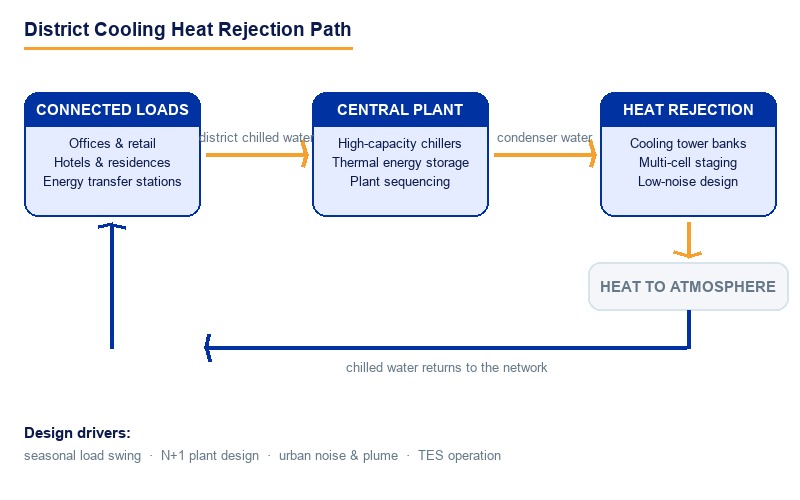
District cooling heat rejection should be selected according to plant capacity, local climate, water availability,
urban constraints, redundancy target, expansion plan and long-term operating cost.
Efficient evaporative condenser water cooling for water-cooled central chiller plants, especially large district cooling plants.
Closed-loop evaporative cooling for cleaner condenser or process loops where fluid protection is required.
Water-saving heat rejection for suitable climates, free cooling loops, auxiliary systems or projects with limited water availability.
Wet-dry or adiabatic systems that balance water saving with peak summer cooling performance.
District cooling selection should connect heat rejection equipment with plant phasing and chiller strategy.
| Industry Condition | Better-Fit Product | Why It Fits | Selection Caution |
|---|---|---|---|
| Large central water-cooled chiller plant | Open Cooling Tower | High-capacity condenser water heat rejection with strong chiller efficiency. | Requires water treatment, drift/plume control, noise planning and service access. |
| Closed network, glycol section or clean secondary loop | Closed Circuit Cooling Tower | Provides loop isolation while maintaining evaporative heat rejection performance. | Coil pressure drop and spray water maintenance must be checked. |
| Urban site with water or plume restrictions | Dry Cooler or Adiabatic Cooler | Reduces water use and visible plume compared with wet-only systems. | Needs careful peak ambient sizing and larger footprint planning. |
| Plant built in multiple phases | Modular Multi-Cell Cooling Tower | Allows capacity to be added as buildings connect to the network. | Hydraulic balance, header sizing and control sequencing must be planned early. |
The right heat rejection equipment depends on water strategy, energy target, local climate, condenser water temperatures,
project scale and site restrictions.
| Item | Open Cooling Tower | Closed Circuit Cooling Tower | Dry Cooler | Hybrid / Adiabatic Cooling |
|---|---|---|---|---|
| Cooling Principle | Direct evaporative cooling of condenser water | Closed fluid coil cooled by spray water and air | Finned coil rejects heat to ambient air | Dry cooling with wet or adiabatic assistance |
| Energy Potential | Strong chiller efficiency where water is available | Good evaporative performance with closed-loop protection | Useful for free cooling where fluid temperatures allow | Balances dry operation and peak evaporative support |
| Water Use | Evaporation and blowdown required | Spray water loop required | Very low water use in dry operation | Lower than full wet operation when dry mode is available |
| Best Fit | Large water-cooled chiller plants and high-efficiency district cooling | Projects needing protected fluid loops or special water strategy | Water-restricted sites, auxiliary loops and suitable climates | Urban projects balancing water, energy and peak demand |
| Main Caution | Water treatment, drift, plume, basin cleaning and condenser water quality | Coil scaling, spray water treatment and higher equipment complexity | Higher condenser temperatures in hot climates and larger footprint | Mode control, adiabatic water quality and maintenance |
These are the practical failure points to check before choosing between an open cooling tower, closed circuit cooling tower, dry cooler or evaporative condenser.
Poor return temperature can force higher flow, more pump power and reduced plant capacity.
Underestimated simultaneous demand can raise condenser water temperature and reduce chiller output.
Maintenance becomes difficult if tower cells and pumps cannot be isolated while the network operates.
Noise, plume or drift can become a project constraint if not addressed before layout approval.
A district cooling plant should be evaluated as a complete system. Chillers, cooling towers, pumps, energy storage and controls
must be sequenced together to reduce energy use while maintaining customer cooling reliability.
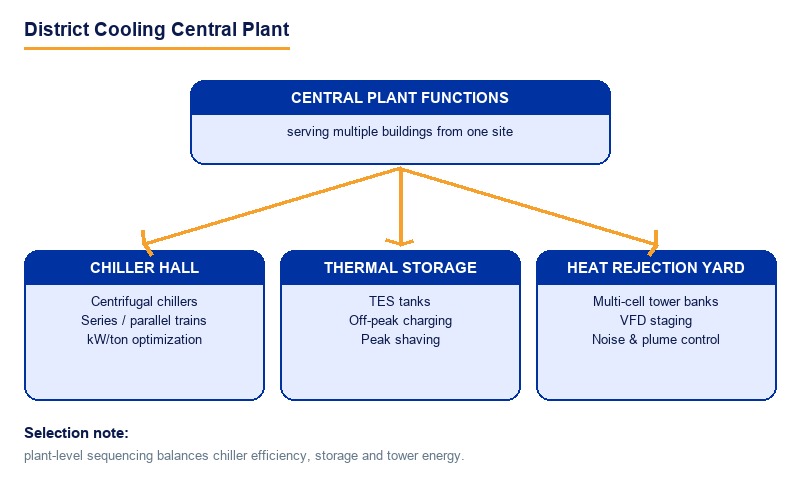
Condenser water temperature control should balance chiller power, tower fan power, pump power and water use.
Storage tanks or ice storage can shift cooling production, reduce peak demand and improve plant flexibility.
District cooling plants often grow over time, so cooling tower cells, pumps and piping should allow planned expansion.
A professional district cooling page should connect the heat rejection equipment with the central plant and distribution systems it supports.
Large chillers producing chilled water while rejecting heat to condenser water and cooling towers.
Multi-cell heat rejection systems supporting peak load, part-load operation and redundancy.
Pumps circulating water between chillers and cooling towers with optimized flow control.
Primary, secondary or variable primary pumping systems for chilled water distribution.
Chilled water or ice storage systems supporting peak shaving and operational flexibility.
Heat exchanger stations connecting district chilled water to building HVAC systems.
Insulated underground or campus piping delivering chilled water to buildings.
Automation systems sequencing chillers, towers, pumps, valves and customer loads.
District cooling design should be based on both peak demand and annual operation. The heat rejection system must support chiller efficiency,
water management, redundancy and phased development.
District cooling heat rejection selection should include plant capacity, condenser conditions, customer load profile and site constraints.
For early-stage projects, phased capacity and future build-out assumptions are very important.
| Required Data | Why It Matters |
|---|---|
| Total Cooling Capacity | Defines central plant size and overall heat rejection requirement. |
| Chiller Type and Quantity | Affects condenser water temperature, heat rejection and redundancy planning. |
| Condenser Heat Rejection | Required for accurate cooling tower or dry cooler sizing. |
| Chilled Water Supply / Return Temperature | Affects delta T, distribution flow and customer energy transfer station design. |
| Condenser Water Supply / Return Temperature | Defines cooling tower duty and chiller performance. |
| Design Wet Bulb Temperature | Required for open cooling tower and evaporative system selection. |
| Design Dry Bulb Temperature | Required for dry cooler, adiabatic cooler and hybrid cooling design. |
| Load Profile and Building Types Served | Determines diversity, part-load operation and storage value. |
| Water Quality and Water Availability | Affects wet/dry/hybrid selection, blowdown, treatment and maintenance. |
| Redundancy Target | Determines chiller, tower, pump and electrical backup strategy. |
| Site Layout, Noise Limit and Plume Concern | Affects tower arrangement, fan selection, sound attenuation and drift/plume control. |
District cooling efficiency depends on total plant operation: chillers, cooling towers, pumps, energy transfer stations,
distribution network and thermal energy storage. The goal is not only low chiller kW/ton, but stable and efficient system-level operation.

Condenser water setpoints should balance chiller power, tower fan power, pump power and water consumption.
Maintaining proper chilled water return temperature reduces distribution flow and helps preserve plant capacity.
Storage charging and discharging should be coordinated with electricity demand, load forecast and chiller operation.
District cooling plants often operate large cooling tower systems with long hours. Water quality and tower maintenance
directly affect chiller efficiency, condenser tube cleanliness and operating reliability.
Water treatment should control hardness, conductivity, pH, chlorides and corrosion risk in the condenser water loop.
Warm condenser water systems require biological control, basin cleaning and regular inspection.
Drift eliminators, tower placement, airflow management and plume review are important in dense urban sites.
District cooling maintenance should protect long-term reliability and customer service continuity.
Equipment should be accessible, serviceable and designed for maintenance without major interruption.
Inspect cooling tower basins, fill, nozzles, drift eliminators, fans, condenser tubes, strainers and water treatment systems.
District cooling performance depends on pumps, valves, sensors, meters and control sequences working correctly.
Energy transfer stations and distribution return temperature should be monitored to prevent low delta T operation.
District cooling systems can be customized according to plant capacity, customer load profile, climate,
water strategy, redundancy, expansion phase, site layout, noise control and energy storage requirements.
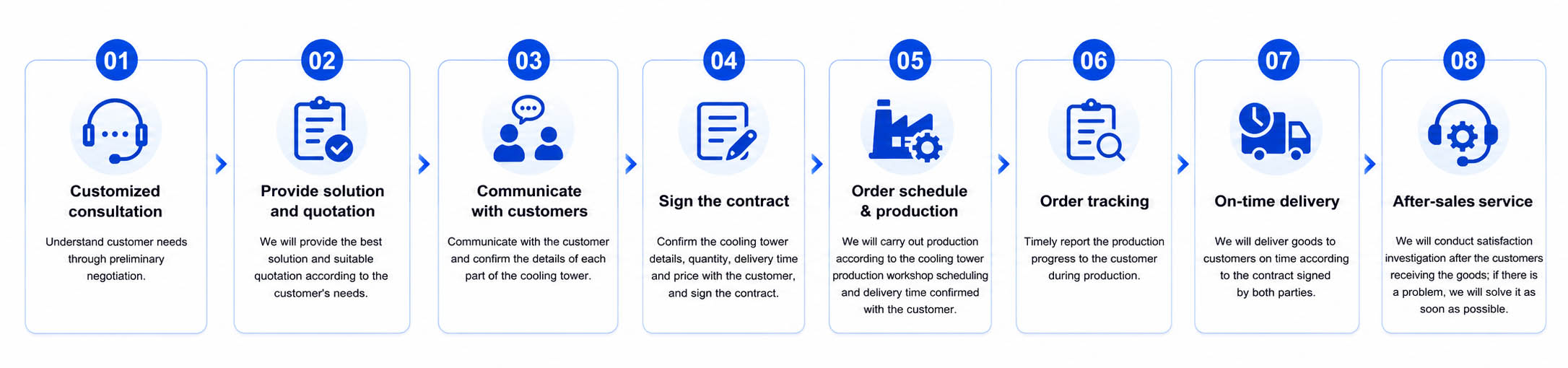
Designed around chiller capacity, condenser heat rejection, cooling tower arrangement, pump configuration and storage strategy.
Configured for chilled water temperature, delta T management, energy transfer stations, metering and customer connection logic.
Adjusted for N+1 redundancy, phased expansion, low-noise operation, plume control, water quality and urban site limits.
Send your plant capacity, chiller information, condenser heat rejection, chilled water and condenser water temperatures,
design wet bulb and dry bulb conditions, water quality, site layout, noise limit, plume concern, redundancy target and expansion plan.
Our engineering team will review whether open cooling towers, closed circuit towers, dry coolers, adiabatic coolers or hybrid systems are more suitable.
These FAQs are written for district cooling developers, HVAC consultants, central plant operators, EPC contractors,
campus facility teams and industrial buyers who need to understand central chiller plants, cooling towers,
condenser water systems, chilled water networks, thermal storage, energy transfer stations, water quality,
redundancy, maintenance and quotation data.
A district cooling solution is a centralized cooling system that produces chilled water at a central plant and distributes it through insulated underground or campus piping to multiple buildings. Instead of each building operating its own chiller plant, the district system can use central chillers, cooling towers, condenser water systems, pumps, thermal energy storage, controls and energy transfer stations to serve offices, hotels, malls, hospitals, campuses, airports or urban developments.
In a typical water-cooled district cooling system, central chillers produce chilled water. The chilled water is distributed to buildings through a supply and return network. Each building uses an energy transfer station or heat exchanger to transfer cooling to its internal HVAC system. Heat rejected from the chillers is transferred to condenser water and removed by cooling towers, closed circuit towers, dry coolers, seawater systems or hybrid heat rejection equipment depending on the project design.
Cooling towers reject heat from the central chiller plant’s condenser water loop. Because district cooling plants often have large and continuous cooling loads, the cooling tower system must be sized for peak heat rejection, part-load efficiency, water quality, drift control, plume control, noise, redundancy, service access and integration with chiller sequencing and condenser water pumps.
The most common choice for water-cooled district cooling plants is an open mechanical draft cooling tower because it can provide efficient condenser water heat rejection at large scale. However, closed circuit cooling towers, dry coolers, adiabatic coolers or hybrid systems may be considered when the project requires cleaner loops, water saving, reduced plume, special water sources, high-rise constraints, limited site area or specific maintenance strategy.
A building chiller plant normally serves one building, while a district cooling plant serves multiple buildings through a chilled water distribution network. District cooling often has larger capacity, centralized operation, load diversity, phased expansion, energy transfer stations, thermal energy storage options, higher reliability requirements and more complex hydraulic control compared with a single-building cooling system.
District cooling can improve efficiency because central plants can use larger high-efficiency chillers, optimized cooling towers, load diversity among buildings, thermal energy storage, professional operation, variable speed pumps, chiller sequencing and better maintenance. Efficiency depends on correct design, low distribution losses, optimized chilled water delta T, condenser water control and long-term operation strategy.
Important data includes total cooling capacity, chiller type, condenser heat rejection, chilled water supply and return temperature, condenser water temperature, design wet bulb and dry bulb temperature, load profile, redundancy requirement, water source, water quality, make-up water availability, site area, tower location, noise limit, plume concern, drift requirement, operating schedule and phased expansion plan.
Water quality affects scaling, corrosion, biological growth, drift, blowdown, fill life, nozzle performance, condenser tube cleanliness and maintenance frequency. District cooling plants should manage hardness, conductivity, pH, chloride, suspended solids, microbiological control, filtration, chemical dosing, basin cleaning and blowdown strategy.
Maintenance includes cooling tower basin cleaning, fill inspection, nozzle cleaning, drift eliminator inspection, fan and motor maintenance, VFD checks, condenser tube cleaning, pump maintenance, valve testing, water treatment monitoring, sensor calibration, control sequence verification, thermal storage inspection and review of customer energy transfer stations.
To request a quotation, send the total cooling capacity, number and type of chillers, condenser heat rejection, chilled water supply and return temperatures, condenser water temperatures, design wet bulb and dry bulb temperature, project location, building types served, load profile, water quality, water availability, redundancy target, site layout, noise limit, plume concern, power supply, material preference and phased expansion plan.
Send us your total cooling capacity, number and type of chillers, condenser heat rejection,
chilled water supply and return temperatures, condenser water temperatures, design wet bulb and dry bulb temperature,
project location, building types served, load profile, water quality, water availability, redundancy target,
site layout, noise limit, plume concern, power supply, material preference and phased expansion plan.
We will help you evaluate the right district cooling solution.