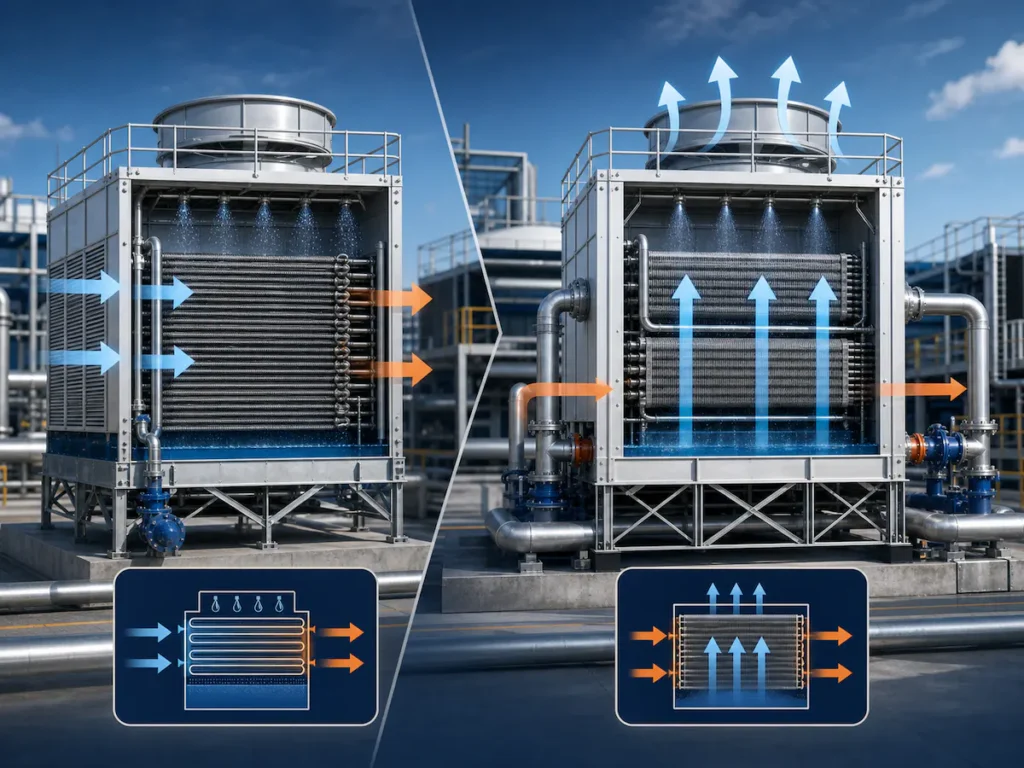
Crossflow vs Counterflow Closed Circuit Cooling Tower
Crossflow and counterflow closed circuit cooling towers are two common designs used for closed-loop heat rejection. Both systems cool process fluid through a heat exchange coil while keeping the process fluid isolated from outside air and spray water. However, their airflow direction, coil arrangement, maintenance access, footprint, operating characteristics, and application suitability are different.
For industrial buyers, HVAC contractors, data center engineers, plant managers, and project contractors, understanding the difference between crossflow and counterflow closed circuit cooling towers is important before selecting a cooling system.
A suitable tower should not be selected only by cooling capacity. It should also match the project’s heat load, water flow rate, inlet and outlet fluid temperature, wet-bulb temperature, fluid type, water quality, footprint, noise limit, installation space, maintenance access, and corrosion resistance requirements.
What Is a Closed Circuit Cooling Tower?
A closed circuit cooling tower is a heat rejection device that cools process fluid inside a closed-loop coil. Unlike an open cooling tower, the process fluid does not directly contact ambient air or spray water.
In a closed circuit cooling tower:
- Hot process fluid enters the heat exchange coil.
- Spray water is distributed over the outside surface of the coil.
- Air flows through the tower and removes heat from the spray water and coil surface.
- A small portion of spray water evaporates and carries heat away.
- The cooled process fluid leaves the coil and returns to the system.
- The spray water is collected in the basin and recirculated by the spray pump.
Because the process fluid remains inside the coil, closed circuit cooling towers are often selected for applications where fluid cleanliness, contamination control, system reliability, and closed-loop operation are important.
Typical applications include:
- HVAC and chiller systems
- Data centers
- Injection molding
- Plastic processing
- Chemical plants
- Compressor cooling
- Food and beverage plants
- Pharmaceutical plants
- Steel and metallurgy
- Industrial process cooling
What Is a Crossflow Closed Circuit Cooling Tower?
A crossflow closed circuit cooling tower is a closed-loop cooling tower in which air flows horizontally across the heat exchange area while spray water flows downward over the coil.
In this design, air usually enters from the side of the tower through air inlet louvers. Spray water flows from the top downward over the coil surface. The air crosses the downward spray water and coil area, removing heat from the system.
The process fluid remains inside the coil and does not contact the outside air.
Basic Working Process
- Hot process fluid enters the coil.
- Spray water flows downward over the outside of the coil.
- Air enters horizontally from the side.
- Air and spray water interact around the coil surface.
- Heat transfers from process fluid to the coil wall, spray water, and air.
- Cooled process fluid exits the coil.
- Spray water returns to the basin and recirculates.
Typical Features of Crossflow Closed Circuit Cooling Towers
Crossflow closed circuit cooling towers are often valued for:
- Convenient internal access
- Easier inspection and maintenance
- Stable air intake from the side
- Good serviceability
- Suitable layout for larger access doors
- Practical design for applications requiring regular cleaning
- Flexible configuration for many industrial projects
Crossflow designs may require a larger footprint than compact counterflow designs, depending on capacity and layout. However, their service access and internal visibility can be attractive for industrial users who focus on long-term maintenance.
What Is a Counterflow Closed Circuit Cooling Tower?
A counterflow closed circuit cooling tower is a closed-loop cooling tower in which air flows upward against the downward flow of spray water. The air and water move in opposite directions through the heat exchange section.
In this design, air typically enters from the lower air inlet area and moves upward through the coil section. Spray water flows downward over the coil. The upward airflow meets the downward spray water, creating counter-current heat exchange.
The process fluid remains isolated inside the coil.
Basic Working Process
- Hot process fluid enters the coil.
- Spray water is sprayed downward over the coil surface.
- Air enters from the lower section of the tower.
- Air moves upward against the downward spray water.
- Heat is transferred from the process fluid to the coil, spray water, and air.
- Warm humid air is discharged by the fan.
- Cooled process fluid exits the coil.
- Spray water returns to the basin and recirculates.
Typical Features of Counterflow Closed Circuit Cooling Towers
Counterflow closed circuit cooling towers are often selected for:
- Compact footprint
- Efficient vertical heat exchange path
- Strong thermal performance in limited space
- Suitable layout for modular equipment
- Reduced plan area compared with some crossflow layouts
- Applications where footprint is a major constraint
Counterflow designs may require more attention to spray distribution, internal inspection access, and maintenance arrangement because the coil, spray system, and airflow path are often more vertically compact.
Quick Comparison Table
| Factor | Crossflow Closed Circuit Cooling Tower | Counterflow Closed Circuit Cooling Tower |
| Airflow direction | Air flows horizontally across the coil and spray water | Air flows upward against downward spray water |
| Spray water direction | Downward over the coil | Downward over the coil |
| Process fluid | Inside closed coil | Inside closed coil |
| Heat transfer principle | Coil heat transfer + evaporative cooling | Coil heat transfer + evaporative cooling |
| Footprint | Often larger, depending on design | Often more compact |
| Height | May be lower or wider depending on layout | May be taller or more vertical |
| Maintenance access | Often easier side access | Access depends on tower design and service doors |
| Coil inspection | Usually more convenient in accessible layouts | May require more planned access space |
| Spray system | Usually easier to observe and maintain in some designs | Spray distribution is critical for performance |
| Air distribution | Side air intake | Lower air intake and vertical airflow |
| Suitable applications | Projects requiring easier maintenance and service access | Projects requiring compact footprint and strong thermal performance |
| Typical buyer concern | Space width and footprint | Maintenance access and internal inspection |
| Selection priority | Serviceability, access, maintenance convenience | Compact layout, performance density, space saving |
Main Difference: Airflow Direction
The main difference between crossflow and counterflow closed circuit cooling towers is airflow direction.
Crossflow Design
In a crossflow design:
- Spray water flows downward.
- Air flows horizontally from the side.
- Air crosses the falling spray water and coil area.
- The airflow and water flow meet at approximately a right angle.
This design can make maintenance access easier because the air inlet side and internal components may be more accessible.
Counterflow Design
In a counterflow design:
- Spray water flows downward.
- Air flows upward from the lower section.
- Air moves opposite to the falling spray water.
- The airflow and water flow are in opposite directions.
This design supports compact vertical heat exchange and is often used where footprint is limited.
Coil Arrangement and Heat Transfer
Both crossflow and counterflow closed circuit cooling towers use a heat exchange coil to isolate the process fluid. The coil is the key component that separates the process side from the spray water and ambient air.
In Crossflow Closed Circuit Towers
The coil is arranged so that side airflow can pass across the coil section. Spray water flows downward over the coil surface. The heat transfer process includes:
- Heat transfer from process fluid to coil wall
- Heat transfer from coil wall to spray water
- Evaporative cooling between spray water and air
- Sensible heat transfer between coil, water, and air
Crossflow layouts can be designed with convenient access for coil inspection, cleaning, and service.
In Counterflow Closed Circuit Towers
The coil is arranged in a vertical airflow path. Air moves upward through the coil section while spray water flows downward. The opposite flow direction helps create strong interaction between air and spray water.
Counterflow designs often use a compact tower body and vertical heat exchange arrangement, which can be useful when installation space is limited.
Maintenance and Service Access
Maintenance access is one of the most important differences between crossflow and counterflow closed circuit cooling towers.
Crossflow Maintenance Characteristics
Crossflow closed circuit cooling towers often provide easier side access to internal areas. This can help maintenance teams inspect:
- Coil surface
- Spray water distribution
- Basin condition
- Louvers
- Drift eliminators
- Access doors
- Fan system
- Spray pump and piping
For industrial facilities with regular maintenance schedules, this serviceability can be an important advantage.
Counterflow Maintenance Characteristics
Counterflow closed circuit cooling towers can be more compact, but the internal arrangement may require more careful maintenance planning. Access doors, inspection ports, and service platforms should be designed properly.
Maintenance teams should check:
- Spray nozzles
- Coil surface
- Air inlet area
- Basin
- Fan and motor
- Drift eliminators
- Internal scaling or fouling
- Water distribution uniformity
A well-designed counterflow tower can still provide good maintenance access, but service layout should be reviewed during project selection.
Footprint and Installation Space
Footprint is a common reason buyers compare crossflow and counterflow closed circuit cooling towers.
Crossflow Footprint
Crossflow towers may require more horizontal installation space because of side air inlet arrangement and internal layout. However, the wider structure can allow better access for inspection and maintenance.
Crossflow may be suitable when:
- The site has enough plan area
- Maintenance access is a priority
- Side air intake space is available
- The owner wants convenient internal inspection
- The tower can be installed with proper airflow clearance
Counterflow Footprint
Counterflow towers often use a more compact vertical arrangement. This can reduce required floor area and make them suitable for space-limited projects.
Counterflow may be suitable when:
- Footprint is limited
- The tower must fit into a compact equipment area
- Vertical space is acceptable
- The project needs a high-capacity tower in a smaller plan area
- Modular installation is preferred
When reviewing installation space, buyers should not only compare tower footprint. They should also consider airflow clearance, service access, piping layout, crane access, pump location, and future maintenance space.
Thermal Performance and Efficiency
Both crossflow and counterflow closed circuit cooling towers can provide reliable cooling performance when properly designed. The final performance depends on more than flow arrangement.
Important performance factors include:
- Heat load
- Fluid flow rate
- Fluid inlet temperature
- Fluid outlet temperature
- Wet-bulb temperature
- Approach
- Coil surface area
- Spray water flow rate
- Airflow rate
- Fan performance
- Water distribution
- Scaling and fouling condition
- Material and coil design
- Site altitude
- Air recirculation control
Crossflow Performance
Crossflow designs can provide stable performance and good serviceability. They may be attractive when maintenance access and water distribution inspection are important.
Counterflow Performance
Counterflow designs are often selected when compactness and performance density are important. The vertical counter-current interaction between air and water can support efficient heat exchange in a smaller footprint.
The best choice should be based on actual project conditions instead of assuming that one type is always better.
Water Distribution and Scaling Risk
Water distribution affects cooling performance and long-term maintenance. Poor spray distribution may cause dry areas, uneven heat transfer, scaling, and reduced tower efficiency.
Crossflow Design Considerations
In crossflow closed circuit cooling towers, the water distribution system should provide even spray coverage over the coil. Because of the side airflow arrangement, inspection access may help operators check spray coverage more easily in some designs.
Counterflow Design Considerations
In counterflow closed circuit cooling towers, spray nozzles must distribute water evenly over the coil section. Because air moves upward against the spray water, nozzle performance and spray pattern are important for maintaining heat transfer efficiency.
For both designs, water quality management is essential. Scaling, corrosion, biological growth, and suspended solids can reduce heat transfer and shorten equipment life.
Noise Considerations
Noise level depends on fan type, fan speed, motor power, airflow path, casing design, water splash, and installation location.
Crossflow and counterflow closed circuit cooling towers can both be designed for low-noise operation. However, the best solution depends on project requirements.
For noise-sensitive projects, consider:
- Low-speed fan design
- Low-noise axial fan
- Sound attenuation options
- Proper tower location
- Vibration control
- Air inlet and discharge direction
- Distance from buildings or property lines
- Night operation limits
Projects such as hotels, hospitals, commercial buildings, urban HVAC systems, and data centers should review noise limits before selecting tower type.
Material Selection
Material selection is important for both crossflow and counterflow closed circuit cooling towers because the equipment operates in a wet, humid, and sometimes corrosive environment.
Common material options include:
- FRP casing
- Galvanized steel frame
- Stainless steel frame
- Stainless steel basin
- Galvanized steel coil
- Stainless steel coil
- PVC drift eliminator
- PVC or PP louvers
- Stainless steel fasteners
- Anti-corrosion coating
Crossflow Material Considerations
Crossflow towers may use FRP casing, metal structure, stainless steel basin options, and corrosion-resistant internal components. If maintenance access is frequent, durable access doors and service platforms should also be considered.
Counterflow Material Considerations
Counterflow towers may use compact metal or FRP structures, stainless steel water-contact components, corrosion-resistant spray systems, and coil material selected according to fluid type and water quality.
For coastal, chemical, high-chloride, or high-humidity environments, stainless steel 304, stainless steel 316, FRP, or upgraded anti-corrosion designs may be recommended.
Application Comparison
Different applications may favor different tower designs depending on cooling duty, water quality, installation layout, and maintenance strategy.
| Application | Crossflow Closed Circuit Tower | Counterflow Closed Circuit Tower |
| HVAC systems | Suitable when maintenance access and service space are important | Suitable when compact footprint is needed |
| Data centers | Suitable for maintainability and inspection planning | Suitable for compact equipment layout and performance density |
| Injection molding | Suitable for clean closed-loop process water and accessible maintenance | Suitable for compact installation near process utilities |
| Chemical plants | Suitable when inspection and anti-corrosion design are priorities | Suitable when space is limited and material upgrade is applied |
| Compressor cooling | Suitable for stable closed-loop operation | Suitable for compact closed-loop cooling |
| Food and beverage | Suitable for easy inspection and clean system requirements | Suitable when space is limited and stainless options are selected |
| Pharmaceutical plants | Suitable for clean process cooling and maintenance access | Suitable for compact closed-loop cooling systems |
| Steel and metallurgy | Suitable when heavy-duty maintenance access is required | Suitable when compact layout is required |
| Plastic processing | Suitable for stable process fluid cooling | Suitable for modular equipment rooms or limited space |
| Industrial refrigeration support | May be used for auxiliary closed-loop cooling | May be used where compact equipment is preferred |
Which One Should You Choose?
There is no universal answer. The right choice depends on project priorities.
Choose a Crossflow Closed Circuit Cooling Tower When:
- Maintenance access is a major priority
- The site has enough horizontal installation space
- Operators need easier coil and internal inspection
- The project requires frequent cleaning or service
- Side air intake arrangement fits the site layout
- The buyer values serviceability and long-term maintenance convenience
- The system serves industrial process cooling with regular inspection needs
Choose a Counterflow Closed Circuit Cooling Tower When:
- Footprint is limited
- A compact tower layout is required
- The project needs high heat rejection in a smaller plan area
- Vertical installation space is acceptable
- The owner wants a compact closed-loop cooling solution
- The site layout favors bottom air intake and top discharge
- Modular equipment arrangement is preferred
Choose Based on Engineering Conditions, Not Only Tower Type
A cooling tower should be selected based on actual design conditions:
- Heat load
- Fluid flow rate
- Fluid inlet temperature
- Fluid outlet temperature
- Local wet-bulb temperature
- Approach
- Fluid type
- Water quality
- Installation space
- Noise limit
- Site altitude
- Maintenance access
- Corrosion risk
- Material requirements
Crossflow vs Counterflow Closed Circuit Cooling Tower: Decision Matrix
| Buyer Requirement | Better Fit | Reason |
| Easier internal access | Crossflow | Side access and wider layout may simplify inspection |
| Compact footprint | Counterflow | Vertical airflow arrangement can reduce plan area |
| Clean process fluid | Both | Both use closed-loop coil design |
| Frequent maintenance | Crossflow | Often easier to inspect and clean |
| Limited equipment room space | Counterflow | More compact body may fit tight areas |
| High corrosion environment | Depends on material | FRP, SS304, SS316, or coating should be selected |
| Low noise requirement | Depends on design | Fan selection and layout are more important than flow type alone |
| High thermal duty | Both | Final performance depends on coil, airflow, water flow, and wet-bulb |
| Easy spray system inspection | Crossflow | Access may be more convenient in many designs |
| Modular installation | Counterflow | Compact units can be practical for modular layouts |
Common Mistakes When Comparing Crossflow and Counterflow Designs
Mistake 1: Comparing Only Cooling Capacity
Two towers with the same nominal capacity may perform differently under real project conditions. Always check wet-bulb temperature, approach, coil design, airflow rate, spray water flow, and installation environment.
Mistake 2: Ignoring Maintenance Access
A compact tower may save space, but maintenance access must still be practical. Access doors, coil cleaning space, spray nozzle inspection, and basin cleaning should be reviewed before purchase.
Mistake 3: Assuming One Type Is Always More Efficient
Crossflow and counterflow designs can both be efficient when properly engineered. The best option depends on project conditions, not only airflow direction.
Mistake 4: Ignoring Water Quality
Poor water quality can cause scaling, corrosion, and reduced heat transfer in both designs. Water treatment and material selection are critical.
Mistake 5: Not Reviewing Airflow Clearance
Cooling towers need enough air inlet and discharge clearance. Poor layout may cause hot air recirculation and reduce cooling performance.
Mistake 6: Treating Closed Circuit Towers Like Open Cooling Towers
Closed circuit towers include coils, spray water systems, and closed-loop process fluid. Selection should consider coil material, fluid type, pressure, and water quality, not only open tower logic.
Required Information for THERMOCORE Selection
To recommend the right crossflow or counterflow closed circuit cooling tower, THERMOCORE usually needs the following information:
| Required Information | Why It Matters |
| Heat load or cooling capacity | Defines required thermal duty |
| Fluid flow rate | Affects coil design and pressure drop |
| Fluid inlet temperature | Defines entering process condition |
| Fluid outlet temperature | Defines target cooling result |
| Wet-bulb temperature | Critical for evaporative cooling performance |
| Fluid type | Water, glycol, or special process fluid |
| Fluid concentration | Important for glycol systems |
| Operating pressure | Affects coil design |
| Water quality | Affects spray system, scaling, and corrosion |
| Installation location | Affects airflow and material selection |
| Footprint limit | Helps compare crossflow and counterflow layouts |
| Noise limit | Affects fan and motor selection |
| Site altitude | Affects air density and performance |
| Material requirement | FRP, galvanized steel, SS304, SS316, or coating |
| Maintenance preference | Helps decide service access requirements |
| Application industry | Helps select suitable design and safety margin |
THERMOCORE Crossflow and Counterflow Closed Circuit Cooling Solutions
THERMOCORE provides closed circuit cooling tower solutions for HVAC, industrial process cooling, refrigeration support, compressor cooling, injection molding, chemical plants, data centers, food and beverage plants, pharmaceutical facilities, steel and metallurgy, and other industrial applications.
Our closed circuit cooling tower solutions can be customized according to:
- Cooling capacity
- Heat exchange coil design
- Crossflow or counterflow structure
- Fluid type and pressure
- Spray water system
- Fan and motor configuration
- Basin design
- Casing material
- Coil material
- Anti-corrosion requirements
- Low-noise requirements
- Footprint restrictions
- Maintenance access design
- Modular installation needs
Whether your project requires easier maintenance access, compact footprint, clean closed-loop cooling, or corrosion-resistant construction, THERMOCORE can help compare crossflow and counterflow closed circuit cooling tower options based on actual working conditions.
Frequently Asked Questions
What is the main difference between crossflow and counterflow closed circuit cooling towers?
The main difference is airflow direction. In a crossflow closed circuit cooling tower, air flows horizontally across the coil and spray water. In a counterflow closed circuit cooling tower, air flows upward against the downward spray water.
Do both crossflow and counterflow closed circuit towers keep process fluid clean?
Yes. Both designs use a heat exchange coil to isolate process fluid from outside air and spray water. The process fluid remains inside the closed loop.
Which is better, crossflow or counterflow closed circuit cooling tower?
Neither design is always better. Crossflow is often preferred when maintenance access and inspection convenience are important. Counterflow is often preferred when compact footprint and vertical heat exchange layout are important.
Which type has a smaller footprint?
Counterflow closed circuit cooling towers often have a more compact footprint because of the vertical airflow arrangement. However, final dimensions depend on heat load, coil design, fan arrangement, and project requirements.
Which type is easier to maintain?
Crossflow closed circuit cooling towers often provide more convenient side access and easier inspection in many designs. Counterflow towers can also be maintained effectively if access doors, service platforms, and inspection points are properly designed.
Which type is better for data centers?
Both can be used for data center cooling. Crossflow may be attractive for maintenance access, while counterflow may be useful for compact equipment layouts. The final choice depends on redundancy, water strategy, noise limits, heat load, and site layout.
Which type is better for chemical plants?
Chemical plants should prioritize corrosion resistance, material selection, closed-loop protection, and maintenance access. Both crossflow and counterflow designs can be suitable if the material and coil design match the chemical environment.
Does airflow direction affect cooling performance?
Yes, airflow direction affects tower layout, heat exchange path, and internal design. However, final performance also depends on wet-bulb temperature, coil surface area, spray water flow, airflow rate, fan performance, and water distribution.
Can THERMOCORE customize crossflow and counterflow closed circuit cooling towers?
Yes. THERMOCORE can customize closed circuit cooling towers according to cooling capacity, fluid type, coil material, casing material, fan configuration, noise requirements, footprint limits, corrosion resistance, and maintenance access requirements.
Request a Closed Circuit Cooling Tower Selection Proposal
Choosing between crossflow and counterflow closed circuit cooling towers should be based on actual engineering conditions. A reliable selection should consider heat load, water or fluid flow rate, inlet and outlet temperature, wet-bulb temperature, coil design, water quality, footprint, noise level, material, and maintenance access.
To receive a suitable THERMOCORE recommendation, please provide:
- Heat load or cooling capacity
- Fluid flow rate
- Fluid inlet and outlet temperature
- Local wet-bulb temperature
- Fluid type and concentration
- Operating pressure
- Water quality
- Application industry
- Installation location
- Available footprint and height limit
- Noise requirement
- Material preference
- Corrosion resistance requirement
- Maintenance access requirement
THERMOCORE can help you compare crossflow and counterflow closed circuit cooling towers and recommend a practical cooling solution for your project.
Request a Closed Circuit Cooling Tower Proposal