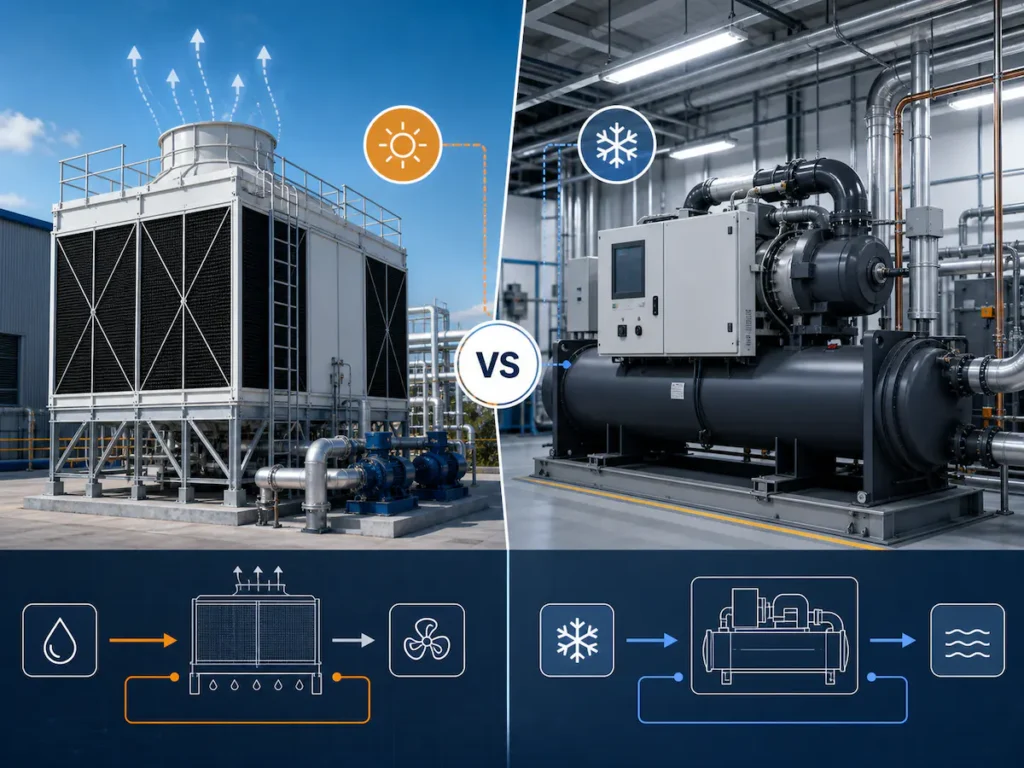
Cooling Tower vs Chiller: What Is the Difference?
Cooling towers and chillers are both important parts of HVAC and industrial cooling systems, but they are not the same equipment. They perform different functions in the cooling process.
The basic difference is simple:
A chiller removes heat from chilled water or process fluid through a refrigeration cycle. A cooling tower rejects heat from condenser water or process water to the atmosphere.
In many water-cooled HVAC systems, the chiller and cooling tower work together. The chiller produces chilled water for the building or process. The cooling tower removes the heat collected by the chiller and releases it outdoors.
For engineering buyers, HVAC contractors, industrial plant managers, and project developers, understanding the difference between a cooling tower and a chiller helps avoid wrong equipment selection, poor system design, higher energy cost, and unstable cooling performance.
Quick Comparison Table
| Factor | Cooling Tower | Chiller |
| Main function | Rejects heat to the atmosphere | Produces chilled water or cools process fluid |
| Cooling principle | Evaporative cooling or air-side heat rejection | Refrigeration cycle |
| Main system role | Heat rejection equipment | Cooling generation equipment |
| Typical location | Outdoor roof, ground, equipment yard, plant utility area | Mechanical room, plant room, outdoor packaged unit |
| Main working medium | Water, spray water, air, process fluid depending on type | Refrigerant, chilled water, process fluid |
| Common system loop | Condenser water loop or process cooling loop | Chilled water loop and refrigerant loop |
| Uses compressor? | No | Yes, in mechanical chillers |
| Uses refrigerant? | Usually no, except evaporative condenser is different equipment | Yes |
| Water consumption | Wet cooling towers consume water through evaporation | Depends on chiller type; water-cooled chillers require condenser water system |
| Best for | Rejecting heat from chillers, condensers, or process systems | Producing low-temperature chilled water or process cooling |
| Typical application | HVAC condenser water, industrial process cooling, refrigeration utilities | HVAC chilled water, process cooling, low-temperature cooling |
What Is a Cooling Tower?
A cooling tower is a heat rejection device used to remove heat from water or process fluid and release that heat into the atmosphere.
In a typical wet cooling tower, hot water enters the tower and is distributed over fill, coil, or heat exchange surfaces. Air passes through the tower. A small portion of water evaporates, and this evaporation removes heat from the remaining water. The cooled water returns to the system.
Cooling towers are commonly used in:
- HVAC chiller systems
- Industrial process cooling
- Data centers
- Chemical plants
- Power plants
- Steel and metallurgy
- Food and beverage plants
- Injection molding
- Plastic processing
- Compressor cooling
- Industrial refrigeration utilities
A cooling tower does not normally create chilled water by itself. It rejects heat from a system that has already absorbed heat.
What Is a Chiller?
A chiller is a cooling machine that removes heat from chilled water, glycol solution, or process fluid through a refrigeration cycle.
In an HVAC system, the chiller produces chilled water that is sent to air handling units, fan coil units, or process equipment. The chilled water absorbs heat from the building or process and returns to the chiller at a higher temperature.
A mechanical chiller usually includes:
- Compressor
- Evaporator
- Condenser
- Expansion device
- Refrigerant circuit
- Control system
The chiller does not simply “make cold.” It removes heat from one side of the system and transfers that heat to another side. That heat must then be rejected through air, water, or another heat rejection method.
Main Difference Between a Cooling Tower and a Chiller
The most important difference is their system function.
A chiller removes heat from chilled water or process fluid. A cooling tower removes heat from condenser water or another heat rejection loop and releases it to the outdoor air.
Chiller Function
The chiller is responsible for producing cold water or process cooling. It uses refrigerant to absorb heat from chilled water in the evaporator. The refrigerant then carries this heat to the condenser side.
Cooling Tower Function
The cooling tower is responsible for rejecting heat from the condenser water loop to the atmosphere. It cools the water that has absorbed heat from the chiller condenser.
Simple Explanation
In a water-cooled chiller system:
- The chiller cools the chilled water.
- The chilled water cools the building or process.
- The condenser water absorbs heat from the chiller.
- The cooling tower cools the condenser water.
- The heat is finally rejected to the atmosphere.
The chiller is the cooling source. The cooling tower is the heat rejection device.
How Cooling Towers and Chillers Work Together
In many large HVAC systems, especially water-cooled chiller plants, the cooling tower and chiller work as one system.
The complete process usually includes three loops:
- Chilled water loop
- Refrigerant loop
- Condenser water loop
1. Chilled Water Loop
The chiller produces chilled water. This chilled water is pumped to air handling units, fan coil units, process equipment, or heat exchangers.
The chilled water absorbs heat from the building or process and returns to the chiller at a higher temperature.
Example:
- Chilled water supply: 7°C
- Chilled water return: 12°C
2. Refrigerant Loop
Inside the chiller, refrigerant absorbs heat from the chilled water in the evaporator. The compressor raises the refrigerant pressure and temperature. The refrigerant then releases heat in the condenser.
This is the refrigeration cycle.
3. Condenser Water Loop
In a water-cooled chiller, condenser water absorbs heat from the chiller condenser. This warm condenser water is pumped to the cooling tower.
The cooling tower removes heat from the condenser water and sends the cooled condenser water back to the chiller.
Example:
- Condenser water supply to chiller: 30°C
- Condenser water return from chiller: 35°C
The cooling tower keeps the condenser water temperature low enough for stable chiller operation.
Cooling Tower vs Chiller in a Water-Cooled Chiller System
A water-cooled chiller usually needs a cooling tower or another heat rejection system. This is because the chiller transfers heat from the chilled water side to the condenser side. That heat cannot disappear. It must be rejected.
In this system, the cooling tower supports the chiller by lowering the condenser water temperature.
If the cooling tower does not perform well, the chiller may experience:
- Higher condenser pressure
- Higher compressor power
- Reduced cooling capacity
- Poor chilled water temperature control
- Increased energy consumption
- Potential high-pressure alarms
- Shorter equipment service life
Therefore, the cooling tower is critical to the performance of a water-cooled chiller plant.
Cooling Tower vs Chiller in an Air-Cooled Chiller System
An air-cooled chiller usually does not need a cooling tower.
In an air-cooled chiller, the condenser rejects heat directly to outdoor air through a finned coil and fans. The refrigeration cycle still exists, but the condenser side is air-cooled instead of water-cooled.
Air-Cooled Chiller
An air-cooled chiller includes:
- Compressor
- Evaporator
- Air-cooled condenser coil
- Fans
- Expansion device
- Refrigerant circuit
It rejects heat directly to the air.
Water-Cooled Chiller with Cooling Tower
A water-cooled chiller includes:
- Compressor
- Evaporator
- Water-cooled condenser
- Condenser water system
- Cooling tower
- Condenser water pump
- Water treatment system
It rejects heat through condenser water and a cooling tower.
Cooling Tower vs Chiller: Working Principle Difference
The working principles are completely different.
Cooling Tower Working Principle
A cooling tower uses air and water heat transfer. In wet cooling towers, part of the circulating water evaporates, and this evaporation removes heat from the remaining water.
Main working process:
- Hot water enters the tower.
- Water is distributed over fill or coil.
- Air passes through the tower.
- Heat transfers from water to air.
- Some water evaporates.
- Cooled water returns to the system.
The cooling tower’s performance is mainly affected by wet-bulb temperature, airflow, water flow, fill or coil condition, and water distribution.
Chiller Working Principle
A chiller uses a refrigeration cycle. Refrigerant absorbs heat from chilled water in the evaporator, is compressed to a higher pressure, releases heat in the condenser, and then expands before repeating the cycle.
Main working process:
- Refrigerant absorbs heat in the evaporator.
- Compressor raises refrigerant pressure and temperature.
- Refrigerant rejects heat in the condenser.
- Expansion valve reduces refrigerant pressure.
- Refrigerant returns to the evaporator.
The chiller’s performance is affected by compressor efficiency, refrigerant type, evaporator condition, condenser condition, chilled water flow, condenser water temperature, and control strategy.
Cooling Tower vs Chiller: Temperature Difference
Cooling towers and chillers usually work at different temperature levels.
Cooling Tower Temperature
A cooling tower usually cools condenser water or process water. It cannot normally produce low-temperature chilled water like a chiller.
For example, a cooling tower may cool condenser water from 35°C to 30°C, depending on wet-bulb temperature and design conditions.
The achievable cold water temperature is limited by the local wet-bulb temperature.
Chiller Temperature
A chiller can produce lower chilled water temperatures because it uses a refrigeration cycle.
For HVAC systems, typical chilled water supply temperature may be around 6–7°C, depending on project design. Industrial process chillers may provide different temperatures according to process requirements.
The chiller can cool water below ambient conditions, but it requires compressor energy.
Cooling Tower vs Chiller: Energy Consumption
A chiller usually consumes more energy than a cooling tower because it uses a compressor. The compressor is the main energy-consuming component in a mechanical chiller.
A cooling tower mainly consumes energy through:
- Fan motors
- Pumps
- Spray pumps in closed circuit designs
- Control systems
In a water-cooled chiller plant, the total energy use includes:
- Chiller compressor power
- Chilled water pump power
- Condenser water pump power
- Cooling tower fan power
- Controls and auxiliary equipment
A well-designed cooling tower can help reduce chiller energy consumption by maintaining lower condenser water temperature. However, the system should be optimized as a whole. Lower condenser water temperature may reduce chiller compressor energy, but tower fan and pump energy must also be considered.
Cooling Tower vs Chiller: Water Use
Water use depends on the system type.
Cooling Tower Water Use
Wet cooling towers use water through:
- Evaporation
- Drift
- Blowdown
- Basin cleaning and maintenance losses
Because evaporation removes heat, makeup water is required. Water treatment is also needed to control scale, corrosion, biological growth, and fouling.
Chiller Water Use
An air-cooled chiller does not require a cooling tower and does not use condenser water evaporation.
A water-cooled chiller itself uses condenser water, but the evaporation and water treatment mainly occur in the cooling tower system.
Therefore, when comparing water use, the correct comparison is usually:
- Air-cooled chiller system: lower water use, often higher compressor energy
- Water-cooled chiller + cooling tower system: higher water use, often better energy efficiency for large applications
The best choice depends on climate, water availability, electricity cost, system size, and project requirements.
Cooling Tower vs Chiller: Maintenance Difference
Cooling towers and chillers require different maintenance work.
Cooling Tower Maintenance
Cooling tower maintenance usually includes:
- Basin cleaning
- Fill inspection and cleaning
- Spray nozzle inspection
- Drift eliminator cleaning
- Fan and motor inspection
- Water treatment
- Scale and corrosion control
- Biological control
- Air inlet and louver inspection
- Checking for hot air recirculation
- Maintaining proper water flow
Because cooling towers are exposed to outdoor air and water evaporation, water quality management is very important.
Chiller Maintenance
Chiller maintenance usually includes:
- Compressor inspection
- Refrigerant level and pressure check
- Evaporator inspection
- Condenser inspection
- Chilled water flow check
- Condenser water flow check for water-cooled chillers
- Control system check
- Electrical inspection
- Oil analysis in some systems
- Tube cleaning for water-cooled condensers
- Sensor calibration
Chiller maintenance is more focused on refrigeration components, controls, and heat exchangers.
Cooling Tower vs Chiller: Application Difference
Cooling towers and chillers are used in different parts of a cooling system.
Cooling Tower Applications
Cooling towers are commonly used for:
- Water-cooled chiller heat rejection
- HVAC condenser water systems
- Industrial process water cooling
- Power plant heat rejection
- Compressor cooling
- Chemical plant cooling
- Steel and metallurgy cooling
- Food and beverage utility cooling
- Injection molding process cooling
- Data center heat rejection systems
Cooling towers are selected when the system needs efficient heat rejection to the atmosphere.
Chiller Applications
Chillers are commonly used for:
- Commercial air conditioning
- Industrial process cooling
- Data center chilled water systems
- Pharmaceutical temperature control
- Food and beverage processing
- Plastic processing
- Chemical process cooling
- Laser and machine cooling
- Low-temperature process systems
- Hospitals, hotels, office buildings, and shopping centers
Chillers are selected when the system needs chilled water or controlled low-temperature fluid.
Can a Cooling Tower Replace a Chiller?
In most cases, a cooling tower cannot replace a chiller if the system needs low-temperature chilled water.
A cooling tower can only cool water close to the ambient wet-bulb temperature. It cannot normally produce chilled water at 7°C or lower in warm ambient conditions.
However, in some applications, a cooling tower, dry cooler, or free cooling system may reduce chiller operation when outdoor conditions are favorable.
For example:
- A cooling tower can provide condenser water cooling for a water-cooled chiller.
- A dry cooler can provide free cooling in cooler climates.
- A closed circuit cooling tower can cool process water if the required temperature is above wet-bulb limits.
- A chiller is still required when the process needs lower temperatures than ambient cooling can provide.
The correct question is not always “cooling tower or chiller?” In many projects, the real question is:
Does the system need mechanical refrigeration, or can heat be rejected directly through ambient cooling?
Can a Chiller Work Without a Cooling Tower?
Yes, some chillers can work without a cooling tower.
An air-cooled chiller rejects heat directly to ambient air and does not need a cooling tower.
A water-cooled chiller normally needs a cooling tower, dry cooler, geothermal loop, or another heat rejection system to remove condenser heat.
Air-Cooled Chiller Without Cooling Tower
Suitable when:
- Water is limited
- Simpler installation is preferred
- Smaller or medium cooling capacity is required
- Outdoor air-cooled equipment is acceptable
- Water treatment should be avoided
Water-Cooled Chiller With Cooling Tower
Suitable when:
- Higher efficiency is needed for large systems
- Water is available
- A chiller plant room is planned
- Long operating hours justify system efficiency
- Proper water treatment and maintenance can be managed
When Should You Use a Cooling Tower?
Use a cooling tower when the project requires heat rejection from condenser water, process water, or a closed-loop cooling system.
A cooling tower may be suitable when:
- A water-cooled chiller is used
- Efficient heat rejection is required
- Water is available
- Evaporative cooling is acceptable
- The cooling duty is large
- The project has outdoor installation space
- Water treatment can be managed
- Lower condenser water temperature is beneficial
- Long-term energy efficiency is important
For some industrial processes, a cooling tower may be used directly without a chiller if the required process water temperature can be achieved by evaporative cooling.
When Should You Use a Chiller?
Use a chiller when the system needs controlled chilled water or process fluid temperature that cannot be achieved by a cooling tower alone.
A chiller may be suitable when:
- Low-temperature chilled water is required
- Precise temperature control is important
- The cooling load is connected to air handling units
- Industrial process temperature must be controlled tightly
- Ambient cooling is not enough
- Cooling is required year-round regardless of outdoor conditions
- The process needs refrigeration-based cooling
A chiller is usually required when the desired fluid temperature is lower than what a cooling tower or dry cooler can provide under local ambient conditions.
Water-Cooled Chiller System: Why the Cooling Tower Matters
In a water-cooled chiller plant, the cooling tower is not an optional accessory. It is part of the heat rejection system.
If the cooling tower is undersized, poorly maintained, or installed with poor airflow, the chiller may run at higher condensing pressure. This can increase compressor energy and reduce cooling reliability.
Important cooling tower factors for chiller systems include:
- Heat rejection capacity
- Condenser water flow rate
- Entering and leaving condenser water temperature
- Local wet-bulb temperature
- Cooling tower approach
- Fan control
- Basin and water treatment
- Fill or coil cleanliness
- Air inlet and discharge clearance
- Hot air recirculation prevention
- Noise requirements
- Maintenance access
Cooling Tower and Chiller Selection Checklist
Before selecting cooling towers, chillers, or a complete cooling system, prepare the following information:
| Selection Factor | Why It Matters |
| Cooling load | Determines chiller capacity and heat rejection duty |
| Chilled water supply temperature | Defines required cooling level |
| Chilled water return temperature | Determines chilled water temperature rise |
| Condenser water temperature | Important for water-cooled chiller operation |
| Cooling tower heat rejection load | Determines tower capacity |
| Water flow rate | Affects pump selection and heat transfer |
| Wet-bulb temperature | Critical for cooling tower selection |
| Dry-bulb temperature | Important for air-cooled chillers and dry coolers |
| Water availability | Helps choose air-cooled or water-cooled system |
| Water quality | Affects cooling tower and condenser maintenance |
| Installation space | Determines equipment layout |
| Noise limit | Affects fan, chiller, and tower selection |
| Energy cost | Important for lifecycle cost comparison |
| Maintenance capability | Helps decide system complexity |
| Application industry | Determines reliability and temperature requirements |
Common Mistakes When Comparing Cooling Towers and Chillers
Mistake 1: Thinking They Do the Same Job
A cooling tower rejects heat. A chiller produces chilled water or process cooling. They are different parts of the system.
Mistake 2: Choosing a Chiller Without Planning Heat Rejection
A water-cooled chiller needs a condenser water and heat rejection system. The cooling tower, pumps, piping, and water treatment should be planned together.
Mistake 3: Expecting a Cooling Tower to Produce Chilled Water
A cooling tower cannot normally produce low-temperature chilled water in warm weather. If low chilled water temperature is required, a chiller is needed.
Mistake 4: Ignoring Cooling Tower Impact on Chiller Efficiency
Poor cooling tower performance can raise condenser water temperature and increase chiller energy consumption.
Mistake 5: Comparing Only Initial Equipment Cost
A complete comparison should include equipment cost, energy cost, water cost, maintenance cost, installation space, downtime risk, and service life.
How THERMOCORE Supports Cooling Tower and Chiller System Projects
THERMOCORE focuses on cooling equipment for heat rejection and industrial cooling systems. Our product range supports HVAC and industrial projects where cooling towers, closed-loop cooling, evaporative condensing, or dry cooling are required.
THERMOCORE product range includes:
- Open Cooling Towers
- Closed Circuit Cooling Towers
- Evaporative Condensers
- Dry Coolers and Air Coolers
- Cooling Tower Parts
For water-cooled chiller systems, THERMOCORE can provide cooling tower solutions according to:
- Chiller condenser heat rejection load
- Condenser water flow rate
- Entering and leaving condenser water temperature
- Local wet-bulb temperature
- Installation layout
- Noise requirement
- Water quality
- Material and anti-corrosion requirements
- Maintenance access
- Project documentation and export requirements
THERMOCORE can also help compare open cooling towers, closed circuit cooling towers, dry coolers, and adiabatic cooling options according to real working conditions.
FAQ: Cooling Tower vs Chiller
What is the main difference between a cooling tower and a chiller?
A chiller produces chilled water or cools process fluid through a refrigeration cycle. A cooling tower rejects heat from condenser water or process water to the atmosphere.
Does a chiller need a cooling tower?
A water-cooled chiller usually needs a cooling tower or another heat rejection system. An air-cooled chiller does not need a cooling tower because it rejects heat directly to air.
Can a cooling tower replace a chiller?
Usually no. A cooling tower cannot normally produce low-temperature chilled water. If the system requires chilled water below ambient cooling limits, a chiller is required.
Why is a cooling tower used with a chiller?
A cooling tower is used with a water-cooled chiller to remove heat from the condenser water. This allows the chiller to reject heat and continue producing chilled water.
Which is more energy efficient, a cooling tower or a chiller?
They perform different jobs. A chiller typically consumes more energy because it uses a compressor. A cooling tower consumes fan and pump energy. In a water-cooled system, both must be optimized together.
What is the difference between chilled water and condenser water?
Chilled water is cooled by the chiller and sent to the building or process. Condenser water absorbs heat from the chiller condenser and carries that heat to the cooling tower.
Is a cooling tower part of a chiller?
No. A cooling tower is separate equipment. However, it is often part of a water-cooled chiller plant.
What information is needed for cooling tower selection for a chiller?
Please provide chiller heat rejection load, condenser water flow rate, entering and leaving condenser water temperature, local wet-bulb temperature, installation location, water quality, noise limit, and material requirements.
Need Help Selecting a Cooling Tower for Your Chiller System?
A cooling tower and a chiller should be selected as part of the complete cooling system. The cooling tower must match the chiller’s condenser heat rejection load, water flow rate, design temperatures, site climate, and installation conditions.
To receive a suitable technical proposal from THERMOCORE, please share:
- Chiller cooling capacity
- Chiller heat rejection load if available
- Condenser water flow rate
- Entering and leaving condenser water temperature
- Local wet-bulb temperature
- Local dry-bulb temperature
- Water quality
- Installation location
- Footprint and height limits
- Noise requirements
- Preferred material or anti-corrosion requirement
- Application industry
THERMOCORE can help you select a practical cooling tower, closed circuit cooling tower, dry cooler, or heat rejection solution for your HVAC or industrial project.
Request a Technical Proposal from THERMOCORE