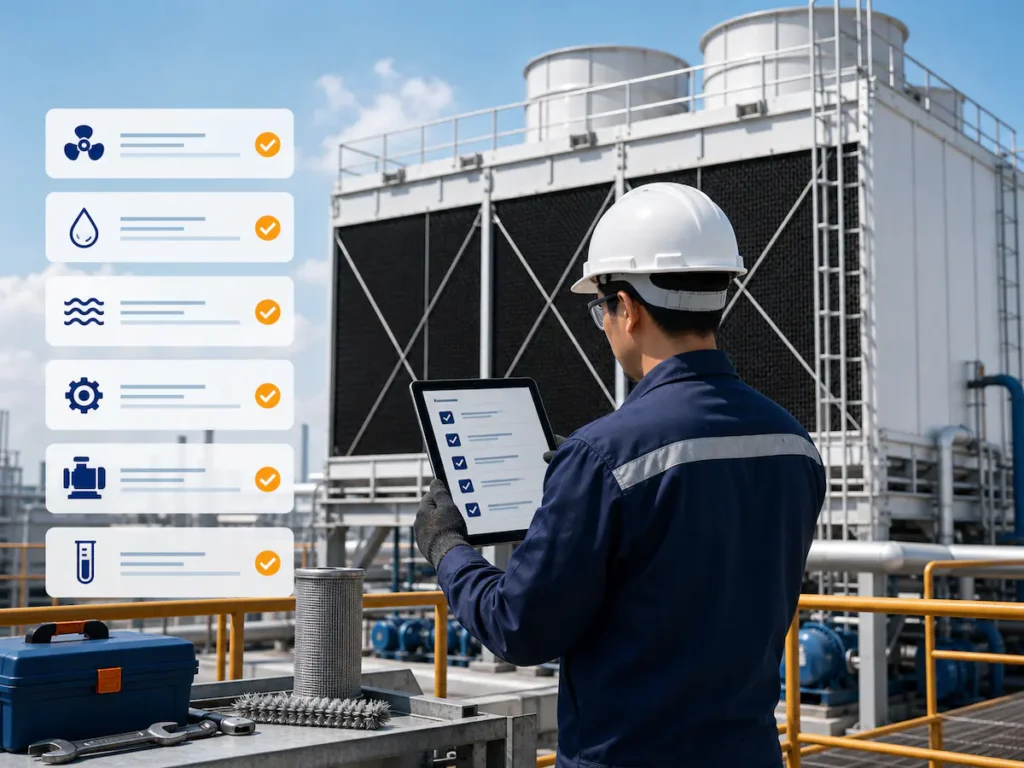
Cooling Tower Maintenance Checklist
A cooling tower maintenance checklist helps operators, facility managers, HVAC contractors, plant engineers, and maintenance teams inspect cooling tower components systematically and prevent small problems from becoming major failures.
Cooling towers operate in a demanding environment. They are exposed to water, air, heat, humidity, minerals, dust, biological growth, chemical treatment, vibration, and outdoor weather. Without regular maintenance, cooling towers may suffer from scaling, corrosion, clogged nozzles, dirty fill, basin sludge, fan vibration, motor overload, poor airflow, high outlet water temperature, water loss, or reduced cooling efficiency.
This guide provides a practical cooling tower maintenance checklist for industrial and HVAC applications. It covers daily, weekly, monthly, quarterly, semi-annual, and annual tasks, as well as component-specific inspection points for open cooling towers, closed circuit cooling towers, evaporative condensers, and related heat rejection equipment.
Why Cooling Tower Maintenance Matters
A cooling tower is part of a larger heat rejection system. If the tower does not operate properly, the whole system may be affected.
Poor cooling tower maintenance can cause:
- Higher outlet water temperature
- Reduced heat transfer efficiency
- Higher chiller or process equipment energy consumption
- Scaling on fill, coil, or heat exchange surfaces
- Corrosion of metal components
- Biological growth in warm water areas
- Clogged spray nozzles
- Reduced airflow
- Fan vibration and mechanical failure
- Motor overload
- Basin leakage or overflow
- Excessive water consumption
- Shortened equipment service life
- Unexpected downtime
A good maintenance program helps protect cooling performance, equipment reliability, water quality, safety, and long-term operating cost.
For industrial users, maintenance is not only about cleaning the cooling tower. It is also about keeping heat transfer surfaces clean, airflow stable, water distribution uniform, mechanical parts reliable, and water chemistry under control.
Important Safety Notice
This checklist is a general maintenance guide. Always follow the cooling tower manufacturer’s operation manual, local regulations, site safety rules, lockout/tagout procedures, and the recommendations of qualified water treatment professionals.
Before inspection or maintenance:
- Shut down equipment when required
- Lock out and tag out fan motors and pumps
- Use proper personal protective equipment
- Avoid entering confined or unsafe spaces without authorization
- Follow site-specific safety procedures
- Confirm that moving parts are stopped
- Be careful around wet surfaces, ladders, platforms, and electrical equipment
- Follow local water hygiene and biological control requirements
Cooling tower maintenance should be performed by trained personnel.
Cooling Tower Maintenance Checklist Overview
The checklist can be divided into six main areas:
| Maintenance Area | What to Check |
| Operating performance | Water temperatures, heat load, flow, abnormal noise, vibration |
| Water system | Basin, water level, float valve, make-up water, blowdown, leaks |
| Heat transfer components | Fill, coil, spray nozzles, water distribution, drift eliminators |
| Mechanical system | Fan, motor, gearbox, belt, bearings, vibration, alignment |
| Structure and access | Casing, frame, louvers, access doors, ladders, platforms |
| Water quality | pH, conductivity, hardness, biocide, scaling, corrosion, biological growth |
Daily Cooling Tower Maintenance Checklist
Daily checks are quick visual and operational inspections. They help identify obvious problems before they affect system performance.
| Item | What to Check | Why It Matters |
| Cooling tower operation | Confirm tower is running normally | Detect abnormal shutdown or control problems |
| Water temperature | Check inlet and outlet water temperature | Identify cooling performance changes |
| Basin water level | Confirm proper operating level | Prevent pump cavitation, overflow, or low water operation |
| Make-up water | Check make-up water operation | Maintain correct basin level |
| Abnormal noise | Listen for unusual fan, motor, or pump noise | Detect mechanical wear or vibration |
| Abnormal vibration | Check visible vibration | Prevent fan, motor, bearing, or structure damage |
| Water flow | Check visible water distribution if accessible | Detect pump, valve, or nozzle problems |
| Leaks | Inspect around basin, piping, valves, and tower body | Prevent water loss and structural damage |
| Airflow | Confirm fan discharge and air intake are not blocked | Maintain heat rejection capacity |
| Visible debris | Check for leaves, dust, plastic, or other debris | Prevent clogging and basin contamination |
| Plume or drift | Observe abnormal drift or excessive water carryover | Detect drift eliminator or airflow issues |
| Control panel | Check alarms, motor status, and operating signals | Detect electrical or control problems |
Daily Maintenance Notes
Daily maintenance should be simple, fast, and consistent. Operators should record abnormal noise, vibration, temperature rise, water level instability, or visible water leakage immediately.
Weekly Cooling Tower Maintenance Checklist
Weekly maintenance focuses on water condition, water distribution, basin cleanliness, and early signs of scaling or biological growth.
| Item | What to Check | Corrective Action |
| Basin condition | Sediment, sludge, algae, floating debris | Clean or schedule basin cleaning |
| Strainer or screen | Blockage or debris | Remove debris and clean screen |
| Water clarity | Cloudy water, discoloration, odor | Check treatment program |
| Water treatment | Chemical dosing, biocide, conductivity | Adjust with water treatment provider |
| Spray nozzles | Uneven spray, clogging, poor coverage | Clean or replace nozzles |
| Fill condition | Visible scale, fouling, algae, blockage | Clean or inspect further |
| Drift eliminator | Fouling, damage, displacement | Clean or repair |
| Louvers | Blockage, splash-out, algae, dirt | Clean and inspect |
| Fan operation | Noise, vibration, rotation, airflow | Investigate abnormal conditions |
| Belt drive, if used | Belt tension and alignment | Adjust if required |
| Pump operation | Noise, vibration, pressure, flow | Inspect pump and piping |
| Valve position | Confirm correct valve status | Adjust incorrect positions |
| Water loss | Unexpected make-up water increase | Check leaks, overflow, drift, blowdown |
Weekly Maintenance Notes
Weekly maintenance is especially important for open cooling towers because circulating water is exposed to air. Airborne dust, leaves, minerals, and microorganisms can enter the system and affect heat transfer performance.
Monthly Cooling Tower Maintenance Checklist
Monthly maintenance should be more detailed. It should cover cleaning, mechanical inspection, water system inspection, and documentation.
| Item | What to Check | Corrective Action |
| Cold water basin | Sludge, scale, corrosion, leakage | Clean basin and repair damaged areas |
| Distribution basin, if used | Blockage, overflow, uneven water level | Clean and balance water distribution |
| Spray nozzles | Clogging, wear, missing nozzles | Clean, tighten, or replace |
| Fill media | Scaling, fouling, breakage, deformation | Clean or replace damaged fill |
| Drift eliminators | Fouling, damage, incorrect position | Clean or replace |
| Louvers | Damage, blockage, splash-out | Clean or repair |
| Fan blades | Dirt, cracks, corrosion, imbalance | Clean and inspect |
| Fan motor | Current, temperature, noise, vibration | Service if abnormal |
| Gearbox, if used | Oil level, leakage, noise | Refill or service according to manual |
| Belt and pulley, if used | Wear, alignment, tension | Adjust or replace |
| Bearings | Lubrication and noise | Lubricate or inspect |
| Fasteners | Loose bolts, corrosion | Tighten or replace |
| Casing and frame | Cracks, corrosion, deformation | Repair or reinforce |
| Access doors | Seal, hinges, handles | Repair for safe access |
| Water treatment records | pH, conductivity, hardness, biocide | Review trends and adjust treatment |
| Operating records | Temperature, water flow, alarms | Compare with previous month |
Monthly Maintenance Notes
Monthly inspection helps identify gradual problems such as scaling, corrosion, fill fouling, and bearing wear. These issues may not be obvious during daily checks but can reduce performance over time.
Quarterly Cooling Tower Maintenance Checklist
Quarterly maintenance should include deeper mechanical inspection and performance review.
| Item | What to Check | Corrective Action |
| Fan blade pitch | Blade angle and consistency | Adjust according to manufacturer’s instructions |
| Fan blade condition | Cracks, erosion, imbalance, corrosion | Repair or replace damaged blades |
| Fan tip clearance | Clearance between fan blade and cylinder | Adjust if outside recommended range |
| Motor amperage | Compare with rated current | Investigate overload or imbalance |
| Motor insulation | Check if required by site practice | Test by qualified personnel |
| Belt drive | Belt wear, tension, pulley alignment | Adjust or replace |
| Gear reducer | Oil quality, oil level, vibration | Service according to manual |
| Drive shaft | Alignment, coupling, vibration | Inspect and correct |
| Vibration | Fan, motor, gearbox, structure | Investigate root cause |
| Structural supports | Corrosion, cracks, loose fasteners | Repair or replace |
| Ladders and platforms | Safety, corrosion, handrails | Repair for safe access |
| Basin coating | Peeling, corrosion, coating failure | Repair coating |
| Fill support | Sagging, corrosion, deformation | Repair support |
| Water distribution | Flow balance across sections | Adjust valves or clean nozzles |
| Performance trend | Compare approach, range, and outlet temperature | Identify performance loss |
Quarterly Maintenance Notes
Quarterly maintenance is important for mechanical reliability. Fans, motors, belts, bearings, and gearboxes are critical rotating components. Early detection of vibration, alignment issues, and wear can prevent major failures.
Semi-Annual Cooling Tower Maintenance Checklist
Semi-annual maintenance is usually performed before or after peak cooling season. It should include a more complete cleaning and system review.
| Item | What to Check | Corrective Action |
| Complete basin cleaning | Sludge, scale, biological growth | Drain and clean safely |
| Fill inspection | Internal scaling, fouling, collapse | Clean or replace |
| Coil inspection, if closed circuit | Scale, corrosion, fouling, leakage | Clean and repair |
| Nozzle system | Spray pattern and blockage | Clean all nozzles |
| Drift eliminators | Deep fouling or damaged sections | Clean or replace |
| Fan system | Blades, hub, shaft, motor, drive | Full mechanical inspection |
| Electrical system | Wiring, terminals, control panel | Inspect by qualified personnel |
| Pump system | Pump noise, seal leakage, vibration | Service pump |
| Valves and float control | Function and leakage | Adjust or repair |
| Water treatment program | Seasonal review | Adjust for water quality and load |
| Corrosion inspection | Metal frame, basin, fasteners | Repair and protect |
| Safety devices | Guards, access doors, ladders | Repair or replace |
| Documentation | Maintenance records and photos | Update maintenance log |
Semi-Annual Maintenance Notes
Semi-annual maintenance should be planned before heavy-load seasons. For HVAC systems, this may be before summer. For industrial plants, timing should match production schedules and shutdown windows.
Annual Cooling Tower Maintenance Checklist
Annual maintenance should be a comprehensive inspection of cooling tower performance, structure, mechanical components, and water-side condition.
| Item | What to Check | Corrective Action |
| Full tower inspection | All major components | Create annual condition report |
| Thermal performance | Approach, range, outlet water temperature | Compare with design conditions |
| Fill condition | Scaling, blockage, brittleness, deformation | Replace if performance is affected |
| Fan system | Blade condition, balance, pitch, motor | Service or overhaul |
| Gearbox or drive | Oil, alignment, bearings, vibration | Service or replace worn parts |
| Basin and casing | Corrosion, cracks, leakage | Repair or restore |
| Structural frame | Load-bearing condition | Repair or reinforce |
| Coil, if applicable | Corrosion, leakage, fouling | Test and clean |
| Drift eliminators | Carryover, blockage, damage | Replace if required |
| Louvers | Airflow restriction, splash control | Clean or repair |
| Piping and valves | Leakage, corrosion, insulation | Repair or replace |
| Water treatment performance | Scale, corrosion, biological control | Review with water treatment provider |
| Spare parts | Belts, nozzles, bearings, filters | Prepare critical spare parts |
| Safety review | Guards, platforms, access points | Update safety measures |
| Maintenance plan | Next year schedule and budget | Plan preventive maintenance |
Annual Maintenance Notes
Annual maintenance should produce a written report. This report can help plant managers plan spare parts, shutdown work, performance improvement, and future equipment upgrades.
Component-Specific Cooling Tower Maintenance Checklist
The following section provides a detailed checklist by component.
1. Cold Water Basin Maintenance
The cold water basin collects cooled water and is one of the most important areas to inspect.
Check the Basin For:
- Sludge
- Sand
- Leaves
- Algae
- Biological growth
- Scale deposits
- Corrosion
- Cracks
- Leakage
- Overflow
- Low water level
- Damaged coating
- Blocked drain
- Blocked strainer
- Poor water circulation
Corrective Actions
- Remove debris and sediment
- Clean basin surfaces
- Check drain and overflow lines
- Inspect float valve operation
- Repair leaks or coating damage
- Check make-up water control
- Verify correct basin water level
- Clean strainers and screens
- Record abnormal water loss
2. Fill Maintenance
Cooling tower fill increases the contact area between air and water. Dirty or damaged fill reduces heat transfer performance.
Check the Fill For:
- Scaling
- Fouling
- Algae growth
- Blockage
- Deformation
- Brittle or broken sheets
- Uneven water flow
- Airflow restriction
- Sagging or collapsed sections
- Poor support condition
Corrective Actions
- Clean fill if fouling is light
- Improve water treatment if scaling appears
- Check water distribution above fill
- Remove debris
- Replace damaged or collapsed fill
- Check fill support system
- Inspect for chemical damage
- Verify that air can pass through the fill properly
Warning Signs of Fill Problems
- Higher outlet water temperature
- Higher approach temperature
- Poor water distribution
- Visible scale
- Reduced airflow
- Water channeling
- Increased fan energy
- Uneven thermal performance
3. Spray Nozzle and Water Distribution Maintenance
The water distribution system must spread water evenly across fill, coil, or heat exchange surfaces. Clogged nozzles can cause dry zones and reduce cooling performance.
Check Nozzles For:
- Clogging
- Uneven spray pattern
- Broken nozzles
- Missing nozzles
- Incorrect orientation
- Scale deposits
- Low water pressure
- Uneven water flow
- Poor coverage area
Corrective Actions
- Remove and clean clogged nozzles
- Replace damaged nozzles
- Check pump pressure
- Flush water distribution piping
- Balance water flow
- Check valves
- Verify spray pattern during operation if safe
- Maintain water treatment to reduce scale
Warning Signs of Nozzle Problems
- Dry fill or coil areas
- Uneven water distribution
- Reduced cooling efficiency
- Local scaling
- Higher outlet water temperature
- Water splash in abnormal areas
4. Drift Eliminator Maintenance
Drift eliminators reduce water droplets carried out with the discharge air. Damaged or dirty drift eliminators can increase water loss and wet the surrounding area.
Check Drift Eliminators For:
- Blockage
- Dirt
- Scale
- Biological growth
- Broken sections
- Missing panels
- Incorrect installation
- Airflow restriction
- Excessive water carryover
Corrective Actions
- Clean drift eliminator surfaces
- Replace broken sections
- Reinstall displaced panels
- Check for proper fit
- Inspect upstream water distribution
- Review fan airflow if drift increases
- Maintain proper water flow and water treatment
Warning Signs of Drift Eliminator Problems
- Water droplets leaving the tower
- Wet area around tower
- Higher make-up water use
- Visible carryover
- Mineral deposits near discharge area
5. Fan System Maintenance
The fan system controls airflow through the cooling tower. Fan problems can quickly reduce cooling performance.
Check Fan Blades For:
- Cracks
- Erosion
- Corrosion
- Dirt buildup
- Imbalance
- Loose bolts
- Incorrect pitch
- Tip clearance problems
- Unusual vibration
Check Fan Motor For:
- Abnormal noise
- High temperature
- Overcurrent
- Loose mounting
- Vibration
- Wiring condition
- Bearing noise
- Motor protection alarms
Check Fan Drive For:
- Belt wear
- Belt tension
- Pulley alignment
- Gearbox oil level
- Gearbox leakage
- Bearing condition
- Coupling alignment
- Shaft vibration
Corrective Actions
- Clean fan blades
- Tighten fasteners
- Adjust blade pitch if required
- Balance fan if vibration occurs
- Lubricate bearings according to manual
- Adjust belt tension
- Replace worn belts
- Check gearbox oil
- Inspect motor current
- Service by qualified technician if abnormal
6. Motor, Gearbox, and Belt Drive Maintenance
Mechanical drive components should be inspected regularly because failure can stop tower airflow.
Motor Checklist
- Check current draw
- Check voltage balance
- Check bearing noise
- Check insulation condition if required
- Check temperature rise
- Check mounting bolts
- Check electrical connections
- Check overload protection
- Check vibration
Gearbox Checklist
- Check oil level
- Check oil quality
- Check oil leakage
- Check abnormal noise
- Check vibration
- Check seals
- Check alignment
- Follow manufacturer lubrication schedule
Belt Drive Checklist
- Check belt tension
- Check belt wear
- Check pulley alignment
- Check belt cracking
- Check belt slipping
- Check guard condition
- Replace worn belts as a set when required
Direct Drive Checklist
- Check motor coupling
- Check alignment
- Check bearing condition
- Check vibration
- Check mounting bolts
- Verify smooth operation
7. Louvers and Air Inlet Maintenance
Air inlet louvers guide air into the tower and help reduce splash-out, sunlight exposure, and debris entry.
Check Louvers For:
- Blockage
- Dirt
- Algae
- Broken blades
- Loose sections
- Splash-out
- Restricted airflow
- UV damage
- Corrosion or brittleness
Corrective Actions
- Clean louvers
- Remove algae
- Replace broken sections
- Confirm proper installation
- Check for splash-out
- Maintain clear air intake space
8. Structure, Casing, and Access Maintenance
The cooling tower structure supports the fan system, fill, basin, coil, casing, and service access.
Check Structure For:
- Corrosion
- Cracks
- Loose bolts
- Deformation
- FRP panel damage
- Coating failure
- Rust stains
- Vibration damage
- Water leakage
- Unsafe platforms
- Damaged ladders
- Loose handrails
- Access door problems
Corrective Actions
- Tighten loose fasteners
- Repair damaged casing
- Treat corrosion early
- Replace unsafe access components
- Repair coating damage
- Check structural support
- Ensure safe maintenance access
9. Closed Circuit Cooling Tower Coil Maintenance
Closed circuit cooling towers use a coil to isolate process fluid from air and spray water. Coil condition is critical for heat transfer.
Check Coil For:
- External scale
- Corrosion
- Fouling
- Leakage
- Poor spray coverage
- Blocked airflow
- Damaged fins or tubes, if applicable
- Uneven temperature distribution
- Signs of freezing damage
- Pressure drop changes
Corrective Actions
- Clean coil surface
- Maintain spray water quality
- Check nozzle coverage
- Inspect for leaks
- Use suitable cleaning methods
- Repair or replace damaged coil sections
- Check process fluid quality
- Protect against freezing if required
Warning Signs of Coil Problems
- Higher process fluid outlet temperature
- Reduced heat transfer
- Increased pump pressure drop
- Visible scale on coil
- Leakage
- Corrosion marks
- Uneven spray water coverage
10. Water Quality Maintenance
Water quality has a direct effect on cooling tower performance and service life. Poor water treatment can lead to scale, corrosion, biological growth, sludge, and reduced heat transfer.
Check Water Quality For:
- pH
- Conductivity
- Total dissolved solids
- Hardness
- Alkalinity
- Chloride
- Biological activity
- Corrosion tendency
- Scale tendency
- Suspended solids
- Chemical dosing level
- Blowdown control
- Make-up water quality
Common Water Quality Problems
| Problem | Possible Cause | Result |
| Scaling | High hardness, poor blowdown control | Reduced heat transfer |
| Corrosion | Low pH, high chloride, poor chemical control | Metal damage and leakage |
| Biological growth | Warm water, poor biocide control | Fouling and hygiene risk |
| Sludge | Suspended solids, poor filtration | Basin fouling and nozzle clogging |
| Foaming | Chemical imbalance or contamination | Operational instability |
| High conductivity | Insufficient blowdown | Scaling and corrosion risk |
Corrective Actions
- Work with a qualified water treatment provider
- Maintain proper blowdown
- Monitor conductivity
- Control pH
- Use suitable corrosion inhibitors
- Use proper biocide program
- Clean basin and strainers
- Remove sludge
- Keep water treatment records
- Review water quality trends
Cooling Tower Cleaning Procedure
Cleaning frequency depends on water quality, operating hours, environmental dust, biological risk, and application. The following is a general cleaning sequence.
General Cleaning Steps
- Review safety procedures and maintenance plan.
- Shut down the cooling tower if required.
- Lock out and tag out fans, pumps, and electrical systems.
- Close necessary valves according to site procedure.
- Drain the basin if deep cleaning is required.
- Remove large debris from basin and screens.
- Clean basin surfaces.
- Clean or inspect fill media.
- Clean spray nozzles and distribution pipes.
- Clean louvers and drift eliminators.
- Inspect fan, motor, and drive components.
- Inspect casing, structure, and access points.
- Refill the basin.
- Restore water treatment settings.
- Start the system and verify operation.
- Record maintenance work, photos, and corrective actions.
Cleaning Notes
Do not use cleaning chemicals or high-pressure washing methods that may damage fill, coil, FRP casing, coatings, seals, or plastic components. Follow manufacturer instructions and water treatment recommendations.
Open Cooling Tower Maintenance Checklist
Open cooling towers expose circulating water directly to air. They require careful water treatment and cleaning.
Main Inspection Points
- Fill cleanliness
- Water distribution
- Spray nozzles or distribution basin
- Cold water basin
- Drift eliminators
- Air inlet louvers
- Fan and motor
- Water treatment
- Blowdown
- Biological control
- Corrosion and scaling
- Basin sludge
- Pump and piping
Key Maintenance Focus
Open cooling towers should focus on water quality, fill condition, basin cleanliness, and airflow. Because the water directly contacts air, debris and minerals can quickly affect performance.
Closed Circuit Cooling Tower Maintenance Checklist
Closed circuit cooling towers use a coil to protect process fluid from external contamination. However, the external spray water loop still requires maintenance.
Main Inspection Points
- Heat exchange coil
- Spray water nozzles
- Spray pump
- Basin
- Fan and motor
- Drift eliminators
- Air inlet louvers
- Process fluid quality
- Coil pressure drop
- Water treatment
- Corrosion protection
- Freeze protection if applicable
Key Maintenance Focus
Closed circuit cooling tower maintenance should focus on both the external spray water loop and the internal process fluid loop. The coil surface must stay clean for efficient heat transfer.
Evaporative Condenser Maintenance Checklist
Evaporative condensers use spray water and airflow to condense refrigerant inside a coil. Maintenance must consider both water-side and refrigerant-side requirements.
Main Inspection Points
- Condensing coil surface
- Spray nozzles
- Spray pump
- Water basin
- Fan and motor
- Drift eliminators
- Air inlet section
- Refrigerant connections
- Operating pressure
- Water quality
- Scale and corrosion
- Access doors and service space
Key Maintenance Focus
Evaporative condenser maintenance should focus on coil cleanliness, spray water distribution, water treatment, and refrigerant-side safety. Coil scaling can increase condensing temperature and reduce refrigeration system efficiency.
Dry Cooler Maintenance Checklist
Dry coolers do not use open evaporative water during dry operation, but they still require air-side and mechanical maintenance.
Main Inspection Points
- Finned tube coil
- Airflow path
- Fan blades
- Fan motors
- Electrical controls
- Coil coating
- Fluid leakage
- Glycol concentration if used
- Debris on coil face
- Noise and vibration
- Corrosion
- Structural frame
Key Maintenance Focus
Dry cooler maintenance focuses on clean coil surfaces, stable airflow, fan operation, and closed-loop fluid condition.
Cooling Tower Troubleshooting Checklist
Use this checklist when cooling performance drops or abnormal operation appears.
Problem: Outlet Water Temperature Is Too High
Possible causes:
- Dirty fill
- Clogged nozzles
- Low airflow
- Fan rotation problem
- Fan speed problem
- High wet-bulb temperature
- Low water flow
- Excess heat load
- Air recirculation
- Scale on heat transfer surfaces
- Poor water distribution
Recommended actions:
- Check inlet and outlet temperatures
- Check water flow rate
- Inspect fill and nozzles
- Verify fan operation
- Check air inlet clearance
- Inspect for recirculation
- Review heat load
- Clean tower components
Problem: Excessive Vibration
Possible causes:
- Fan imbalance
- Loose bolts
- Bearing wear
- Motor misalignment
- Belt problem
- Gearbox issue
- Structural looseness
Recommended actions:
- Stop equipment if vibration is severe
- Inspect fan blades
- Check belt alignment
- Check bearings
- Check motor mounts
- Tighten fasteners
- Perform vibration analysis if required
Problem: Excessive Water Loss
Possible causes:
- Overflow
- Float valve problem
- Drift eliminator damage
- Excessive drift
- Basin leakage
- Blowdown setting issue
- Pump or piping leakage
Recommended actions:
- Check basin level
- Inspect float valve
- Check drift eliminators
- Inspect basin and piping
- Review blowdown rate
- Check make-up water meter if available
Problem: Scale Formation
Possible causes:
- Hard water
- High cycles of concentration
- Poor blowdown control
- Inadequate water treatment
- High water temperature
Recommended actions:
- Review water chemistry
- Adjust blowdown
- Clean scaled components
- Improve treatment program
- Inspect nozzles and fill
- Monitor conductivity
Problem: Corrosion
Possible causes:
- Poor water chemistry
- Low pH
- High chloride
- Chemical exposure
- Damaged coating
- Poor material selection
Recommended actions:
- Review water treatment
- Inspect affected areas
- Repair coating damage
- Replace corroded components
- Consider material upgrade
- Use stainless steel or FRP options where suitable
Cooling Tower Maintenance Schedule
The following schedule can be used as a general reference. Actual frequency should be adjusted according to tower type, operating hours, water quality, environment, manufacturer recommendations, and local regulations.
| Frequency | Main Tasks |
| Daily | Check operation, temperature, water level, noise, vibration, leaks |
| Weekly | Check basin, water clarity, treatment, nozzles, drift eliminators, visible fill condition |
| Monthly | Clean basin, inspect fill, nozzles, fan, motor, belt, structure, water records |
| Quarterly | Inspect fan pitch, vibration, belt alignment, gearbox, structure, safety access |
| Semi-Annual | Deep clean basin, inspect coil/fill, nozzles, drift eliminators, electrical and pump systems |
| Annual | Full inspection, performance review, major component assessment, maintenance planning |
Cooling Tower Maintenance Record Template
A maintenance checklist should be documented. Records help track trends, prove work completion, and support future troubleshooting.
Recommended Maintenance Record Fields
| Field | Example |
| Tower ID | CT-01 |
| Location | Rooftop / Plant utility area |
| Date | YYYY-MM-DD |
| Technician | Name |
| Operating status | Normal / Abnormal |
| Inlet water temperature | °C or °F |
| Outlet water temperature | °C or °F |
| Basin water level | Normal / Low / High |
| Water clarity | Clear / Cloudy / Dirty |
| pH | Value |
| Conductivity | Value |
| Fan noise | Normal / Abnormal |
| Vibration | Normal / Abnormal |
| Nozzle condition | Clean / Clogged |
| Fill condition | Clean / Scaled / Damaged |
| Basin condition | Clean / Sludge / Leakage |
| Corrective action | Description |
| Photos attached | Yes / No |
| Follow-up required | Yes / No |
Documentation Best Practices
- Record every inspection
- Take photos of abnormal conditions
- Track temperature trends
- Track water chemistry trends
- Record cleaning and repairs
- Record parts replacement
- Review repeated problems
- Use digital checklists if possible
- Keep maintenance history for each tower
Maintenance Checklist by Component
| Component | Daily | Weekly | Monthly | Quarterly | Annual |
| Basin water level | Check | Check | Inspect controls | Review losses | Full inspection |
| Basin cleanliness | Visual | Remove debris | Clean | Inspect coating | Deep clean |
| Fill | Visual if accessible | Check fouling | Inspect | Clean if needed | Replace if damaged |
| Spray nozzles | Observe spray | Check clogging | Clean | Flow balance | Replace if worn |
| Drift eliminator | Observe drift | Inspect | Clean | Inspect fit | Replace if damaged |
| Fan | Listen | Observe vibration | Inspect | Check pitch/balance | Overhaul if needed |
| Motor | Check alarm | Listen | Check current | Inspect | Full electrical review |
| Belt/gearbox | Listen | Check belt | Lubricate/service | Inspect alignment | Service/replace |
| Louvers | Visual | Clean debris | Inspect | Repair | Replace if damaged |
| Structure | Visual | Check obvious damage | Inspect | Tighten/repair | Full structural review |
| Water quality | Check if required | Test | Trend review | Program review | Annual treatment review |
Common Maintenance Mistakes to Avoid
Mistake 1: Cleaning Only the Basin
The basin is important, but cleaning the basin alone is not enough. Fill, nozzles, drift eliminators, louvers, fan system, and water treatment must also be maintained.
Mistake 2: Ignoring Water Distribution
Uneven water distribution can reduce heat transfer and cause local scaling. Spray nozzles and distribution basins should be inspected regularly.
Mistake 3: Waiting Until Cooling Performance Drops
By the time outlet water temperature rises, scaling, fouling, airflow restriction, or mechanical problems may already be serious.
Mistake 4: Ignoring Fan Vibration
Fan vibration can damage bearings, motors, gearboxes, fan blades, and structure. Abnormal vibration should be addressed early.
Mistake 5: Using Poor Water Treatment
Water treatment is essential for controlling scale, corrosion, and biological growth. Poor water treatment can reduce heat transfer and shorten equipment life.
Mistake 6: Not Keeping Records
Without records, maintenance teams cannot identify trends. Temperature, water quality, vibration, and cleaning records help detect gradual performance loss.
Mistake 7: Ignoring Airflow Clearance
Blocked air inlets or hot air recirculation can reduce cooling tower performance even if the tower itself is clean.
Mistake 8: Not Following Manufacturer Instructions
Different cooling tower types have different maintenance requirements. Always follow the manufacturer’s manual and project-specific operation conditions.
How Maintenance Improves Cooling Tower Performance
A well-maintained cooling tower can operate closer to its design performance. Maintenance improves performance by keeping heat transfer surfaces clean, airflow stable, and water distribution uniform.
Key performance benefits include:
- Lower outlet water temperature
- Better approach performance
- Lower chiller condenser temperature
- Reduced fan and pump stress
- Lower energy consumption
- Longer fill and coil life
- Lower risk of unexpected shutdown
- Better water quality control
- Reduced scaling and corrosion
- More stable industrial process cooling
For critical applications such as data centers, chemical plants, industrial refrigeration, injection molding, pharmaceutical production, and steel processing, preventive maintenance is essential for stable operation.
THERMOCORE Cooling Tower Maintenance and Product Support
THERMOCORE designs and manufactures heat rejection equipment for HVAC, industrial process cooling, refrigeration, data centers, chemical plants, food and beverage, pharmaceutical, petrochemical, power, plastic processing, steel and metallurgy, compressor cooling, and other industrial applications.
Our product range includes:
- Open Cooling Towers
- Closed Circuit Cooling Towers
- Evaporative Condensers
- Dry Coolers and Air Coolers
- Cooling Tower Parts
Maintenance requirements may vary depending on tower type.
Open Cooling Towers
Open cooling towers require regular basin cleaning, fill inspection, spray nozzle maintenance, water treatment, drift eliminator cleaning, and fan system inspection.
Closed Circuit Cooling Towers
Closed circuit cooling towers require maintenance of the external spray water system and the internal process fluid loop. Coil cleanliness and water quality are especially important.
Evaporative Condensers
Evaporative condensers require coil inspection, spray water maintenance, fan system inspection, water treatment, and refrigerant-side safety review.
Dry Coolers
Dry coolers require coil cleaning, fan maintenance, electrical inspection, and closed-loop fluid checks. They usually have lower water-side maintenance than evaporative systems.
THERMOCORE can help buyers select suitable cooling equipment, spare parts, material options, and maintenance-friendly designs according to working conditions.
Frequently Asked Questions
How often should a cooling tower be maintained?
Cooling towers should be inspected regularly. Daily and weekly checks are recommended for operating condition, water level, water quality, noise, vibration, and visible problems. Monthly, quarterly, semi-annual, and annual maintenance should include deeper cleaning and mechanical inspection. Actual frequency should follow manufacturer recommendations, site conditions, water quality, and local regulations.
What should be included in a cooling tower maintenance checklist?
A cooling tower maintenance checklist should include basin, fill, spray nozzles, water distribution, drift eliminators, fan blades, motor, gearbox, belt drive, louvers, casing, structure, water quality, water treatment, leaks, vibration, noise, and operating temperatures.
Why is cooling tower maintenance important?
Cooling tower maintenance helps maintain cooling performance, reduce energy consumption, prevent scaling and corrosion, control biological growth, extend equipment life, and reduce unexpected downtime.
What are common cooling tower maintenance problems?
Common problems include scale buildup, clogged nozzles, dirty fill, basin sludge, biological growth, corrosion, fan vibration, belt wear, motor overload, gearbox issues, poor airflow, excessive drift, and high outlet water temperature.
How do you clean a cooling tower basin?
A basin should be cleaned by following safety procedures, shutting down and isolating equipment if required, removing debris and sludge, cleaning surfaces, checking drains and strainers, inspecting for corrosion or leakage, and restoring proper water treatment before operation.
How do you know if cooling tower fill needs cleaning or replacement?
Fill may need cleaning or replacement if it shows heavy scaling, fouling, algae growth, brittleness, deformation, collapse, airflow blockage, water channeling, or reduced heat transfer performance.
Why do cooling tower nozzles clog?
Nozzles may clog because of scale, sediment, biological growth, debris, poor filtration, or poor water treatment. Regular inspection and cleaning help maintain uniform water distribution.
What causes cooling tower corrosion?
Corrosion may be caused by poor water chemistry, low pH, high chloride, oxygen exposure, chemical contamination, poor material selection, damaged coating, or inadequate corrosion inhibitor control.
What causes a cooling tower to lose efficiency?
Efficiency may drop because of dirty fill, clogged nozzles, poor airflow, fan problems, scaling, corrosion, water imbalance, hot air recirculation, high wet-bulb temperature, or excessive heat load.
Can THERMOCORE provide maintenance-friendly cooling tower designs?
Yes. THERMOCORE can provide cooling tower designs with suitable access doors, maintenance platforms, corrosion-resistant materials, efficient spray systems, removable components, and customized configurations for easier inspection and service.
Request Cooling Tower Maintenance or Replacement Support
A maintenance checklist helps keep cooling towers operating reliably, but some problems may require professional inspection, spare parts, cleaning, repair, or equipment replacement.
If your cooling tower has poor cooling performance, severe corrosion, damaged fill, clogged spray nozzles, fan vibration, basin leakage, coil scaling, high outlet water temperature, or repeated maintenance issues, THERMOCORE can help evaluate suitable solutions.
To receive support, please provide:
- Cooling tower type
- Application industry
- Heat load or cooling capacity
- Water flow rate
- Inlet and outlet water temperature
- Local wet-bulb temperature
- Water quality condition
- Current maintenance problems
- Photos of basin, fill, nozzles, fan, and casing
- Installation location
- Material requirement
- Spare parts requirement
- Whether replacement or upgrade is being considered
THERMOCORE can help you review cooling tower condition, select replacement parts, compare cooling tower types, and choose a suitable heat rejection solution for your project.
Request Cooling Tower Maintenance or Replacement Support