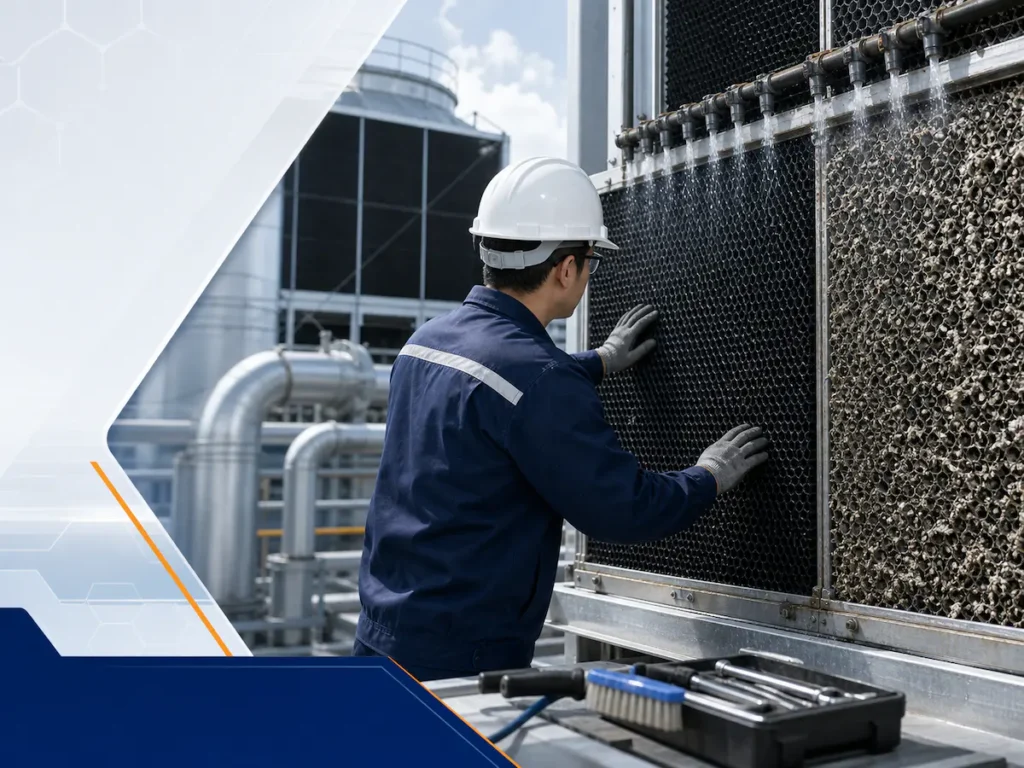
Cooling Tower Fill Cleaning Guide
Cooling tower fill is one of the most important heat transfer components in an open cooling tower. It increases the contact area between air and water, improves evaporation, and helps the tower reduce circulating water temperature efficiently.
However, cooling tower fill is also one of the easiest components to become dirty, scaled, fouled, clogged, biologically contaminated, or physically damaged. When fill becomes blocked or covered by deposits, airflow and water distribution become uneven. As a result, the cooling tower may lose performance, consume more energy, require more water treatment, and struggle to reach the required outlet water temperature.
This cooling tower fill cleaning guide explains how to inspect, clean, rinse, and maintain cooling tower fill. It also explains when cleaning is enough and when fill replacement is the better choice.
This guide is written for HVAC contractors, industrial plant engineers, facility managers, maintenance teams, project contractors, and cooling tower buyers who want to improve cooling tower performance and reduce maintenance problems.
What Is Cooling Tower Fill?
Cooling tower fill is the heat exchange media inside an open cooling tower. Its function is to increase the contact area and contact time between hot water and air.
When hot water enters the cooling tower, it is distributed over the fill. The fill spreads the water into thin films or droplets, allowing air to remove heat through evaporation and sensible heat transfer. The cooled water then falls into the cold water basin and returns to the system.
Without clean and properly functioning fill, the cooling tower cannot provide efficient heat rejection.
Main Functions of Cooling Tower Fill
Cooling tower fill helps to:
- Increase air-water contact area
- Extend water residence time
- Improve evaporation efficiency
- Reduce water outlet temperature
- Support stable cooling performance
- Improve tower thermal capacity
- Reduce energy waste caused by poor heat transfer
- Help distribute water more evenly across the tower section
Why Cooling Tower Fill Gets Dirty
Cooling tower fill operates in an open and wet environment. Airborne dust, minerals, biological matter, suspended solids, and water treatment imbalance can all cause fill contamination.
Common causes of dirty or fouled fill include:
- Hard water
- High mineral concentration
- Poor blowdown control
- High cycles of concentration
- Suspended solids
- Dust and airborne particles
- Leaves and outdoor debris
- Algae growth
- Biofilm
- Sludge from basin water
- Poor water treatment
- Clogged spray nozzles
- Uneven water distribution
- Low water velocity in some areas
- High water temperature
- Chemical imbalance
- Poor filtration
- Long operation without cleaning
Fill fouling is not only a cleaning problem. It is often a sign of a larger water treatment, filtration, air quality, or water distribution problem.
Common Types of Cooling Tower Fill Contamination
Different types of deposits require different cleaning methods. Before cleaning the fill, identify what kind of contamination exists.
1. Mineral Scale
Mineral scale usually appears as white, gray, or hard deposits on fill surfaces. It is often caused by calcium carbonate, calcium sulfate, silica, or other dissolved minerals that concentrate as water evaporates.
2. Biological Fouling
Biological fouling may appear as slime, algae, biofilm, or soft organic deposits. It is usually caused by warm water, sunlight, nutrients, poor biocide control, or stagnant areas.
3. Mud and Sludge
Mud and sludge often come from basin sediment, suspended solids, dust, rust particles, or poor filtration. Sludge can block fill channels and reduce airflow.
4. Oil or Process Contamination
In some industrial plants, oil mist, process contaminants, or airborne chemicals may enter the tower and stick to fill surfaces. This can create sticky deposits that are difficult to remove.
5. Physical Debris
Leaves, plastic, packaging material, fibers, dust, or outdoor debris can enter through air inlets and block fill passages.
Signs That Cooling Tower Fill Needs Cleaning
Cooling tower fill cleaning should be considered when visual inspection or operating data shows performance loss.
Visual Signs
- White scale deposits on fill
- Green algae growth
- Brown or black sludge
- Blocked fill channels
- Uneven wetting
- Dry areas in the fill
- Water channeling
- Debris trapped inside fill
- Dirty or slimy fill surface
- Mineral deposits under fill packs
- Fill surface looks clogged or heavy
Operating Signs
- Outlet water temperature is higher than normal
- Cooling tower approach increases
- Chiller condenser water temperature rises
- Fan runs longer or at higher speed
- Pump pressure changes
- Water distribution becomes uneven
- Tower cannot reach design performance
- Energy consumption increases
- Makeup water or chemical use increases
- Production cooling becomes unstable
Maintenance Signs
- Nozzles clog repeatedly
- Basin sludge returns quickly after cleaning
- Drift eliminators become dirty faster than normal
- Water treatment readings are unstable
- Fill cleaning frequency becomes shorter
- Fill appears heavy, brittle, or deformed
Why Dirty Fill Reduces Cooling Tower Performance
Dirty fill affects both water flow and airflow. When fill passages are blocked, water cannot spread evenly and air cannot pass through the tower properly.
Dirty or clogged fill can cause:
- Reduced air-water contact
- Lower evaporation efficiency
- Higher outlet water temperature
- Larger approach temperature
- Poor water distribution
- Higher fan energy
- Increased chiller energy consumption
- More scaling and biological growth
- Higher maintenance cost
- Shorter fill service life
- Increased risk of fill collapse
- Lower cooling tower capacity
In severe cases, cleaning may not restore performance because the fill structure has already been permanently damaged.
Safety Before Cleaning Cooling Tower Fill
Cooling tower cleaning must be performed safely. Always follow the manufacturer’s manual, local regulations, site safety procedures, and the recommendations of qualified water treatment professionals.
Before cleaning:
- Shut down the cooling tower when required
- Lock out and tag out fan motors and pumps
- Close necessary valves according to site procedure
- Wear suitable personal protective equipment
- Use eye protection, gloves, protective clothing, and respiratory protection when required
- Avoid standing on unstable fill or unsafe internal structures
- Do not enter confined areas without authorization
- Avoid direct exposure to contaminated water mist
- Be careful with slippery surfaces
- Use only approved cleaning chemicals
- Follow chemical dilution and contact time instructions
- Dispose of sludge and wastewater according to local regulations
- Restart the system only after inspection and safe commissioning
Cooling tower fill cleaning should be performed by trained personnel. If there is heavy biological contamination, chemical exposure, severe scaling, or structural damage, professional service should be considered.
Cooling Tower Fill Cleaning Process Overview
A practical fill cleaning process includes the following steps:
- Inspect the cooling tower and fill condition.
- Identify the type of fouling or deposit.
- Decide whether cleaning or replacement is appropriate.
- Shut down and isolate the system safely.
- Remove loose debris from basin, louvers, and fill area.
- Pre-treat biological growth if required.
- Clean the fill using suitable mechanical or chemical methods.
- Clean nozzles, distribution system, basin, and drift eliminators.
- Rinse and flush the system thoroughly.
- Restart the tower and monitor performance.
- Adjust water treatment to prevent repeat fouling.
- Record cleaning results and plan the next inspection.
Step 1: Inspect the Fill Before Cleaning
Before cleaning, inspect the fill carefully. The goal is to understand whether the fill can be cleaned or whether replacement is required.
What to Inspect
Check the fill for:
- Scale thickness
- Sludge buildup
- Biological growth
- Airflow blockage
- Water channeling
- Broken sheets
- Deformation
- Sagging
- Brittleness
- Collapsed sections
- Chemical damage
- UV aging
- Uneven wetting
- Overloaded fill packs
- Poor fill support
- Nozzle coverage problems
Record Operating Data
Before cleaning, record:
- Inlet water temperature
- Outlet water temperature
- Wet-bulb temperature
- Approach temperature
- Water flow rate
- Fan operation
- Basin condition
- Water quality readings
- Conductivity
- pH
- Hardness
- Biological treatment condition
- Photos of fill condition
This data helps confirm whether cleaning improves performance after the work is completed.
Step 2: Identify the Fill Type
Cleaning method depends heavily on fill type. The two main fill categories are film fill and splash fill.
Film Fill
Film fill spreads water into thin films over closely spaced sheets. It offers high heat transfer efficiency, but it can be more sensitive to clogging and physical damage.
Film fill is commonly used in many HVAC and industrial cooling towers where water quality is reasonably controlled.
Splash Fill
Splash fill breaks water into droplets as water falls over bars or grids. It is often more tolerant of dirty water, suspended solids, or industrial environments, but it may require a larger tower volume for the same heat transfer duty.
Why Fill Type Matters During Cleaning
Film fill usually requires gentler cleaning because high pressure can deform, crack, or damage the sheets. Splash fill may tolerate more aggressive rinsing depending on material and structure, but excessive pressure or improper tools can still damage it.
Step 3: Decide Whether to Clean or Replace the Fill
Cleaning is useful when fill is dirty but still structurally sound. Replacement is better when fill is physically damaged or permanently blocked.
Cleaning May Be Suitable When:
- Fill has light to moderate scale
- Fill has removable sludge or biofilm
- Fill structure is still stable
- Fill sheets are not brittle
- Fill is not collapsed
- Water distribution can be restored
- Airflow passages are not permanently blocked
- Cleaning restores acceptable performance
- Fill support structure is still strong
Replacement May Be Better When:
- Fill is cracked
- Fill is brittle
- Fill is sagging
- Fill has collapsed sections
- Fill channels are permanently clogged
- Scale is too thick to remove safely
- Fill material is chemically damaged
- Fill has lost its original shape
- Fill is heavily fouled again soon after cleaning
- Tower performance remains poor after cleaning
- Fill support is damaged
- Fill is near the end of its service life
Clean vs Replace Decision Table
| Fill Condition | Recommended Action |
| Light dust or debris | Rinse and clean |
| Light biological slime | Biocide treatment and cleaning |
| Moderate scale | Chemical or controlled mechanical cleaning |
| Heavy hard scale | Evaluate descaling or replacement |
| Brittle fill | Replace |
| Collapsed fill | Replace |
| Cracked fill sheets | Replace damaged sections |
| Fill channels blocked permanently | Replace |
| Repeated fouling after cleaning | Review water treatment and consider replacement |
| Poor performance after cleaning | Recheck design and consider fill replacement |
Step 4: Shut Down and Prepare the Cooling Tower
Once the cleaning plan is confirmed, prepare the tower safely.
Preparation Checklist
- Inform operations team
- Schedule shutdown window
- Stop the cooling tower fan
- Stop spray or circulation pumps if required
- Lock out and tag out electrical equipment
- Close required valves
- Drain basin if deep cleaning is needed
- Remove access panels or louvers if needed
- Prepare cleaning tools
- Prepare approved cleaning chemicals
- Prepare rinse water
- Prepare sludge disposal method
- Confirm PPE and safety controls
- Take before-cleaning photos
Do not begin cleaning while fans or pumps can start automatically.
Step 5: Remove Loose Debris
Before cleaning the fill, remove loose debris from the tower.
Areas to Clean First
- Cold water basin
- Basin strainer
- Louvers
- Air inlet area
- Fill support area
- Distribution basin if used
- Spray header area
- Drift eliminators
- Access doors
- Internal floor surfaces
- Nearby piping and valves
Removing loose debris prevents it from being pushed deeper into the fill during washing.
Step 6: Pre-Treat Biological Growth if Required
If algae, slime, or biofilm is present, pre-treatment may be needed before physical cleaning. Biological deposits can be sticky and difficult to remove with water alone.
Biological Fouling May Require:
- Approved biocide treatment
- Proper contact time
- Controlled circulation
- Basin cleaning
- Sludge removal
- Fill surface cleaning
- Final rinse and flush
- Water treatment adjustment after restart
The exact chemical program should be selected by a qualified water treatment provider. Do not use household chemicals or unapproved cleaners.
Important Note
Biological fouling is not solved by one-time cleaning alone. If water treatment, sunlight exposure, stagnant zones, or basin sludge remain uncontrolled, algae and biofilm may return quickly.
Step 7: Choose the Right Cleaning Method
Cooling tower fill can be cleaned with mechanical cleaning, chemical cleaning, or a combination of both. The right method depends on fill type, contamination type, water quality, and fill condition.
Mechanical Cleaning
Mechanical cleaning uses water rinsing, brushing, vacuuming, or controlled washing to remove loose deposits.
Suitable For:
- Dust
- Loose debris
- Light sludge
- Soft biological deposits
- Light mineral deposits
- Surface fouling
Mechanical Cleaning Methods
Common methods include:
- Low-pressure water rinsing
- Soft brush cleaning
- Controlled spray washing
- Basin vacuuming
- Manual debris removal
- Section-by-section cleaning
- Fill pack removal and cleaning if designed for removal
Important Caution
High-pressure washing can damage some fill types, especially film fill. It may bend sheets, enlarge passages, break glued joints, or reduce thermal performance. Use pressure carefully and follow the fill manufacturer’s recommendations.
Chemical Cleaning
Chemical cleaning is used when scale, biofilm, or organic deposits cannot be removed by water rinsing alone.
Suitable For:
- Mineral scale
- Calcium deposits
- Biofilm
- Organic fouling
- Algae
- Iron deposits
- Persistent sludge
Chemical Cleaning Considerations
Before chemical cleaning, confirm:
- Fill material compatibility
- Tower casing material compatibility
- Basin material compatibility
- Coil material compatibility if applicable
- Cleaning chemical concentration
- Contact time
- Water temperature
- pH control
- Corrosion risk
- Wastewater disposal requirements
- Worker safety requirements
Chemical Cleaning Warning
Do not use strong chemicals without professional guidance. Improper chemical cleaning can damage PVC fill, FRP panels, coatings, galvanized steel, stainless steel, seals, and other cooling tower components.
Step 8: Clean Film Fill Carefully
Film fill has narrow passages and high heat transfer efficiency. However, it can be more vulnerable to clogging and physical damage.
Film Fill Cleaning Tips
- Use low-pressure rinsing first
- Work from top to bottom when possible
- Avoid aggressive straight water jets
- Avoid standing on fill
- Do not use sharp tools
- Use approved fill-compatible cleaners
- Clean in sections
- Rinse thoroughly after chemical treatment
- Inspect for deformation or broken sheets
- Replace sections that are brittle, collapsed, or permanently clogged
Common Film Fill Problems
- Narrow passages blocked by scale
- Biological slime bridging between sheets
- Sheet deformation
- Brittle edges
- Fill pack collapse
- Uneven water distribution
- Permanent clogging from hard deposits
If film fill is heavily scaled or collapsed, replacement is often more practical than repeated cleaning.
Step 9: Clean Splash Fill
Splash fill is generally more open than film fill and can tolerate dirtier water conditions. However, it still requires regular cleaning.
Splash Fill Cleaning Tips
- Remove large debris first
- Rinse with controlled water pressure
- Brush accessible surfaces if needed
- Clean support grids
- Check for broken splash bars
- Inspect mounting and alignment
- Remove sludge from lower sections
- Check for missing components
- Replace damaged parts
- Confirm water is breaking into droplets properly after restart
Common Splash Fill Problems
- Broken bars
- Missing sections
- Sludge accumulation
- Biological growth
- Scale deposits
- Poor water breakup
- Uneven spray distribution
- Support failure
Splash fill may be easier to clean in some industrial applications, but damaged sections should still be replaced.
Step 10: Clean the Water Distribution System
Fill cleaning will not solve the problem if water distribution remains poor. Clogged nozzles or uneven distribution can make fill dirty again quickly.
Check the Distribution System For:
- Clogged nozzles
- Broken nozzles
- Missing nozzles
- Uneven spray pattern
- Blocked spray pipes
- Dirty distribution basin
- Scale deposits
- Low pump pressure
- Incorrect valve position
- Poor flow balance
Cleaning Actions
- Remove and clean nozzles
- Replace damaged nozzles
- Flush spray headers
- Clean distribution basin
- Check water pressure
- Verify spray coverage
- Adjust valves if needed
- Inspect water flow after restart
Step 11: Clean the Basin and Strainers
A dirty basin can re-contaminate clean fill. Basin sludge, sand, algae, and suspended solids can be recirculated back to the fill through the pump and nozzles.
Basin Cleaning Checklist
- Drain basin if required
- Remove sludge
- Remove floating debris
- Clean basin walls and floor
- Clean strainers
- Check drain and overflow
- Inspect float valve
- Check for corrosion or cracks
- Inspect basin coating
- Check pump suction area
- Flush remaining solids
- Refill with treated water
Why Basin Cleaning Matters
If the basin is not cleaned, debris can return to the spray nozzles and fill. This creates repeat fouling and shortens the time between cleaning cycles.
Step 12: Clean Drift Eliminators and Louvers
Drift eliminators and louvers also affect airflow and water control. If they are dirty or blocked, tower performance may decline even after fill cleaning.
Drift Eliminator Checklist
Check for:
- Scale
- Dirt
- Biological growth
- Broken sections
- Missing panels
- Incorrect installation
- Blocked airflow
- Excessive water carryover
Louver Checklist
Check for:
- Algae
- Dust
- Broken blades
- Splash-out
- Air inlet blockage
- UV aging
- Loose parts
- Poor fit
Clean or replace damaged sections as needed.
Step 13: Rinse and Flush Thoroughly
After cleaning, the system must be rinsed thoroughly. Cleaning residues, loosened deposits, and suspended solids should not remain in the tower.
Rinsing Checklist
- Rinse fill from top to bottom where accessible
- Use appropriate water pressure
- Flush basin
- Flush nozzles and spray headers
- Flush drain lines
- Remove loosened debris
- Confirm no chemical residue remains
- Check pH before restart if chemicals were used
- Dispose of wastewater properly
- Refill with clean treated water
Post-Rinse Inspection
After rinsing, inspect:
- Fill surface
- Fill passages
- Nozzle spray pattern
- Basin cleanliness
- Drift eliminators
- Louvers
- Water clarity
- Pump strainer
- Remaining scale or sludge
Step 14: Restart and Monitor Performance
After cleaning, restart the cooling tower carefully and monitor performance.
Startup Checklist
- Refill basin to proper level
- Confirm valves are open
- Check pump operation
- Check spray water distribution
- Start fan according to procedure
- Check fan rotation
- Check abnormal noise or vibration
- Check water leaks
- Check motor current
- Confirm water flow
- Check inlet and outlet water temperature
- Record approach and range
- Check water treatment settings
- Monitor for 24–48 hours if possible
Performance Indicators After Cleaning
Cleaning should improve:
- Water distribution
- Airflow
- Outlet water temperature
- Approach temperature
- Fan operating efficiency
- Chiller or process cooling stability
- Visible fill condition
- Basin cleanliness
- Nozzle performance
If performance does not improve after cleaning, the fill may be damaged, the tower may be undersized, or other problems may exist.
Cooling Tower Fill Cleaning Checklist
| Step | Inspection or Action | Completed |
| 1 | Record operating data before cleaning | ☐ |
| 2 | Inspect fill condition | ☐ |
| 3 | Identify fill type: film or splash | ☐ |
| 4 | Identify contamination type | ☐ |
| 5 | Decide clean vs replace | ☐ |
| 6 | Shut down and isolate equipment safely | ☐ |
| 7 | Lock out fans and pumps | ☐ |
| 8 | Remove loose debris | ☐ |
| 9 | Pre-treat biological growth if needed | ☐ |
| 10 | Clean fill with suitable method | ☐ |
| 11 | Clean nozzles and distribution system | ☐ |
| 12 | Clean basin and strainers | ☐ |
| 13 | Clean drift eliminators and louvers | ☐ |
| 14 | Rinse and flush system | ☐ |
| 15 | Refill with treated water | ☐ |
| 16 | Restart tower and inspect operation | ☐ |
| 17 | Record post-cleaning temperature data | ☐ |
| 18 | Adjust water treatment program | ☐ |
| 19 | Take after-cleaning photos | ☐ |
| 20 | Schedule next inspection | ☐ |
Cleaning Frequency: How Often Should Cooling Tower Fill Be Cleaned?
There is no single cleaning frequency that fits every cooling tower. Fill cleaning frequency depends on water quality, air quality, operating hours, tower location, industry, water treatment program, and seasonal conditions.
General Frequency Guidelines
| Condition | Suggested Inspection or Cleaning Approach |
| Clean commercial HVAC site | Inspect monthly, clean as needed |
| Dusty industrial site | Inspect monthly or more frequently |
| Hard water condition | Inspect scale buildup regularly |
| High biological risk | Inspect and treat frequently |
| Heavy seasonal operation | Clean before peak season |
| Cooling tower after long shutdown | Inspect and clean before restart |
| Repeated nozzle clogging | Inspect fill and basin immediately |
| High outlet temperature | Inspect fill, nozzles, airflow, and basin |
| Visible fouling or scale | Clean or evaluate replacement |
Many sites schedule full cooling tower cleaning before peak cooling season and after heavy operating periods. However, fill condition should be checked regularly rather than only during annual maintenance.
How to Prevent Fill Fouling After Cleaning
Cleaning removes current deposits, but prevention reduces how quickly fouling returns.
1. Maintain Proper Water Treatment
Water treatment should control:
- Scale
- Corrosion
- Biological growth
- pH
- Conductivity
- Hardness
- Blowdown
- Cycles of concentration
- Suspended solids
- Biocide effectiveness
2. Control Blowdown
Blowdown helps limit dissolved solids. If blowdown is insufficient, minerals concentrate and scale formation becomes more likely.
3. Keep the Basin Clean
Basin sludge can recirculate into fill and nozzles. Regular basin cleaning reduces fill contamination.
4. Clean Nozzles Regularly
Nozzle clogging causes uneven water distribution, dry fill areas, and local scale buildup.
5. Improve Filtration
If suspended solids are high, filtration or side-stream filtration can help reduce fouling.
6. Reduce Airborne Debris
Check louvers, screens, and tower location. Dusty environments may require more frequent inspection.
7. Monitor Performance Trends
Record outlet water temperature, approach, fan operation, and water treatment readings. A rising approach may indicate fill fouling before severe blockage is visible.
8. Choose Suitable Fill Type
In dirty water applications, splash fill or wider-channel fill may be more practical than narrow film fill.
Fill Cleaning for Different Cooling Tower Types
Open Cooling Towers
Open cooling towers usually rely heavily on fill for heat transfer. Fill cleaning is especially important because circulating water directly contacts air and fill surfaces.
Focus areas:
- Fill cleanliness
- Spray nozzles
- Distribution basin
- Basin sludge
- Drift eliminators
- Louvers
- Water treatment
- Airflow
Closed Circuit Cooling Towers
Some closed circuit cooling towers use fill sections in addition to coils, especially in combined flow or hybrid heat exchange designs. If fill is included, it should be inspected for fouling and scale.
Focus areas:
- Fill section, if included
- Coil surface
- Spray nozzles
- Spray water quality
- Basin
- Drift eliminators
- Pump and spray system
Evaporative Condensers
Evaporative condensers may include fill in certain combined flow designs. In other designs, the coil is the primary heat exchange surface. If fill is present, fouling can affect water cooling and refrigerant condensing performance.
Focus areas:
- Fill section, if applicable
- Condensing coil
- Spray nozzles
- Basin
- Water treatment
- Drift eliminators
- Refrigerant operating conditions
Dry Coolers
Dry coolers do not use cooling tower fill. Their cleaning focus is on finned tube coils, fans, and air inlet surfaces rather than fill media.
Common Mistakes in Cooling Tower Fill Cleaning
Mistake 1: Using Too Much Water Pressure
High pressure may damage film fill, bend sheets, break glued joints, or reduce thermal efficiency. Cleaning pressure should match fill type and material condition.
Mistake 2: Cleaning Fill but Ignoring Nozzles
If spray nozzles remain clogged, the fill will become dirty again quickly because water distribution is still uneven.
Mistake 3: Cleaning Fill but Ignoring the Basin
A dirty basin can send sludge and solids back to clean fill. Basin cleaning should be part of fill cleaning.
Mistake 4: Using Unapproved Chemicals
Improper chemicals can damage PVC fill, FRP casing, coatings, metals, seals, and water treatment balance. Use compatible cleaners and follow professional guidance.
Mistake 5: Cleaning Fill That Should Be Replaced
Brittle, cracked, collapsed, or permanently clogged fill may not recover through cleaning. Repeated cleaning wastes time and may keep the tower below acceptable performance.
Mistake 6: Not Recording Before-and-After Data
Without temperature and water quality records, it is difficult to prove whether cleaning improved tower performance.
Mistake 7: Ignoring Water Treatment Root Causes
If fouling was caused by poor water treatment, cleaning alone will not solve the problem. The tower may foul again quickly.
Mistake 8: Standing on Fill
Fill is not designed to support body weight. Standing on fill can cause collapse, deformation, or injury.
When Cleaning Is Not Enough
Cooling tower fill should be replaced when it can no longer provide reliable heat transfer or airflow.
Fill Replacement Should Be Considered If:
- Fill is collapsed
- Fill is brittle
- Fill is cracked
- Fill sheets are deformed
- Fill is chemically damaged
- Fill passages are permanently blocked
- Heavy scale cannot be removed safely
- Fill support is failing
- Tower performance remains poor after cleaning
- Fouling returns quickly after cleaning
- Fill material is not suitable for the water quality
- Fill has reached the end of its service life
What to Check Before Replacement
Before replacing fill, check:
- Original fill type
- Fill height and dimensions
- Fill material
- Water quality
- Operating temperature
- Airflow requirement
- Tower model
- Fill support structure
- Nozzle layout
- Water distribution
- Tower thermal duty
- Application industry
Choosing the wrong replacement fill can reduce cooling performance or increase fouling risk.
Cooling Tower Fill Cleaning Record Template
A fill cleaning record helps track maintenance history and identify recurring problems.
| Record Field | Example |
| Cooling tower ID | CT-01 |
| Tower type | Open cooling tower |
| Fill type | Film fill |
| Date of inspection | YYYY-MM-DD |
| Date of cleaning | YYYY-MM-DD |
| Technician | Name |
| Fill condition before cleaning | Scaled / fouled / blocked / damaged |
| Contamination type | Scale / algae / sludge / debris |
| Cleaning method | Low-pressure rinse / chemical cleaning / manual cleaning |
| Chemicals used | Name and concentration |
| Basin cleaned | Yes / No |
| Nozzles cleaned | Yes / No |
| Drift eliminators cleaned | Yes / No |
| Inlet water temperature before | °C or °F |
| Outlet water temperature before | °C or °F |
| Outlet water temperature after | °C or °F |
| Water quality readings | pH / conductivity / hardness |
| Fill replacement needed | Yes / No |
| Photos attached | Yes / No |
| Follow-up action | Description |
THERMOCORE Cooling Tower Fill and Maintenance Support
THERMOCORE provides heat rejection equipment and cooling tower parts for HVAC, industrial process cooling, refrigeration, data centers, chemical plants, power facilities, food and beverage production, pharmaceutical plants, plastic processing, steel and metallurgy, compressor cooling, and petrochemical applications.
Our product range includes:
- Open Cooling Towers
- Closed Circuit Cooling Towers
- Evaporative Condensers
- Dry Coolers and Air Coolers
- Cooling Tower Parts
Cooling tower fill cleaning and maintenance may be required when the tower has:
- Poor cooling performance
- High outlet water temperature
- Dirty or blocked fill
- Heavy scale
- Biological growth
- Nozzle clogging
- Basin sludge
- Uneven water distribution
- High approach temperature
- Reduced airflow
- Repeated maintenance problems
THERMOCORE can help customers evaluate whether fill should be cleaned, replaced, or upgraded based on actual working conditions.
Frequently Asked Questions
What is cooling tower fill cleaning?
Cooling tower fill cleaning is the process of removing scale, sludge, algae, biofilm, debris, and other deposits from cooling tower fill media to restore airflow, water distribution, and heat transfer performance.
Why does cooling tower fill need cleaning?
Cooling tower fill needs cleaning because mineral scale, biological growth, dust, sludge, and suspended solids can block fill passages and reduce heat transfer efficiency.
How do I know if cooling tower fill is dirty?
Dirty fill may show visible scale, algae, sludge, blocked channels, uneven wetting, dry areas, or water channeling. Operating signs include higher outlet water temperature, higher approach temperature, and reduced cooling performance.
Can cooling tower fill be cleaned with a pressure washer?
Pressure washing must be used carefully. Some splash fill may tolerate controlled pressure, but film fill can be damaged by aggressive high-pressure washing. Always follow fill manufacturer recommendations.
What chemicals are used to clean cooling tower fill?
Chemical selection depends on the type of deposit and fill material. Scale, biofilm, and organic fouling may require different cleaners. Use only approved cooling tower cleaners and follow professional water treatment guidance.
Can scaled fill be cleaned?
Light or moderate scale may be removed through suitable mechanical or chemical cleaning. Heavy hard scale may be difficult to remove without damaging the fill, and replacement may be more practical.
How often should cooling tower fill be cleaned?
Cleaning frequency depends on water quality, operating hours, air quality, water treatment, and fill condition. Many towers are inspected monthly and cleaned before peak season or when fouling appears.
When should cooling tower fill be replaced instead of cleaned?
Fill should be replaced when it is brittle, cracked, collapsed, deformed, chemically damaged, permanently clogged, or unable to restore performance after cleaning.
Does dirty fill increase energy consumption?
Yes. Dirty fill reduces heat transfer and may cause higher outlet water temperature. This can increase chiller energy consumption, fan operation time, and overall system energy cost.
Can poor water treatment cause fill fouling?
Yes. Poor water treatment can lead to scale, corrosion, biological growth, sludge, and repeated fill fouling. Cleaning should be combined with water treatment review.
Does THERMOCORE provide cooling tower fill or replacement support?
Yes. THERMOCORE can help review cooling tower fill condition, recommend suitable fill types, and support replacement parts or cooling tower upgrade solutions based on project requirements.
Request Cooling Tower Fill Cleaning or Replacement Support
Cooling tower fill cleaning should not be treated as a one-time task only. If fill fouling returns quickly, the root cause may be water quality, poor blowdown, nozzle clogging, basin sludge, air contamination, or unsuitable fill type.
To receive THERMOCORE support, please provide:
- Cooling tower type
- Cooling tower model or photos
- Fill type, if known
- Application industry
- Heat load or cooling capacity
- Water flow rate
- Inlet and outlet water temperature
- Local wet-bulb temperature
- Water quality report, if available
- Photos of fill condition
- Photos of basin and nozzles
- Current cooling problem
- Maintenance history
- Whether cleaning or replacement is being considered
- Material or anti-corrosion requirement
- Installation location
THERMOCORE can help you evaluate cooling tower fill condition, compare cleaning and replacement options, select suitable fill media, and recommend a practical heat rejection solution for your project.
Request Cooling Tower Fill Cleaning or Replacement Support