Condenser Back Pressure
Higher circulating water temperature can raise turbine condenser pressure and reduce plant output.
Power plants require cooling systems that can support stable heat rejection, equipment reliability, water management and continuous operation.
Depending on plant size and cooling duty, the solution may include open cooling towers, closed circuit cooling towers, dry coolers,
hybrid cooling systems, pumps, heat exchangers, controls and water treatment.
This page is written for power generation cooling applications, including steam turbine condenser cooling, gas engine and generator auxiliary cooling,
biomass and captive power plants, balance-of-plant cooling loops, lube oil cooling, compressor cooling and retrofit heat rejection projects.
Power plant cooling is closely connected to plant efficiency, equipment protection and operational reliability.
In steam cycle plants, condenser cooling affects condenser pressure and turbine performance. In engine, gas turbine,
biomass, captive and industrial power plants, cooling systems protect generator auxiliary equipment, jacket water loops,
lube oil systems, compressors, heat exchangers and balance-of-plant equipment.
A professional power plant cooling solution should define the project scope clearly. Very large utility plants may require natural draft
or large field-erected towers, while many export and industrial power projects are better served by mechanical draft cooling towers,
modular open towers, closed circuit cooling towers, dry coolers or hybrid cooling systems.
Power generation cooling is not a small utility load. Poor heat rejection can reduce output, raise auxiliary power and create environmental constraints.
Higher circulating water temperature can raise turbine condenser pressure and reduce plant output.
Design wet bulb, approach and water distribution strongly affect summer performance.
Plume, drift, blowdown, water withdrawal and discharge requirements may shape tower selection.
Generator coolers, lube oil, engine jacket water and balance-of-plant systems need dependable backup.
Power plant cooling must reject large condenser and auxiliary heat loads while protecting output, condenser back pressure, water use and environmental compliance. Cooling performance can directly affect generation capacity during hot weather.
Thermocore products are selected by duty: open cooling towers for main circulating water, closed circuit towers for auxiliary closed cooling water, dry coolers for engine or water-limited duties, and hybrid or adiabatic systems where water and peak performance must be balanced.
Power plant heat rejection starts at condensers and auxiliary equipment. Thermocore equipment is selected by circulating water flow, wet bulb condition, auxiliary loop requirements and environmental constraints.

Power plant cooling solutions vary widely by plant size and equipment served. For many industrial and distributed power projects,
modular mechanical draft systems and closed-loop auxiliary cooling systems provide practical flexibility.
Evaporative cooling for circulating water systems, condenser cooling and general power plant utility cooling loads.
Closed-loop evaporative cooling for generator auxiliary systems, glycol loops, engine jacket water and clean fluid circuits.
Air-cooled heat rejection for water-saving power plants, auxiliary loops, lube oil cooling and dry operation requirements.
Wet-dry or adiabatic solutions for plants that need to balance water savings with peak summer performance.
Power plant heat rejection should be selected by duty type, water source and output sensitivity.
| Industry Condition | Better-Fit Product | Why It Fits | Selection Caution |
|---|---|---|---|
| Steam turbine condenser circulating water | Open Cooling Tower | High-capacity evaporative cooling for main condenser heat rejection. | Wet bulb basis, drift, plume, basin design and water treatment are critical. |
| Auxiliary closed cooling water or generator support loop | Closed Circuit Cooling Tower | Protects closed auxiliary fluid while rejecting heat outdoors. | Coil pressure drop, redundancy and maintenance access must be included. |
| Water-limited peaking plant or engine jacket water | Dry Cooler | Low-water closed-loop cooling for engines, generators or auxiliary systems. | Hot weather outlet temperature and fan power must be checked. |
| Site requiring balance of water and performance | Hybrid or Adiabatic Cooling | Can reduce water use while providing peak support during hot periods. | Controls, water quality and operating modes must be engineered carefully. |
Cooling system selection should balance thermal performance, plant output, water consumption, auxiliary power,
environmental restrictions and long-term maintenance.
| Item | Open Wet Cooling Tower | Closed Circuit Cooling Tower | Dry Cooler | Hybrid / Adiabatic Cooling |
|---|---|---|---|---|
| Cooling Principle | Direct evaporative cooling of circulating water | Closed fluid coil cooled by spray water and air | Finned coil rejects heat to ambient air | Dry cooling with wet or adiabatic assistance |
| Water Use | Higher due to evaporation and blowdown | Evaporative spray water required | Very low water use in dry operation | Lower than full wet operation when dry mode is available |
| Cooling Temperature Potential | Can approach wet bulb temperature | Evaporative performance with closed-loop protection | Limited by dry bulb temperature | Balances water saving and peak performance |
| Best Fit | Main condenser cooling where water is available | Auxiliary cooling, glycol and protected fluid loops | Water-restricted sites and closed-loop auxiliary systems | Sites needing reduced water use with peak heat rejection support |
| Main Caution | Water treatment, drift, plume and blowdown management | Coil scaling, spray water treatment and material selection | Larger footprint and high dry bulb limitation | More complex controls and water quality review |
These are the practical failure points to check before choosing between an open cooling tower, closed circuit cooling tower, dry cooler or evaporative condenser.
Insufficient heat rejection can raise condenser pressure and reduce generation capacity.
Poor tower approach or fan strategy can increase plant parasitic load.
Drift, plume or blowdown issues can become operating restrictions.
Weak backup for lube oil, jacket water or generator coolers can threaten plant reliability.
Power plant cooling tower discussions often include natural draft and mechanical draft towers. They serve different project scales,
construction approaches and control requirements.
Natural draft towers use the buoyancy of warm humid air to create airflow without large fans. They are commonly associated with very large
power stations and field-erected civil structures.
Mechanical draft towers use fans to move air. They are widely used for industrial power plants, auxiliary cooling, modular cooling systems,
captive power plants and retrofit projects.
A power plant solution page should connect the cooling tower system to the actual equipment and heat sources that plant engineers need to protect.
Main circulating water heat rejection for steam cycle condensation and condenser pressure control.
Closed-loop cooling water or air/water cooling support for generator heat removal.
Cooling for gas engines, diesel engines and reciprocating engine power plants.
Heat rejection for turbine, engine and compressor lubrication systems.
Intercoolers, aftercoolers and compressor auxiliary cooling loops.
Plate or shell-and-tube heat exchangers serving auxiliary cooling water systems.
Auxiliary heat rejection and cooling water support for electrical systems where applicable.
Pump seal coolers, sampling systems, air compressors and miscellaneous utility cooling loads.
Power plant cooling selection should be based on plant duty, cooling load, climate, water source, equipment reliability,
environmental requirements and long-term operating strategy.
Power plant cooling selection should include both thermal data and site data. For auxiliary systems, the equipment served
and fluid loop requirements are often just as important as the total heat load.
| Required Data | Why It Matters |
|---|---|
| Plant Type | Steam, biomass, gas engine, captive power or auxiliary cooling requires different system logic. |
| Equipment Served | Condenser, generator, jacket water, lube oil or compressor cooling determines temperature and reliability needs. |
| Heat Load / Cooling Capacity | Defines total heat rejection duty. |
| Water or Fluid Flow Rate | Determines pump flow, pipe size, tower loading and pressure drop. |
| Inlet Water or Fluid Temperature | Defines hot-side condition entering the cooling equipment. |
| Outlet Water or Fluid Temperature | Defines cooling target and approach requirement. |
| Design Wet Bulb Temperature | Required for evaporative cooling tower selection. |
| Design Dry Bulb Temperature | Required for dry cooler and hybrid cooling selection. |
| Water Source and Water Quality | Affects water treatment, fill, nozzles, coils, basin, materials and blowdown. |
| Water Availability and Environmental Requirements | Affects wet/dry/hybrid selection, plume, drift and discharge design. |
| Redundancy, Footprint and Maintenance Access | Determines module count, layout, isolation, access and service strategy. |
Power plant cooling should be evaluated at system level. Lower water temperature may improve condenser or equipment performance,
but fan power, pump power, water use and control stability must also be considered.

Multi-cell tower operation and VFD fans can adjust airflow according to plant load and ambient conditions.
Proper pump selection and control help maintain flow while reducing unnecessary auxiliary power.
Cooling water setpoints should protect plant performance without causing excessive fan, pump or water use.
Water strategy is often the deciding factor in power plant cooling. Wet systems require reliable makeup water, while dry and hybrid systems
may reduce water use but require different thermal and economic evaluation.
Wet cooling towers require makeup water for evaporation, drift and blowdown. Water source reliability should be reviewed.
Raw water, recycled water or high-mineral water can affect scale, corrosion, biological growth and maintenance.
Drift eliminators, blowdown control and tower placement should be considered for environmental and site requirements.
Power plant cooling systems should be designed for continuous service, maintainable operation and protection of critical equipment.
Redundancy should be planned around the specific equipment served.
Multiple cooling cells can support part-load operation, maintenance isolation and redundancy.
Auxiliary cooling loops may require standby pumps, bypasses and reliable controls.
Temperature, flow, vibration, water level, conductivity and fan status monitoring can reduce failure risk.
Power plant cooling maintenance should be planned around availability, safety and equipment protection.
A well-designed layout makes inspection and cleaning possible without unnecessary outage risk.
Water treatment, basin cleaning, blowdown control and filtration help prevent scaling, corrosion and biological fouling.
Fans, motors, gearboxes, belts, shafts and bearings should be inspected for vibration, wear and reliability.
Fill, coils, dry cooler fins and heat exchangers should be kept clean to maintain heat transfer capacity.
Power plant cooling systems can be customized according to plant type, heat load, cooling method, water availability,
environmental requirements, equipment served, material requirements, redundancy and control strategy.
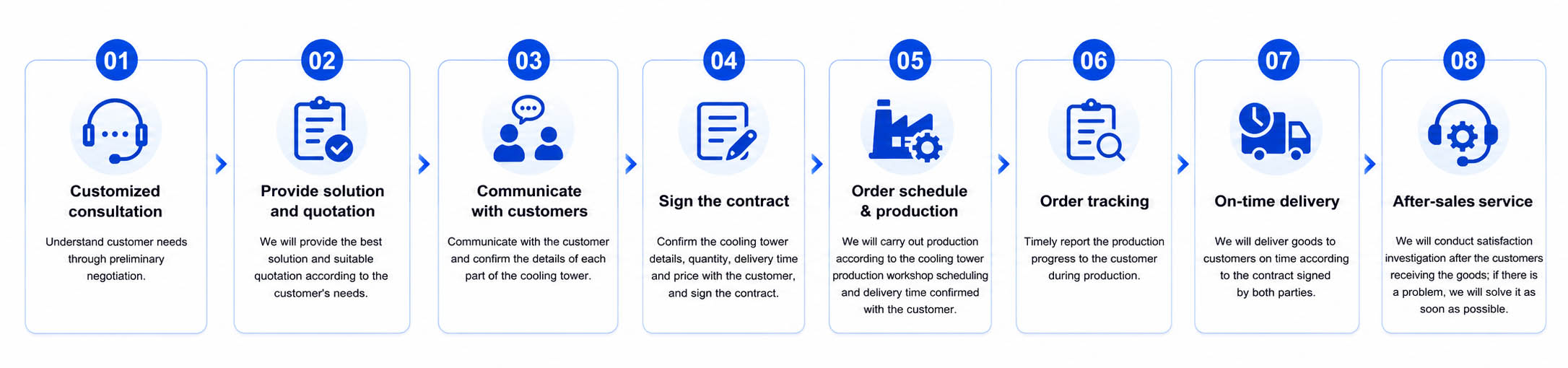
Designed around plant type, condenser load, auxiliary heat load, flow rate, inlet/outlet temperature and ambient conditions.
Configured as wet open cooling, closed circuit cooling, dry cooling, adiabatic cooling or hybrid cooling.
Adjusted for water quality, corrosion, standby capacity, multi-cell layout, access platforms and plant control integration.
Send your plant type, equipment served, heat load, water or fluid flow rate, inlet and outlet temperature,
water source, water quality, dry bulb or wet bulb design condition, environmental limits and redundancy requirements.
Our engineering team will review whether open cooling, closed circuit cooling, dry cooling or hybrid cooling is more suitable.
These FAQs are written for power plant engineers, EPC contractors, utility system designers and industrial buyers who need to understand
power plant cooling tower selection, wet vs dry cooling, auxiliary cooling, natural vs mechanical draft towers, water strategy,
reliability, maintenance and quotation data.
A power plant cooling tower solution is a heat rejection system designed to remove heat from steam turbine condensers, generator auxiliary systems, engine jacket water loops, lube oil coolers, compressor cooling systems, heat exchangers and balance-of-plant equipment. It may include open cooling towers, closed circuit cooling towers, dry coolers, hybrid cooling systems, pumps, heat exchangers, controls, water treatment and redundancy planning.
In a power plant, heat is transferred from condensers, engines, generators or auxiliary equipment into circulating water or a closed cooling loop. The warm water is sent to a cooling tower, dry cooler or closed circuit cooling system. Heat is rejected to outdoor air through evaporation, dry air cooling or wetted coil heat transfer. The cooled water or fluid then returns to the condenser or equipment cooling loop.
The best cooling system depends on plant size, water availability, cooling load, condenser requirements, environmental limits and equipment served. Large steam plants may use field-erected or natural draft cooling towers, while smaller power plants, captive power plants, biomass plants, gas engine plants and auxiliary systems may use mechanical draft cooling towers, closed circuit cooling towers, dry coolers or hybrid cooling systems.
Natural draft cooling towers use the density difference between warm moist air inside the tower and cooler ambient air outside the tower to create airflow. They are commonly associated with very large power plants. Mechanical draft cooling towers use fans to move air and are more common for modular, package, industrial and auxiliary power plant cooling systems. Mechanical draft towers are easier to modularize and control at smaller and medium capacities.
Wet cooling can usually achieve lower cooling water temperatures because it relies on evaporation and wet bulb temperature. Dry cooling saves water but is limited by ambient dry bulb temperature and often requires larger heat exchange area. Power plants with limited water availability, environmental restrictions or plume concerns may consider dry or hybrid cooling, while plants prioritizing lower condenser temperature may use wet cooling where water is available.
A closed circuit cooling tower is suitable for auxiliary cooling loops where the fluid should remain clean or protected, such as generator cooling water, engine jacket water, lube oil cooler loops, glycol systems, compressor cooling, transformer cooling support or sensitive heat exchanger loops. The process fluid stays inside a coil, reducing contamination from outdoor air and spray water.
Important data includes heat load, circulating water flow rate, inlet and outlet water temperature, design wet bulb or dry bulb temperature, plant type, equipment served, condenser or heat exchanger requirements, water source, water quality, water availability, operating hours, redundancy requirement, footprint, environmental limits, plume concerns, noise requirement, power supply and material preference.
Water availability is one of the most important selection factors. Wet cooling uses evaporation and blowdown, so it requires reliable makeup water. Dry cooling significantly reduces water use but may increase equipment size and fan power. Hybrid cooling can reduce water use compared with wet cooling while improving peak performance compared with dry-only cooling. The correct choice depends on local climate, water cost, discharge limits and plant performance targets.
Common material options include FRP casing, galvanized steel, stainless steel 304 or 316, aluminum-zinc coated panels, concrete structures for large field-erected towers, PVC or PP fill, drift eliminators, spray nozzles, coated coils, stainless steel coils, carbon steel coils, axial fans, gearboxes or direct-drive motors. Material selection depends on water quality, corrosion environment, temperature, load and expected service life.
To request a quotation, send the plant type, equipment served, heat load, circulating water or fluid flow rate, inlet and outlet temperature, design wet bulb or dry bulb temperature, project location, water quality, water availability, open or closed loop preference, operating hours, redundancy requirement, footprint, environmental requirements, noise limit, power supply and material preference.
Send us your plant type, equipment served, heat load, circulating water or fluid flow rate, inlet and outlet temperature,
design wet bulb or dry bulb temperature, project location, water source, water quality, water availability, open or closed loop preference,
operating hours, redundancy requirement, footprint, environmental requirements, noise limit, power supply and material preference.
We will help you evaluate the right power plant cooling tower solution.