Different Process Temperatures
Extrusion, blow molding, film, sheet and thermoforming lines may need different water temperatures and flow stability.
Plastic processing plants need stable cooling to control product quality, protect machines, reduce cycle time, maintain line speed and support continuous production. A professional cooling solution may include cooling towers, closed circuit cooling towers, dry coolers, chillers, heat exchangers, pump stations, filtration and water treatment.
This page explains how plastic processing cooling systems work, how to choose between cooling towers, closed circuit towers, dry coolers and chiller-assisted systems, and what engineering data is needed for injection molding, extrusion, blow molding, film, sheet, pipe, profile, compounding, pelletizing and plastic recycling applications.
Plastic processing cooling is more than general factory cooling. It affects mold temperature, die stability, roll temperature, water bath temperature, line speed, part shrinkage, product dimensions, film stability, pipe ovality, pelletizing quality and the life of hydraulic and mechanical systems.
A complete plastic processing cooling solution may combine central cooling towers, chillers, dry coolers, closed circuit cooling towers, heat exchangers, process water tanks, filtration, pump stations and temperature control units. The correct configuration depends on process type, plastic material, required water temperature, production capacity, water quality, ambient climate and future expansion.
Plastic processing plants often combine many processes in one factory. A single generic cooling loop can be too dirty, too warm or too unstable for critical tooling.
Extrusion, blow molding, film, sheet and thermoforming lines may need different water temperatures and flow stability.
Scale or rust in narrow passages can affect die temperature, calibration tanks and product dimensions.
Cooling instability can cause warpage, uneven thickness, slow line speed or dimensional drift.
Hydraulic systems, compressors, chillers and vacuum pumps may share cooling demand with process lines.
Plastic processing cooling must stabilize tooling temperature, protect dies and molds, support line speed and control auxiliary heat loads. Extrusion, blow molding, film, sheet, pipe and thermoforming lines may not all need the same cooling loop.
Thermocore products are selected by process temperature and cleanliness: open towers for general plant cooling, closed circuit towers for clean tooling loops, dry coolers for water-saving higher-temperature loops, and chiller-assisted systems for precision dies, rolls or molds.
Plastic processing heat is created at dies, molds, rolls, calibration tanks, hydraulic systems and auxiliary equipment. Thermocore equipment is selected after separating general utility loads from precision tooling loads.

Plastic processing cooling should be selected according to required water temperature, process precision, water quality, production capacity, plant climate and whether the system needs open or closed loop operation.
Cost-effective evaporative cooling for general process water, hydraulic oil cooling and plant utility cooling where open water exposure is acceptable.
Closed-loop evaporative cooling that protects process water from outdoor contamination and reduces fouling in molds, dies and heat exchangers.
Closed-loop air cooling for water-saving operation, glycol loops, free cooling and auxiliary machine cooling.
Used when the process needs lower or more precise water temperature than cooling towers or dry coolers can provide.
Plastic processing selection should separate general utility cooling from clean tooling or precision temperature needs.
| Industry Condition | Better-Fit Product | Why It Fits | Selection Caution |
|---|---|---|---|
| General extrusion, blow molding or utility process water | Open Cooling Tower | Economical cooling for broad plant heat rejection where open water is acceptable. | Needs filtration and treatment to protect tooling and heat exchangers. |
| Clean tooling, calibration or protected process loop | Closed Circuit Cooling Tower | Keeps process water closed and reduces contamination of dies, molds and exchangers. | Coil scaling and spray water treatment must still be managed. |
| Precise roll, die, film or sheet temperature control | Chiller-Assisted System | Provides stable lower temperature for quality-sensitive plastic processes. | Higher energy use should be controlled with staging and free cooling where possible. |
| Water-saving site or higher-temperature loop | Dry Cooler | Closed-loop low-water cooling for suitable ambient and temperature conditions. | May need chiller backup for low-temperature requirements. |
The best solution depends on the required process temperature, water quality risk, climate, energy target, maintenance capability and product precision requirement.
| Item | Open Cooling Tower | Closed Circuit Cooling Tower | Dry Cooler | Chiller-Assisted System |
|---|---|---|---|---|
| Cooling Principle | Direct evaporative cooling of circulating water | Closed fluid coil cooled by spray water and air | Finned coil rejects heat to ambient air | Mechanical refrigeration cools process water or glycol |
| Temperature Capability | Limited by wet bulb temperature and approach | Evaporative performance with closed-loop protection | Limited by dry bulb temperature and coil approach | Can provide lower and more precise water temperature |
| Water Cleanliness | Water exposed to air, dust and biological growth | Process fluid protected inside coil | Process fluid protected inside finned coil | Usually closed chilled water loop, still requires treatment |
| Best Fit | General plant process water and cost-sensitive systems | Clean loops for molds, dies, rolls, hydraulic systems and heat exchangers | Water-saving sites, glycol loops and free cooling | Precision temperature control, hot climates and high-quality production |
| Main Caution | Scale, corrosion, fouling and water treatment | Coil scaling, spray water treatment and material selection | Higher outlet temperature in hot climates | Higher energy use and refrigeration maintenance |
These are the practical failure points to check before choosing between an open cooling tower, closed circuit cooling tower, dry cooler or evaporative condenser.
Cooling that cannot hold temperature can slow extrusion, molding or forming output.
Uneven cooling can create warpage, shrinkage, thickness variation or unstable calibration.
Scale and rust can restrict narrow die, mold or roll cooling channels.
Compressors, hydraulic oil and chillers can overload the cooling system if ignored.
Different plastic processes have different cooling priorities. A broad “plastic processing cooling” solution should not treat injection molding, extrusion, film, sheet, blow molding and recycling lines as the same cooling problem.
Mold temperature, cooling water flow, cycle time, shrinkage and hydraulic oil cooling are the main concerns.
Die cooling, barrel cooling, calibration tanks, water baths, gearboxes and line speed stability are key.
Chill rolls, air rings, thickness control and surface quality may require stable low-temperature cooling.
Mold cooling, hydraulic oil cooling, compressor cooling and cycle stability affect bottle and container quality.
Vacuum calibration tanks, spray baths, sizing sleeves and water temperature control affect dimensional accuracy.
Strand cooling, water-ring pelletizing, extruder cooling, filtration and process water cleanliness are important.
A professional plastic processing solution page should connect the cooling system to the actual factory equipment and heat sources.
Cooling channels in molds and dies control product solidification, shape and surface quality.
Process water removes heat from pipes, profiles, strands, sheets and extruded products.
Roll temperature control affects film, sheet, thickness stability and surface finish.
Oil cooling protects pumps, seals, valves and machine reliability.
Provide low-temperature or precision water for demanding plastic processes.
Cooling for strand pelletizing, water-ring pelletizers and recycling extrusion lines.
Auxiliary cooling for compressors, vacuum systems, dryers and plant utilities.
Separate clean and dirty water loops, protect equipment and maintain stable cooling performance.
Plastic processing cooling selection should consider the production process, product quality target, temperature requirement, heat load, water quality and future expansion plan.
Plastic processing cooling selection can start with process type and machine data. If exact heat load is not available, production capacity, installed power, water flow and temperature requirement can support preliminary selection.
| Required Data | Why It Matters |
|---|---|
| Plastic Process Type | Injection, extrusion, film, sheet, blow molding, pelletizing or recycling changes cooling requirements. |
| Machine Quantity and Installed Power | Helps estimate total heat load and future cooling capacity. |
| Plastic Material | Affects processing temperature, cooling rate and product quality sensitivity. |
| Production Capacity / Throughput | Important for estimating resin heat removal and line cooling demand. |
| Required Cooling Water Temperature | Determines whether tower water is enough or a chiller is required. |
| Water Flow Rate and Temperature Difference | Allows direct heat load calculation when available. |
| Hydraulic Oil / Auxiliary Cooling Load | Important for machine reliability and total plant heat rejection. |
| Design Wet Bulb Temperature | Required for open and closed evaporative cooling tower selection. |
| Design Dry Bulb Temperature | Required for dry cooler and air-cooled system selection. |
| Water Quality and Open/Closed Loop Preference | Affects fouling control, filtration, treatment and system configuration. |
| Factory Layout and Expansion Plan | Determines equipment location, pump station, piping and future capacity reservation. |
In plastic processing, cooling stability affects both the production line and the final product. A well-designed cooling system helps reduce scrap, improve repeatability and protect machine uptime.
Stable water temperature and sufficient flow can reduce cooling bottlenecks in molding, extrusion, sheet, film and pelletizing lines.
Consistent cooling helps control shrinkage, thickness, ovality, flatness and profile accuracy.
Correct cooling can reduce warpage, sink marks, surface haze, uneven gloss, internal stress and unstable film/sheet appearance.
Plastic processing cooling circuits can include small mold channels, die cooling passages, roll cooling circuits, heat exchangers and chiller evaporators. Poor water quality can quickly reduce flow and heat transfer.
Hard water can create scale inside molds, dies, heat exchangers, chillers and cooling tower circuits.
Rust, particles, plastic fines, biofilm and suspended solids can block nozzles, filters, molds, dies and exchangers.
Open water systems need treatment to reduce corrosion and biological growth that can affect process stability.
Maintenance should focus on stable flow, clean heat transfer surfaces, correct water treatment and reliable control. Neglected cooling systems can increase scrap, energy use and machine downtime.
Inspect basins, fill, nozzles, coils, fans, motors and water distribution to maintain heat rejection capacity.
Filters, strainers, tanks, manifolds, molds, dies, rolls and heat exchangers should be kept clean.
Temperature sensors, pumps, chiller controls and tower controls should be checked to maintain stable process cooling.
Plastic processing cooling systems can be customized according to process type, machine count, product quality target, water temperature, cooling load, water quality, factory layout, energy strategy and future expansion.
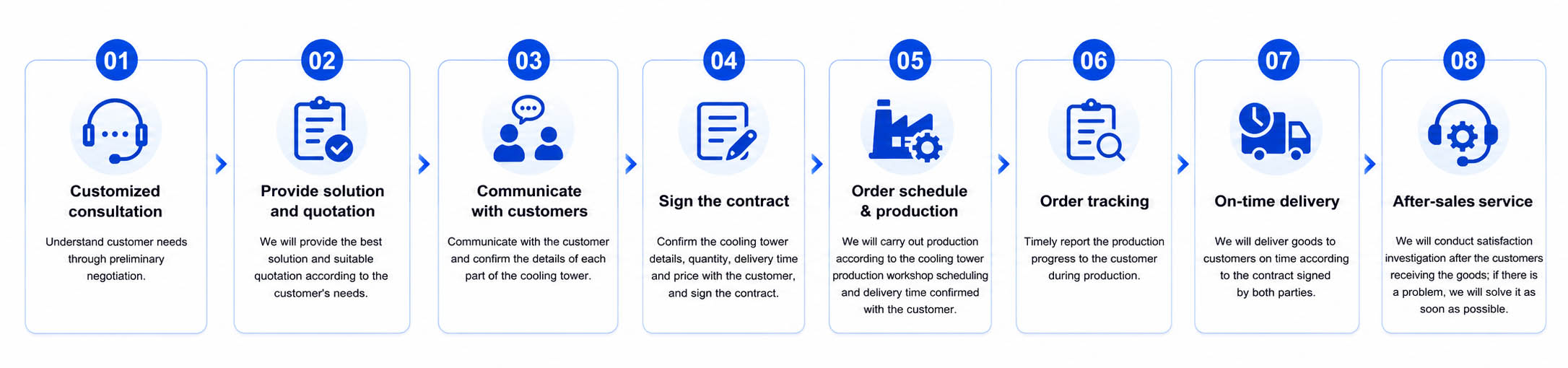
Designed around injection molding, extrusion, film, sheet, pipe, blow molding, pelletizing or recycling equipment.
Configured as open cooling tower, closed circuit cooling tower, dry cooler, adiabatic cooler, chiller-assisted or combined central plant.
Adjusted for filtration, water treatment, process tanks, heat exchanger separation, pump station, low-noise design and expansion.
Send your process type, machine quantity, installed power, plastic material, production capacity, required cooling water temperature, water quality, project location and expansion plan. Our engineering team will review whether an open cooling tower, closed circuit cooling tower, dry cooler, chiller-assisted system or combined central cooling plant is more suitable.
These FAQs are written for plastic processing plants, extrusion line builders, injection molding factories, recycling line operators, equipment integrators and industrial buyers who need to understand process water cooling, cooling tower vs chiller selection, closed-loop cooling, water quality, energy control, maintenance and quotation data.
A plastic processing cooling solution is a process cooling and heat rejection system designed to remove heat from plastic production equipment such as injection molding machines, extrusion lines, blow molding machines, film lines, sheet lines, pipe and profile lines, pelletizing systems, recycling lines, hydraulic systems, chillers and mold or die cooling circuits. The goal is to maintain stable process temperature, protect equipment, improve product quality and support continuous production.
Plastic processing generates heat from molten resin, motors, hydraulics, dies, molds, barrels, rollers, gearboxes and auxiliary equipment. Cooling water, chilled water, glycol or oil cooling loops absorb this heat and transfer it to a cooling tower, closed circuit cooling tower, dry cooler, chiller, heat exchanger or combined central cooling plant. The cooled fluid then returns to machines, molds, dies, rolls or water baths.
Cooling may be required for injection molds, extrusion dies, calibration tanks, water baths, haul-off cooling, chill rolls, hydraulic oil coolers, gearboxes, pelletizing water systems, air compressors, vacuum pumps, blown film air rings, sheet rolls, pipe/profile calibration systems, recycling pelletizing lines and central process water loops.
A cooling tower is suitable when the required cooling water temperature can be achieved above the outdoor wet bulb temperature. A chiller is required when the process needs lower or more precise water temperature, such as precision molding, film or sheet cooling, chilled rolls, high-speed extrusion, hot climates or engineering plastics. Many plastic plants use both: a cooling tower for general heat rejection and a chiller for low-temperature or precision loops.
A closed circuit cooling tower is suitable when the plant wants to keep process water clean, reduce fouling in molds, dies, heat exchangers and calibration systems, protect glycol or treated water loops, or reduce contamination from outdoor air and open tower water. It is useful for precision molds, extrusion dies, hydraulic oil cooling, recycling pelletizing support and plants with poor water quality.
A dry cooler is suitable when water saving, closed-loop operation, lower water treatment complexity, free cooling or plume reduction is important, and when the required outlet fluid temperature can be achieved above ambient dry bulb temperature. Dry coolers can serve hydraulic oil cooling, glycol loops, extrusion auxiliary cooling, machine cooling, compressor cooling and process water pre-cooling.
Important data includes process type, machine quantity, installed power, plastic material, production capacity, process heat load, cooling water flow rate, inlet and outlet temperature, required water temperature, mold or die temperature requirement, chiller capacity if existing, hydraulic oil cooling load, design wet bulb or dry bulb temperature, project location, water quality, open or closed loop preference, footprint, noise requirement and expansion plan.
Water quality affects scale, corrosion, biological growth, fouling, blocked mold channels, die cooling instability, heat exchanger performance, pump reliability and chiller efficiency. Hard water, rust, suspended solids and biofilm can reduce flow and create uneven cooling. Closed loops, filtration, water treatment and proper material selection help protect equipment.
Open loop cooling exposes circulating water to air through a cooling tower, which can be economical but may introduce dust, oxygen, minerals and biological contamination. Closed loop cooling keeps process fluid isolated from the outdoor environment, reducing fouling and corrosion risk in molds, dies, rolls and heat exchangers. Closed loops usually require a closed circuit tower, dry cooler, chiller or heat exchanger.
To request a quotation, send the plastic process type, machine quantity, installed power, plastic material, production capacity, required cooling water temperature, water flow rate if available, inlet and outlet temperature, chiller capacity if existing, hydraulic oil cooling load, wet bulb or dry bulb design temperature, project location, water quality, open or closed loop preference, footprint, noise limit, power supply and expansion plan.
Send us your plastic process type, machine quantity, installed power, plastic material, production capacity, required cooling water temperature, water flow rate if available, inlet and outlet temperature, existing chiller capacity if any, hydraulic oil or auxiliary cooling load, design wet bulb or dry bulb temperature, project location, water quality, open or closed loop preference, footprint, noise limit, power supply and expansion plan. We will help you evaluate the right plastic processing cooling solution.