High Discharge Temperature
Poor intercooling or aftercooling increases discharge temperature, moisture load and compressor trip risk.
Compressors generate heat during air or gas compression, and stable cooling is essential for discharge temperature control, oil temperature protection, bearing reliability, moisture management and continuous operation. A professional compressor cooling solution may include intercoolers, aftercoolers, oil coolers, jacket water coolers, closed circuit cooling towers, dry coolers, cooling towers, chillers, heat exchangers, glycol loops, pumps and monitoring systems.
This page explains how compressor cooling systems work, how to choose between cooling towers, closed circuit towers, dry coolers and chiller-assisted systems, and what engineering data is needed for air compressors, process gas compressors, refrigeration compressors, hydrogen compressors, natural gas compressors, CO₂ compressors and industrial compressor stations.
Compressor cooling is not only about removing heat from compressed air or gas. It directly affects compressor efficiency, discharge temperature, oil life, bearing protection, gas moisture behavior, compressor alarms, downstream drying, process stability and machine uptime.
A complete compressor cooling solution should identify each heat source: intercooler duty, aftercooler duty, oil cooler duty, jacket water duty, motor or drive cooling, seal cooler duty and auxiliary equipment loads. The heat rejection method should then be selected according to required cooling fluid temperature, ambient condition, water quality, gas type, redundancy and maintenance strategy.
A compressor package can lose capacity or trip even when the nominal cooler size looks correct. The key is controlling temperatures under peak load, dirty water and changing ambient conditions.
Poor intercooling or aftercooling increases discharge temperature, moisture load and compressor trip risk.
Dirty water, scale or corrosion can reduce oil cooler performance and raise lubricant temperature.
Gas compressor stations may need simple closed loops, glycol protection, reliable controls and low-maintenance heat rejection.
Load/unload cycles, seasonal air temperature and multiple compressor sequencing change the actual heat rejection requirement.
Compressor cooling must keep discharge temperature, oil temperature, intercooler performance and aftercooler performance under control. A compressor package can lose capacity, trip on temperature or damage lubricant even when the nominal cooling capacity looks sufficient.
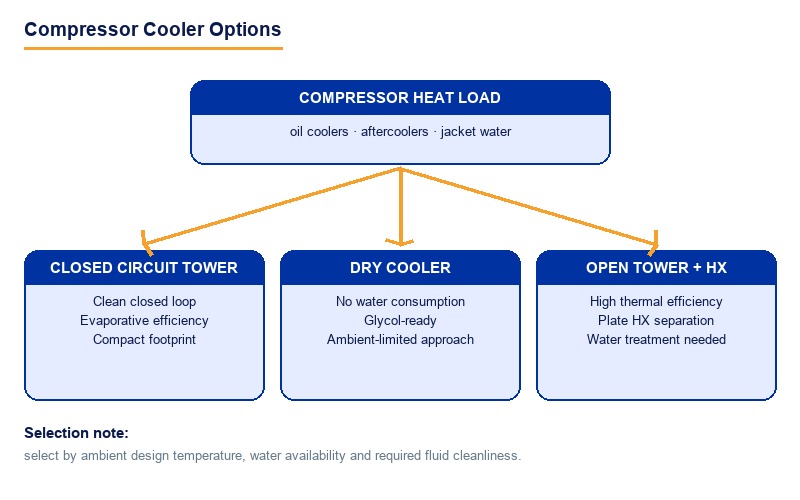
Thermocore product selection depends on compressor type, cooling fluid, water cleanliness and site conditions. Open towers can serve general utility cooling, closed circuit towers protect jacket water or glycol loops, dry coolers fit remote low-water stations, and evaporative condensers support refrigeration compressor condensing.
The cooling path depends on whether heat comes from compressed air, process gas, oil, jacket water or refrigerant condensing. Thermocore equipment rejects that heat while keeping the compressor-side loop clean when required.
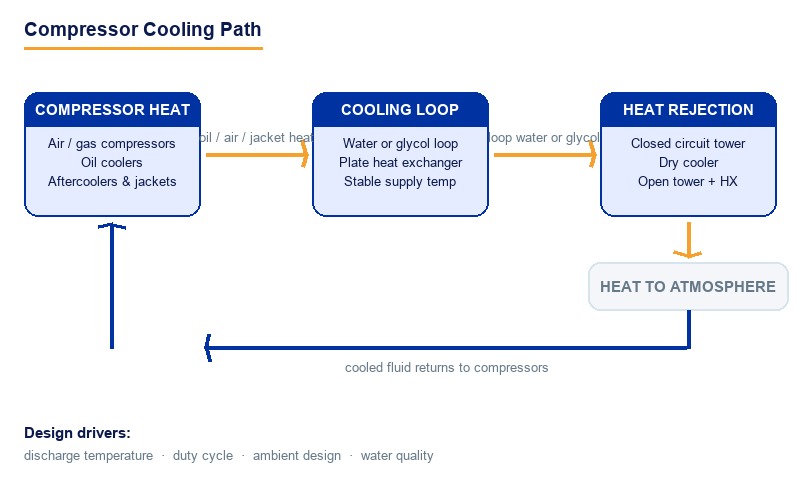
Compressor cooling should be selected according to heat load, fluid temperature target, gas type, water quality, ambient climate, water availability and operating reliability requirements.
Closed-loop evaporative cooling for clean compressor cooling water, glycol loops, oil cooler loops and sensitive process compressor auxiliaries.
Water-saving closed-loop cooling for oil coolers, jacket water circuits, glycol loops and compressor stations in suitable climates.
Efficient wet cooling for plant circulating water systems serving multiple compressor coolers and process heat exchangers.
Used when the compressor or downstream process requires lower or more precise cooling fluid temperature than ambient heat rejection can provide.
Compressor cooling should match the compressor package, cooling fluid and maintenance reality.
| Industry Condition | Better-Fit Product | Why It Fits | Selection Caution |
|---|---|---|---|
| Plant air compressor aftercoolers and utility water loops | Open Cooling Tower | Economical cooling for general compressor rooms where treated open water is acceptable. | Heat exchangers and oil coolers need protection from scale, mud and biological fouling. |
| Jacket water, oil cooling or clean glycol loop | Closed Circuit Cooling Tower | Keeps the compressor-side fluid clean while using evaporative performance outdoors. | Check coil pressure drop, glycol concentration, spray water quality and coil material. |
| Remote compressor station or water-saving requirement | Dry Cooler | Simple closed-loop cooling with glycol option and low water consumption. | Capacity is tied to dry bulb temperature, so hot-day discharge temperature must be checked. |
| Refrigeration compressor condensing duty | Evaporative Condenser | Lowers condensing temperature for refrigeration systems compared with many dry-only options. | Requires refrigerant, pressure rating, oil return and maintenance planning. |
The best compressor cooling solution depends on required cooling water temperature, water strategy, cooler cleanliness, climate and compressor duty profile.
| Item | Closed Circuit Cooling Tower | Dry Cooler | Open Cooling Tower | Chiller-Assisted Cooling |
|---|---|---|---|---|
| Cooling Principle | Closed fluid coil cooled by spray water and air | Finned coil rejects heat to ambient air | Direct evaporative cooling of circulating water | Mechanical refrigeration cools water or glycol |
| Fluid Cleanliness | Compressor-side fluid protected inside coil | Compressor-side fluid protected inside finned coil | Water exposed to air, dust and biological growth | Usually closed chilled water or glycol loop |
| Temperature Capability | Wet-bulb-based evaporative performance | Dry-bulb-limited outlet temperature | Wet-bulb-based lower water temperature | Lower and more precise temperature possible |
| Best Fit | Oil coolers, jacket water, clean compressor cooling and process gas systems | Water-saving compressor stations and closed glycol loops | Large plant utility loops and cost-sensitive circulating water | Process-critical low-temperature compressor cooling |
| Main Caution | Spray water treatment and coil maintenance | Higher temperatures in hot climates | Water treatment, fouling and contamination risk | Higher energy use and refrigeration maintenance |
These are the practical failure points to check before choosing between an open cooling tower, closed circuit cooling tower, dry cooler or evaporative condenser.
Insufficient cooling can trigger high discharge temperature, high oil temperature or compressor protection shutdowns.
Open water without filtration or treatment can clog aftercoolers and oil coolers.
Sizing only for average weather can cause derating during the hottest production days.
Dirty utility water in sensitive compressor loops can increase maintenance and shorten cooler life.
Compressor cooling is usually divided into several heat sources. A professional cooling design should identify each cooler duty instead of treating the compressor as one single heat load.
Removes heat between compression stages to improve multistage compression reliability and reduce next-stage inlet temperature.
Removes heat from final compressed gas before dryers, receivers, process equipment or downstream piping.
Protect lubrication, bearings, seals, cylinder jackets and compressor auxiliaries from high operating temperatures.
A strong compressor cooling page should connect the heat rejection system with the actual compressor package components that generate heat.
Between-stage cooling for multistage reciprocating, centrifugal or process gas compressors.
Final discharge gas cooling before separators, dryers, receivers or process equipment.
Lubricating oil cooling to protect bearings, seals, gears and compressor reliability.
Cooling for cylinders, casings, engine-driven compressor jackets and water-cooled components.
Cooling for critical rotating equipment auxiliaries and seal support systems.
Aftercooling and temperature control to support moisture removal and dryer performance.
Plate, shell-and-tube or finned exchangers separating compressor loops from tower water or process fluids.
Cooling water pumps, valves, filters, sensors, alarms and control panels supporting stable operation.
Compressor cooling design should consider gas type, compression ratio, cooler duty, fluid temperature, water quality, ambient condition and operating reliability. Incorrect cooling can reduce compressor performance and increase shutdown risk.
Compressor cooling selection should include compressor data, cooler duty and cooling fluid conditions. If exact cooler duty is not available, compressor model, installed power and existing temperature data can support preliminary selection.
| Required Data | Why It Matters |
|---|---|
| Compressor Type and Model | Defines cooling circuits, heat load distribution and manufacturer limits. |
| Gas Type and Gas Flow | Affects heat load, safety, condensation risk and cooler material selection. |
| Operating Pressure and Number of Stages | Important for intercooler, aftercooler and discharge temperature control. |
| Installed Power or Heat Rejection Load | Helps determine total cooling capacity. |
| Intercooler / Aftercooler Duty | Defines gas cooling requirements and cooling water demand. |
| Oil Cooler and Jacket Water Load | Important for compressor reliability and auxiliary cooling design. |
| Cooling Fluid Type and Flow Rate | Determines pump sizing, heat exchanger sizing and loop configuration. |
| Inlet and Outlet Fluid Temperature | Defines cooling range and heat rejection equipment selection. |
| Design Wet Bulb Temperature | Required for cooling tower and closed circuit tower selection. |
| Design Dry Bulb Temperature | Required for dry cooler, air cooler and adiabatic cooler selection. |
| Water Quality, Footprint and Redundancy | Affects material selection, open/closed loop design and service reliability. |
Compressor cooling should be designed around the compressor’s allowable temperatures and downstream process requirements. The lowest possible cooling temperature is not always the best choice.
Proper intercooling and aftercooling help reduce thermal stress and protect downstream equipment.
Lubricating oil temperature should remain within the compressor manufacturer’s recommended range.
Aftercooling can condense moisture from compressed air or process gas, so separators and drains may be required.
Compressor coolers often have narrow passages and high heat flux. Poor water quality can quickly reduce heat transfer, increase oil or discharge temperature and trigger compressor shutdowns.
Hard water can create scale inside oil coolers, jacket water coolers, intercoolers and aftercoolers.
Rust, particles and biofilm can block cooler passages, strainers and heat exchangers.
Closed loops, glycol systems and cooling tower water should use compatible corrosion inhibitors and materials.
Maintenance should protect heat transfer performance, oil temperature control, compressor alarms and cooling loop reliability. The system should be easy to clean, inspect and isolate for service.
Intercoolers, aftercoolers, oil coolers and jacket water coolers should be inspected and cleaned based on fouling and pressure drop.
Inspect basins, fill, nozzles, coils, fans, motors and water distribution to maintain heat rejection capacity.
Sensors, valves, pump controls, glycol concentration and water treatment should be checked to prevent high-temperature events.
Compressor cooling systems can be customized according to compressor type, gas service, cooler duty, cooling fluid, water quality, temperature control requirement, hazardous-area boundary, redundancy and site layout.
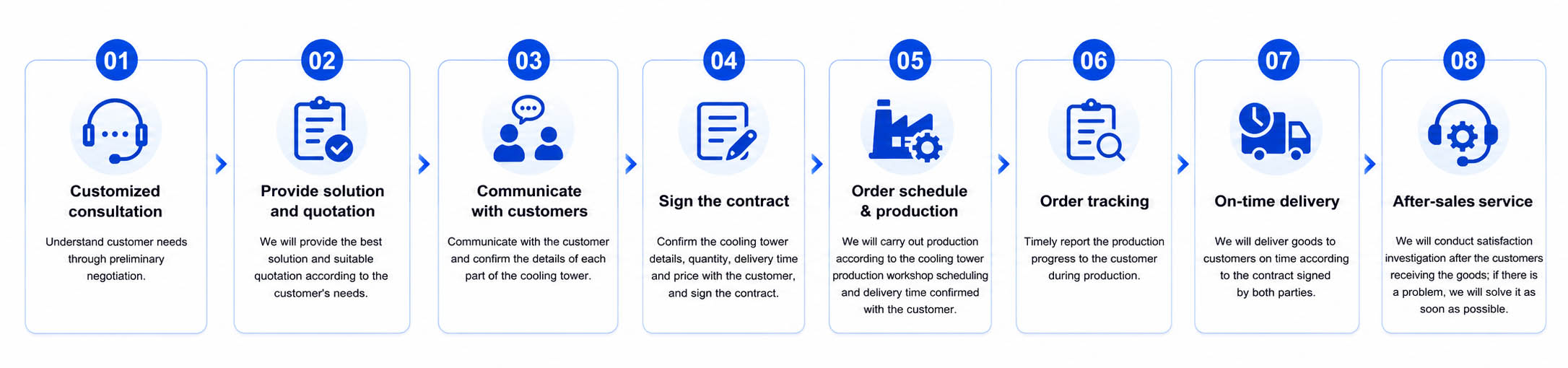
Designed around gas type, stage count, pressure, flow, intercooler, aftercooler, oil cooler and jacket water duty.
Configured as closed circuit cooling, dry cooling, open cooling tower, adiabatic cooling, chiller-assisted or heat exchanger-separated loop.
Adjusted for standby pumps, multi-cell towers, temperature alarms, flow monitoring, glycol, filtration and low-noise operation.
Send your compressor type, model, gas type, gas flow, installed power, operating pressure, intercooler and aftercooler duty, oil cooler and jacket water load, cooling fluid temperature, water quality, wet bulb and dry bulb design data and redundancy requirements. Our engineering team will review whether a closed circuit cooling tower, dry cooler, open cooling tower, chiller-assisted system or heat exchanger-separated loop is more suitable.
These FAQs are written for compressor package suppliers, plant engineers, process gas system integrators, refrigeration contractors, air compressor users and industrial buyers who need to understand intercooling, aftercooling, oil cooling, jacket water cooling, cooling tower vs dry cooler selection, water quality, redundancy, maintenance and quotation data.
A compressor cooling solution is a heat rejection system designed to remove heat from air compressors, process gas compressors, refrigeration compressors, hydrogen compressors, natural gas compressors, biogas compressors, CO2 compressors, instrument air systems and compressor auxiliary equipment. It may include intercoolers, aftercoolers, oil coolers, jacket water coolers, closed circuit cooling towers, dry coolers, open cooling towers, chillers, heat exchangers, pumps, glycol loops, filtration and control systems.
Compressors convert mechanical energy into pressure energy, and compression generates heat. Additional heat is also produced by motors, bearings, lubricating oil, seals and auxiliary systems. Without proper cooling, discharge temperature, oil temperature, bearing temperature or motor temperature can rise, reducing efficiency, damaging components, increasing moisture load and causing shutdown alarms.
Compressor heat is removed through intercoolers, aftercoolers, oil coolers, jacket water circuits, air-cooled radiators, water-cooled heat exchangers or closed-loop cooling systems. The heat is transferred to water, glycol, oil or ambient air. The warm cooling fluid is then sent to a cooling tower, closed circuit cooling tower, dry cooler, chiller or heat exchanger system for heat rejection.
An intercooler removes heat between compression stages, reducing the temperature of the gas before it enters the next stage. An aftercooler removes heat from the compressed gas after the final compression stage. Both improve system reliability and can help reduce moisture load in compressed air systems or protect downstream process equipment.
Air-cooled compressors reject heat directly to ambient air through fans and finned surfaces. Water-cooled compressors transfer heat to cooling water through heat exchangers, oil coolers or jacket water circuits. Water-cooled systems can be more suitable for large compressors, hot environments, indoor installations or process applications where stable cooling is required.
A cooling tower is suitable when low cooling water temperature and efficient wet-bulb-based heat rejection are needed and water treatment is acceptable. A dry cooler is suitable when water saving, closed-loop operation, reduced plume or simpler water-side maintenance is important, and when the required fluid temperature can be achieved above ambient dry bulb temperature. The final selection depends on compressor heat load, outlet temperature target, climate and water strategy.
A closed circuit cooling tower is suitable when the compressor cooling fluid should remain clean and protected from outdoor contamination. It is often used for oil cooler loops, jacket water cooling, glycol circuits, process gas compressor auxiliaries, hydrogen compressor cooling, refrigeration compressor support and industrial plants where fouling of heat exchangers must be minimized.
Important data includes compressor type, gas type, compressor capacity, number of stages, heat rejection load, cooling fluid type, flow rate, inlet and outlet temperature, oil cooling load, jacket water load, intercooler and aftercooler duty, operating pressure, operating hours, design wet bulb and dry bulb temperature, water quality, redundancy requirement, footprint, noise limit and material preference.
Material selection depends on water quality, gas type, temperature, corrosion environment and loop design. Cooling towers may use FRP, galvanized steel, stainless steel, aluminum-zinc panels and PVC/PP fill. Compressor coolers may use copper, stainless steel, carbon steel, titanium or coated tubes depending on process and water chemistry. Closed loops may require compatible inhibitors, glycol and corrosion-resistant pumps or heat exchangers.
To request a quotation, send compressor type, compressor model, gas type, gas flow, number of stages, operating pressure, installed power, heat rejection load if available, intercooler and aftercooler duty, oil cooling and jacket water load, cooling fluid type, flow rate, inlet and outlet temperature, design wet bulb and dry bulb temperature, project location, water quality, operating hours, redundancy target, footprint, noise limit, power supply and material preference.
Send us your compressor type, compressor model, gas type, gas flow, number of stages, operating pressure, installed power, heat rejection load if available, intercooler and aftercooler duty, oil cooling and jacket water load, cooling fluid type, flow rate, inlet and outlet temperature, design wet bulb and dry bulb temperature, project location, water quality, operating hours, redundancy target, footprint, noise limit, power supply and material preference. We will help you evaluate the right compressor cooling solution.