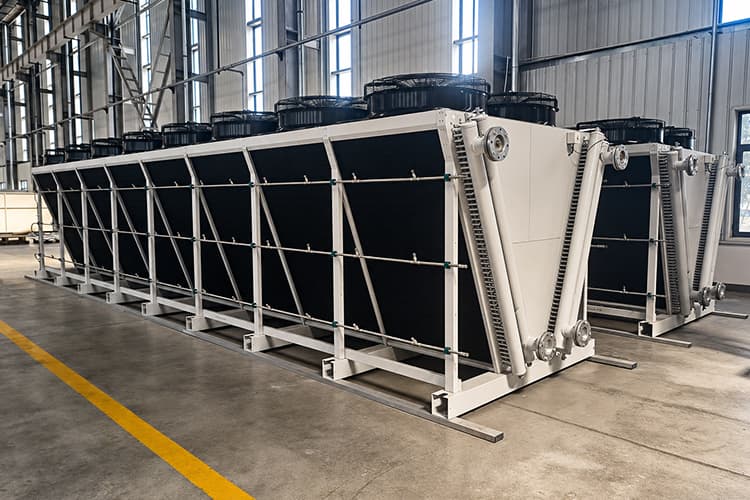
Lower Water Use Than Cooling Towers
Water is used mainly during high ambient conditions instead of continuous evaporative operation.
Thermocore adiabatic coolers are designed for HVAC systems, data centers, industrial process cooling, closed-loop glycol systems, free cooling applications and manufacturing facilities where hot-weather performance, low water consumption and process fluid protection are important.
An adiabatic cooler combines dry finned coil cooling with controlled air pre-cooling. During normal conditions, the unit operates like a dry cooler. During high ambient conditions, the adiabatic section reduces the air temperature before it reaches the coil, improving heat rejection while using far less water than a conventional cooling tower.
An adiabatic cooler is a closed-loop heat rejection system that combines dry coil cooling with evaporative air pre-cooling. Process fluid, water or glycol flows inside finned tube coils and does not directly contact outside air or spray water. Ambient air passes through or across an adiabatic pre-cooling section before reaching the coil when hot-weather assistance is required.
This product is suitable for projects that need better hot-climate performance than a dry cooler, lower water consumption than a cooling tower, and better fluid protection than open evaporative cooling systems.
The system usually operates in dry mode first. Hot fluid flows inside the finned tube coil while fans move ambient air across the coil. When dry cooling is not enough, the adiabatic pre-cooling section activates and reduces the air temperature before the air reaches the coil.

Adiabatic coolers are selected when dry cooling alone cannot maintain the required outlet temperature during hot weather, but the project still needs lower water consumption, closed-loop fluid protection and reduced cooling tower maintenance.
Water is used mainly during high ambient conditions instead of continuous evaporative operation.
Adiabatic air pre-cooling lowers the air temperature entering the coil and improves heat rejection capacity.
The process fluid remains inside the coil and is not exposed to outdoor air or open spray water.
Adiabatic assistance can extend free cooling operation in data center and HVAC systems.
Compared with continuous evaporative cooling towers, adiabatic operation can reduce visible plume in many conditions.
The unit can operate in dry mode, adiabatic assist mode or staged fan control mode according to system demand.
Adiabatic coolers are used where customers need water-saving heat rejection with better peak-temperature performance than standard dry cooling. They are suitable for HVAC, industrial process cooling, data centers and closed-loop utility cooling systems.
Adiabatic coolers and dry coolers both protect the process fluid inside a closed coil. The main difference is that an adiabatic cooler can reduce the entering air temperature during hot conditions, while a dry cooler relies on ambient air only.
| Item | Adiabatic Cooler | Dry Cooler |
|---|---|---|
| Cooling Method | Dry coil cooling with adiabatic air pre-cooling when needed | Dry sensible air cooling only |
| Water Use | Intermittent water use during adiabatic operation | No water use in standard dry operation |
| Hot-Weather Performance | Better than dry cooler under high ambient conditions | Limited by dry bulb temperature |
| Maintenance | Coils, fans, adiabatic media, water distribution and controls | Coils, fans, controls and fluid loop |
| Best For | Projects needing water saving and better peak ambient performance | Projects where water use should be avoided completely |
| Selection Logic | Choose when dry cooling alone is not enough in hot weather | Choose when outlet temperature target is achievable by dry cooling |
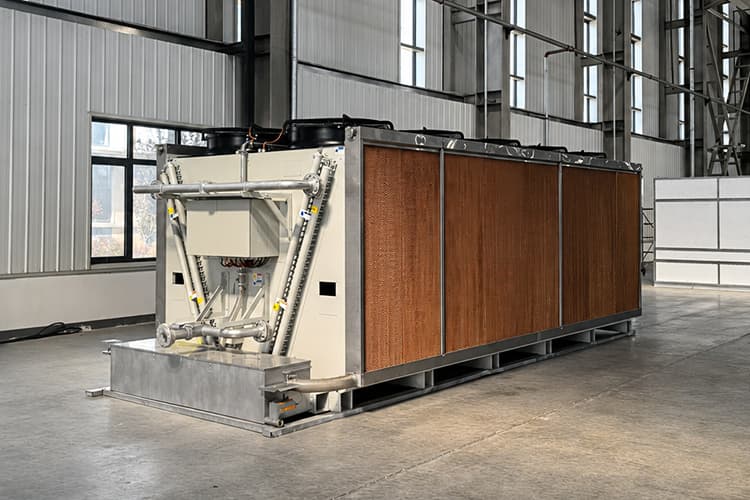
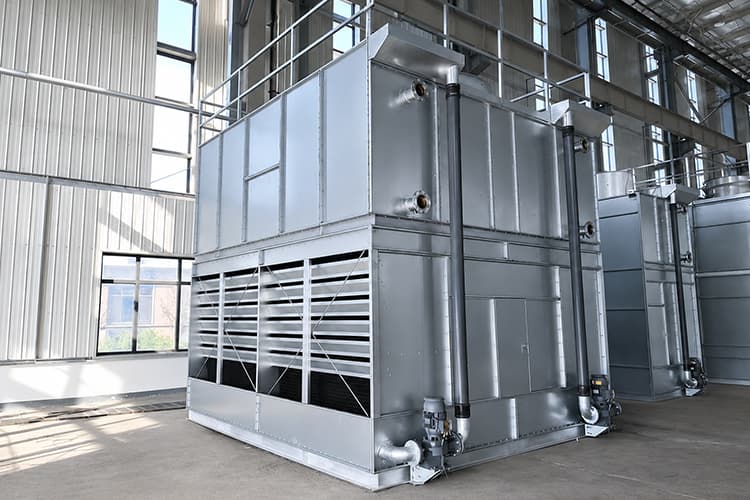
These systems all reject heat, but they use water differently. An adiabatic cooler uses water to pre-cool air only when needed, a cooling tower exposes circulating water directly to air, and a closed circuit cooling tower uses spray water over a closed coil.

| Item | Adiabatic Cooler | Open Cooling Tower | Closed Circuit Cooling Tower |
|---|---|---|---|
| Fluid Protection | Process fluid stays inside dry finned coil | Circulating water is exposed to air | Process fluid stays inside coil |
| Water Use | Intermittent, usually lower annual use | Continuous make-up water required | Spray water loop required during evaporative operation |
| Cooling Limit | Between dry bulb and wet bulb depending on adiabatic effectiveness | Limited by wet bulb temperature | Limited by wet bulb and coil heat transfer |
| Water Treatment | Required for adiabatic water section | Required for open circulating water | Required for spray water loop |
| Best For | Water-saving closed-loop cooling with peak ambient support | Lowest practical evaporative water temperature | Closed-loop fluid protection with evaporative performance |
Selecting an adiabatic cooler requires fluid data, ambient air conditions, water quality and operating strategy. A professional selection should consider heat load, fluid type, glycol concentration, dry bulb, wet bulb, annual operating hours, water availability, fan control and desired dry/adiabatic operating sequence.
| Parameter | Why It Matters |
|---|---|
| Heat Rejection Capacity | Determines cooler size and required heat transfer capability. |
| Fluid Type | Water, glycol or process fluid affects heat transfer and pressure drop. |
| Glycol Concentration | Affects viscosity, freezing point, coil sizing and pump power. |
| Fluid Flow Rate | Influences coil circuiting, pressure drop and heat transfer. |
| Inlet / Outlet Fluid Temperature | Defines the required cooling duty and approach target. |
| Design Dry Bulb Temperature | Defines peak dry air cooling condition. |
| Design Wet Bulb Temperature | Helps evaluate adiabatic pre-cooling effectiveness. |
| Water Quality | Affects media life, scaling risk and water treatment requirements. |
| Operating Hours | Determines expected annual water use and adiabatic system duty. |
| Noise Requirement | Affects fan selection, fan speed and control strategy. |
| Control Strategy | Determines dry mode, adiabatic mode, fan staging and water activation logic. |
Performance depends on the finned coils, adiabatic media, water distribution system, fans, controls, casing, frame and airflow path. Each component should support stable dry operation, controlled adiabatic assistance and practical maintenance.
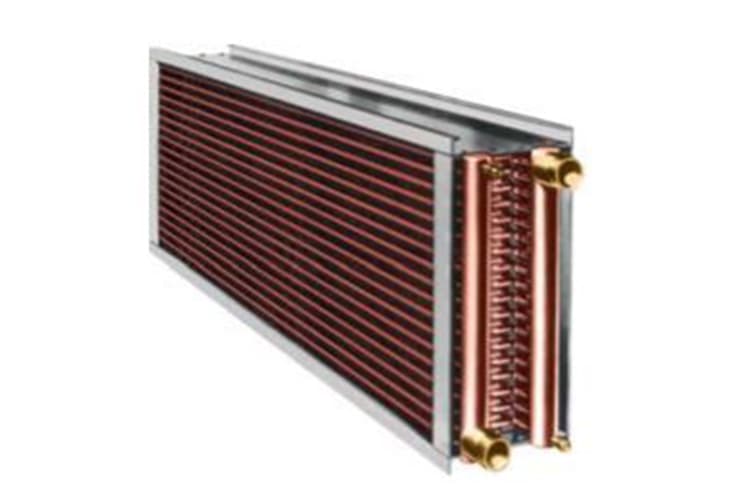
The closed heat exchange core where process fluid rejects heat to air.

Pre-cools the incoming air through controlled water evaporation.

Supplies water evenly to the adiabatic media or pre-cooling section.

Moves air through the pre-cooling and coil sections.
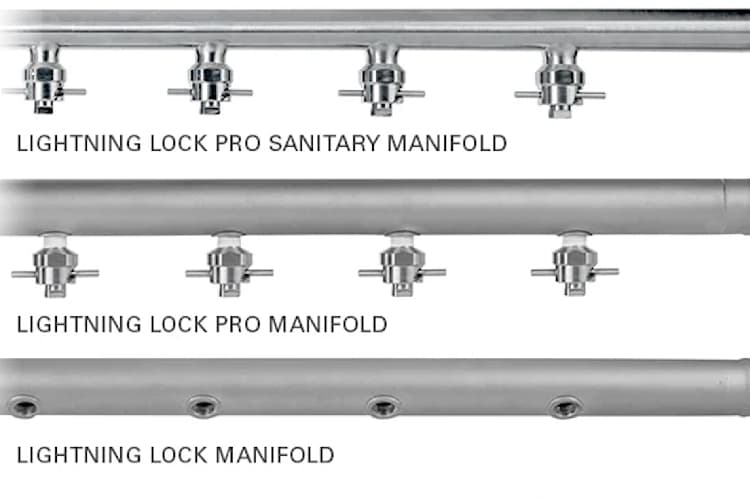
Distributes fluid into coil circuits and collect cooled fluid from the unit.
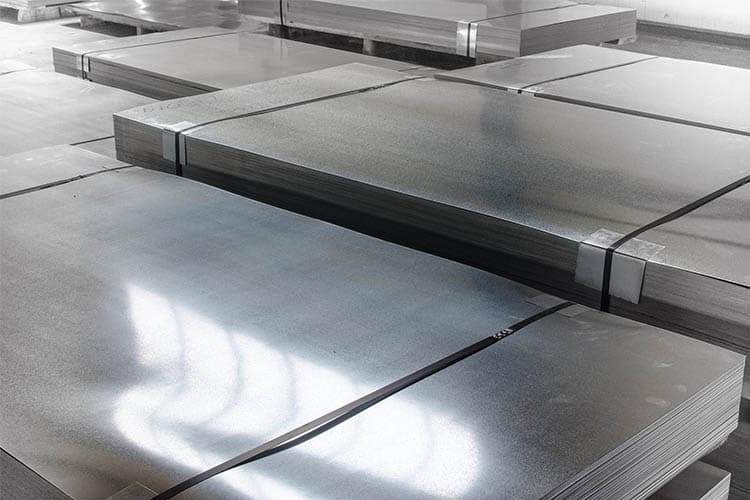
Support outdoor installation, airflow path and component protection.
Material selection affects corrosion resistance, heat transfer, water-side durability, service life and maintenance cost. The best configuration depends on fluid type, water quality, ambient environment, coastal exposure, industrial pollution and budget.

Coil material should match heat transfer requirements, fluid compatibility and corrosion environment.
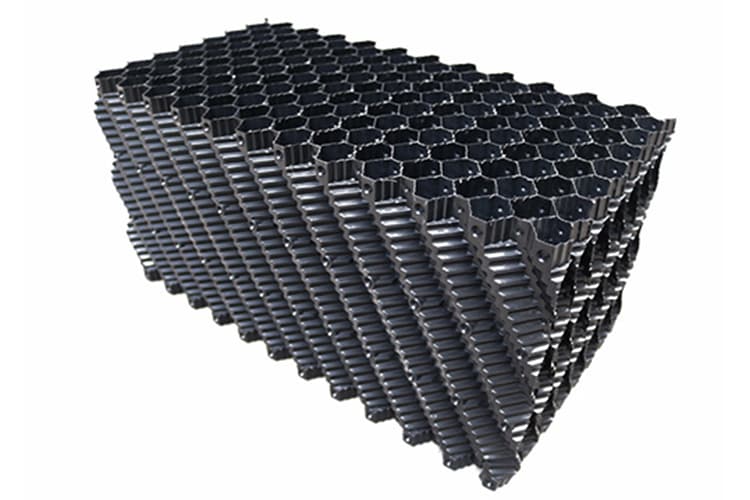
Water-side parts should resist scaling, fouling and mineral deposits under local water conditions.
Fan, casing and control selections affect airflow, energy consumption, sound level and outdoor durability.
A good adiabatic cooler page should explain water use clearly. Adiabatic coolers reduce water consumption compared with cooling towers, but they still require proper water management because the pre-cooling section uses evaporation during hot conditions.
Water is only used when the control system activates adiabatic pre-cooling based on ambient or fluid temperature.
Water quality affects scaling, deposits, biological growth and adiabatic media service life.
Cold climate projects should consider drain-down, freeze protection, valve location and seasonal operation mode.
An adiabatic cooler has lower water system exposure than a cooling tower, but it requires more maintenance than a dry-only cooler. Coil cleanliness, media condition, water distribution and control logic should be checked regularly.
Finned coils and air inlet areas should be kept clean to maintain airflow and heat transfer efficiency.
Media, pads or wetting sections should be inspected for scaling, clogging, uneven wetting and mineral deposits.
Closed-loop fluid and controls should be monitored to maintain stable outlet temperature and freeze protection.
Adiabatic coolers are selected when customers need water-saving heat rejection with better hot-weather performance than dry cooling alone.
Water is used only during adiabatic assist periods instead of continuous evaporation.
Process fluid remains inside the coil and is not exposed to outside air.
Adiabatic pre-cooling improves capacity during high dry bulb conditions.
Can extend free cooling operation for HVAC and data center systems.
Lower drift, blowdown and open-water exposure than many cooling tower systems.
Dry mode, adiabatic mode and fan speed control can be staged by system demand.
Useful where water cost, water scarcity or discharge control is a project concern.
Coil, media, fan, control and material options can be configured for project needs.
Thermocore can customize adiabatic coolers according to heat rejection capacity, fluid type, glycol concentration, coil material, adiabatic media, fan configuration, water management, control strategy, casing material, noise requirement, installation layout and export shipping requirements.
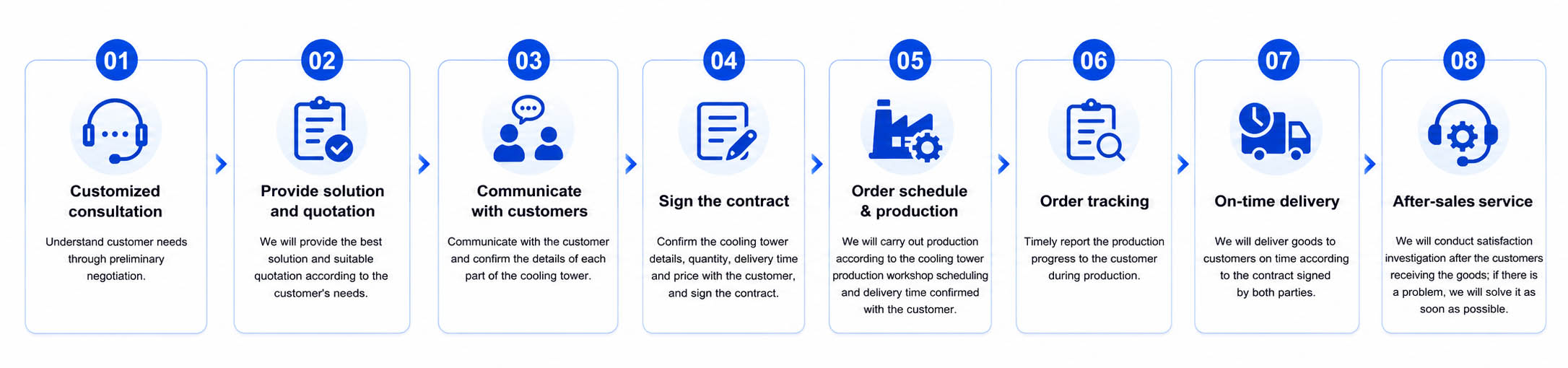
For projects with special heat load, fluid temperature, approach or dry/wet bulb requirements.
For water saving, media selection, water distribution, flushing, drainage and water quality requirements.
For low noise, energy saving, corrosion resistance, BMS integration and special voltage requirements.
Send your heat rejection capacity, fluid type, glycol concentration, flow rate, inlet and outlet temperature, design dry bulb and wet bulb temperature, water quality and operating schedule. Our engineering team will compare adiabatic cooler, dry cooler, closed circuit cooling tower and open cooling tower options for your project.
These FAQs are written for HVAC engineers, data center teams, industrial buyers and contractors who need to understand adiabatic cooler selection, dry/adiabatic operation, water management, controls, maintenance and customization.
An adiabatic cooler is a closed-loop air-cooled heat rejection unit that combines dry cooling with adiabatic air pre-cooling. Process fluid, water or glycol flows inside finned tube coils, while ambient air passes across the coil surface. During hot ambient conditions, an adiabatic pre-cooling system wets pads, media or a controlled air pre-cooling section before the air reaches the coil. This reduces the entering air temperature and improves heat rejection while using much less water than a conventional open cooling tower.
Hot fluid enters the closed finned tube coil. In normal conditions, fans move ambient air across the coil for dry sensible heat rejection. When ambient temperature rises or outlet fluid temperature cannot be maintained in dry mode, the adiabatic system activates. Water is applied to pre-cooling media or an air-side wetting section, and evaporation lowers the air temperature before it reaches the coil. The cooler can then reject more heat while the process fluid remains isolated inside the coil.
An adiabatic cooler is selected when a project needs lower outlet fluid temperatures than a standard dry cooler can provide in hot weather, but the customer still wants lower water consumption and better fluid protection than an open cooling tower. It is useful for HVAC, industrial process cooling, data centers, free cooling loops and water-sensitive projects that require a balance between energy efficiency, water saving and thermal performance.
A standard dry cooler rejects heat using ambient air only, so its performance is limited by dry bulb temperature. An adiabatic cooler adds a water-assisted air pre-cooling stage that lowers the air temperature entering the coil during hot conditions. This allows the adiabatic cooler to achieve lower fluid outlet temperatures or smaller equipment size than a dry-only cooler in many climates, but it requires water supply, water management and additional maintenance for the adiabatic section.
A cooling tower exposes circulating water directly to air and uses continuous evaporative cooling. An adiabatic cooler keeps the process fluid inside a closed coil and only uses water to pre-cool the air when needed. Cooling towers can often reach lower water temperatures closer to wet bulb temperature, but they require more water treatment and make-up water. Adiabatic coolers usually consume less water and provide better process fluid isolation.
Both can protect the process fluid inside a coil. A closed circuit cooling tower uses spray water over the coil for evaporative heat transfer, while an adiabatic cooler mainly cools the incoming air before it reaches a dry finned coil. The adiabatic cooler usually has lower water consumption than continuous spray coil systems, but closed circuit cooling towers may provide stronger evaporative performance when very low fluid temperatures are required.
Important selection data includes heat rejection capacity, fluid type, glycol concentration if applicable, fluid flow rate, inlet fluid temperature, required outlet fluid temperature, design dry bulb temperature, design wet bulb temperature, project location, altitude, operating hours, water availability, noise requirement, power supply and material preference.
Yes, but the water treatment requirement is usually different from an open cooling tower. The process fluid is closed inside the coil, but the adiabatic pre-cooling water still needs water quality management to reduce scaling, biological growth, mineral deposits and media fouling. The required treatment depends on water quality, operating hours, bleed strategy and adiabatic system design.
Common material options include copper tube aluminum fin coils, stainless steel tubes, epoxy-coated fins, galvanized steel casing, Aluzinc steel casing, stainless steel casing, adiabatic pre-cooling media, water distribution piping, axial fans, EC fans and control panels. Material selection should consider water quality, ambient environment, coastal exposure, industrial pollution and required service life.
To receive an accurate quotation, send the heat rejection capacity, fluid type, glycol concentration, flow rate, inlet and outlet fluid temperatures, design dry bulb temperature, design wet bulb temperature, project location, altitude, water quality, operating schedule, power supply, installation space, noise requirement, material preference and any control or customization requirements.
Send us your heat rejection capacity, fluid type, glycol concentration, flow rate, inlet and outlet fluid temperature, design dry bulb and wet bulb temperature, project location, water quality and noise requirement. Our engineering team will help you select a suitable adiabatic cooler configuration.